
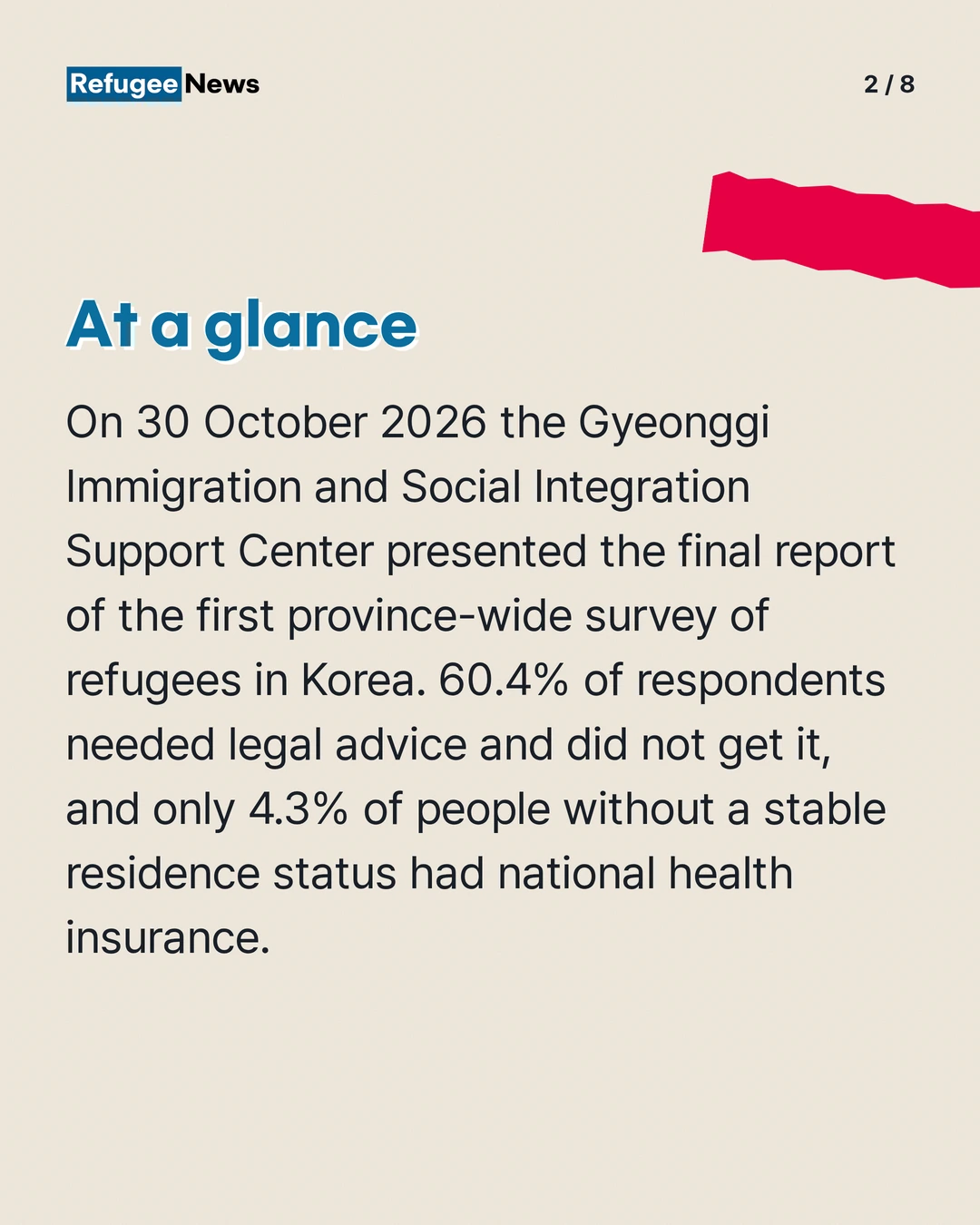
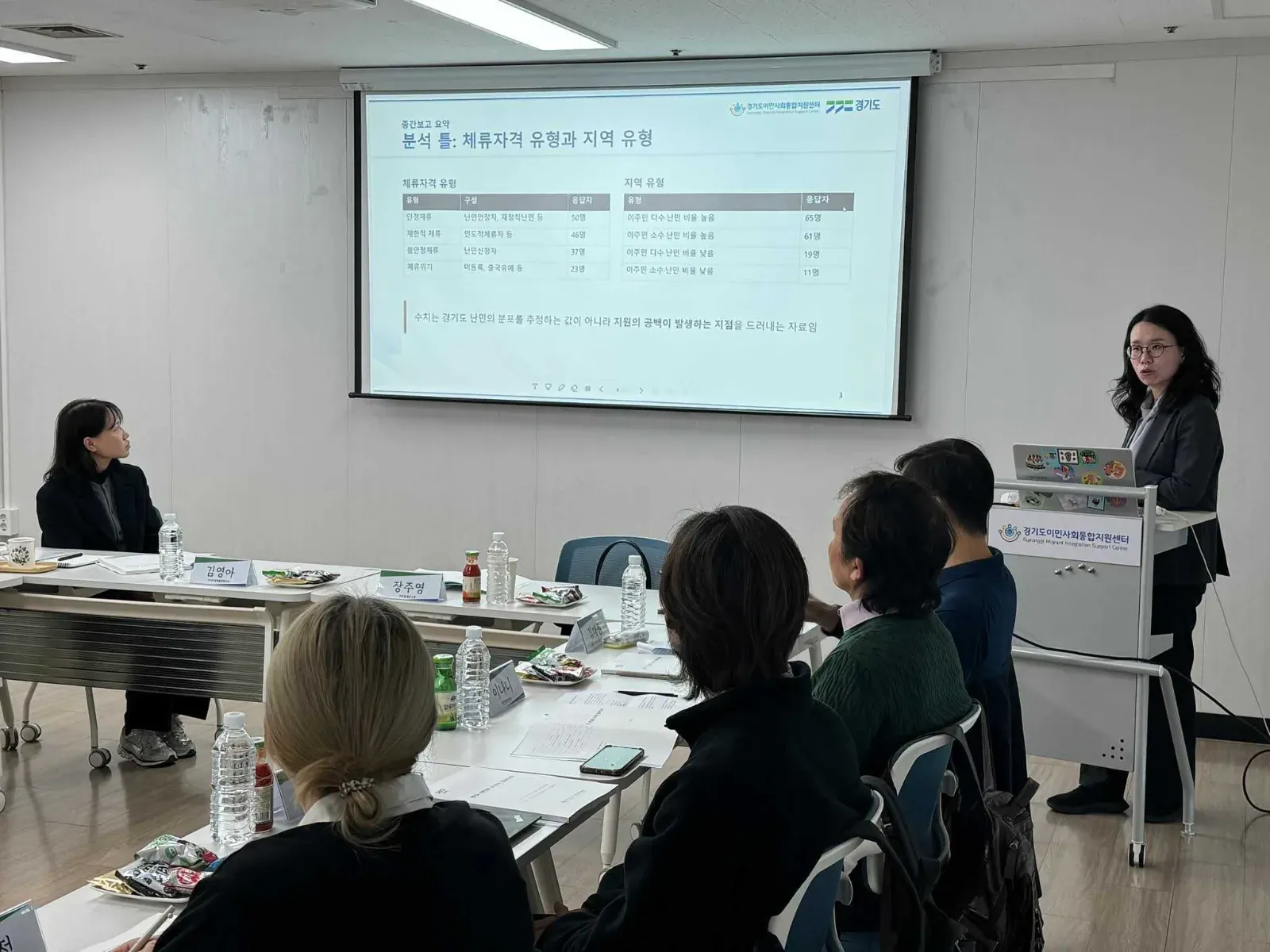
On Friday, 30 October 2026, the Gyeonggi Immigration and Social Integration Support Center (경기도이민사회통합지원센터) held a session to present the final report of the “Gyeonggi Refugee Situation Monitoring Survey”, the first survey of its kind carried out by a Korean province across its entire territory. Researchers from the Migration Policy Institute, MAP (Migration to Asia Peace) and the Center itself took part in the study, and researcher Jang Ju-young (장주영) of the Migration Policy Institute presented the main findings.
Background
In 2025, Gyeonggi Province enacted the “Ordinance on the Protection of Refugees’ Human Rights and the Guarantee of Their Basic Livelihood”. It defines “refugee” more broadly than the national Refugee Act, covering asylum seekers, people with humanitarian status and those living in similar circumstances. According to the report, 18,169 residents in these categories lived in the province at the end of March 2026, about 2.5% of foreigners with long-term residence.
The survey used a mixed-methods design: a multilingual questionnaire completed by 156 refugees over the age of 15 from 22 cities and counties between August and early September, plus 19 in-depth interviews (9 refugees and 10 people working in refugee support). The study stresses that the sample was designed to show gaps in support, not to estimate how refugees are distributed across the province.
Key findings
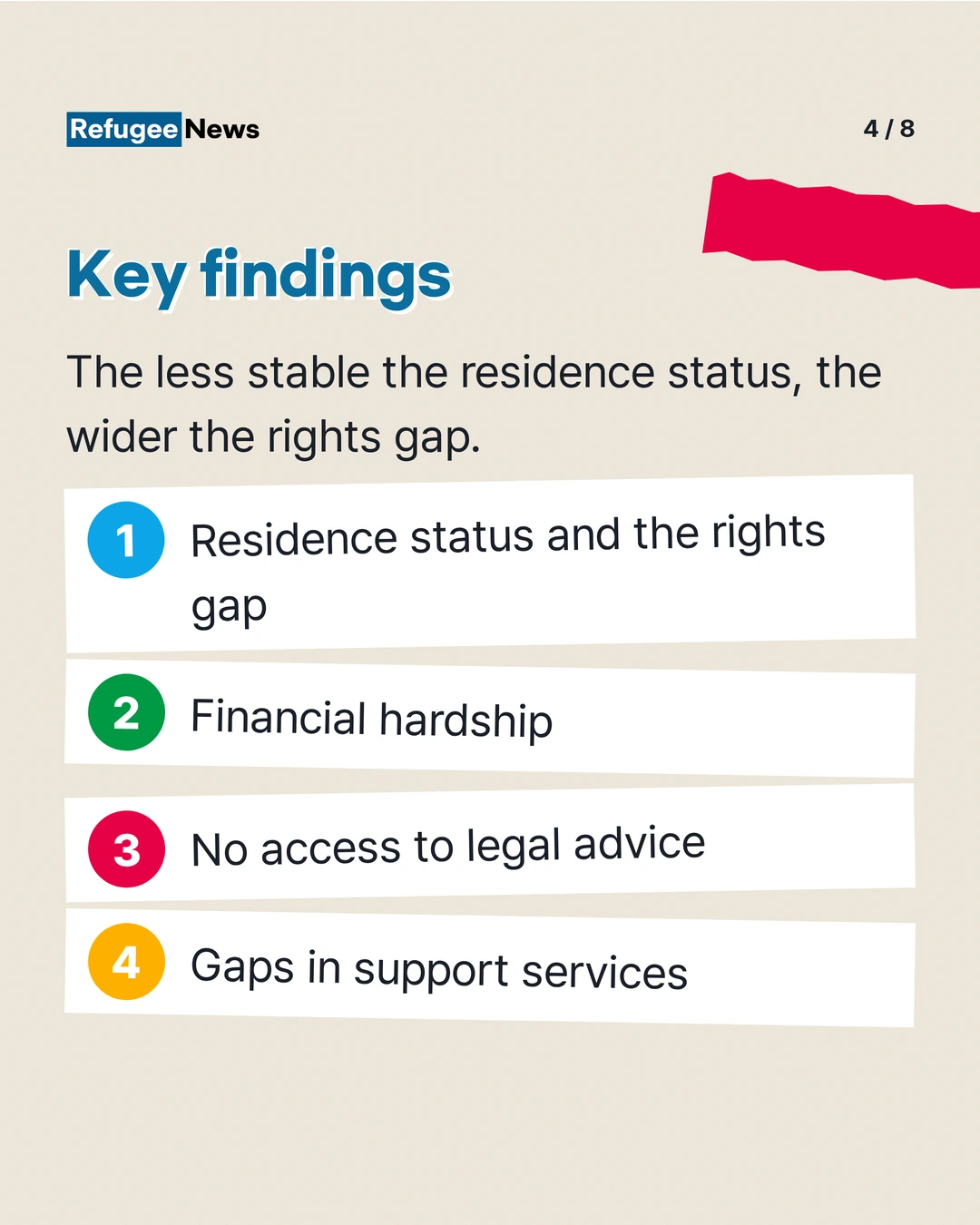
Residence status and the rights gap
The less stable the residence status, the wider the rights gap. National health insurance coverage was 97.8% among residents with stable status, but only 4.3% among those in a “residence crisis” (unregistered, or with deportation deferred). Of this last group, 82.6% said they were unable to go to a hospital when they needed to, and 91.3% reported feeling sadness or despair for two weeks or more.
Financial hardship
83.9% of adult respondents faced economic difficulties in the past year, including all 23 people in the “residence crisis” group. Emergency livelihood and housing support ranked first among priorities for every residence category.
No access to legal advice
About 60.4% (90 people) said they needed legal advice and did not receive it, and many turn to chat groups within their own communities, with the risk of misinformation that this carries. Even at the stage of filing an asylum claim, 78.3% of the “residence crisis” group said nobody helped them.
Gaps in support services
In areas with many migrants and a low share of refugees, 41.3% said they had received no support services at all, and 65.1% said it was hard to find information about services. Having migrant support centres nearby does not mean services reach refugees.
Discrimination with no recourse
About 106 people reported experiencing discrimination, yet an official body was approached only three times, while 59 people did nothing about it.
The interviews also brought up issues the questionnaire did not cover, including unaccompanied minors and the lack of legal guardianship for them, single-parent households, gaps in identity documents and birth certificates, the mental health of the second generation, children with disabilities, and care for long-term residents.
Main recommendations
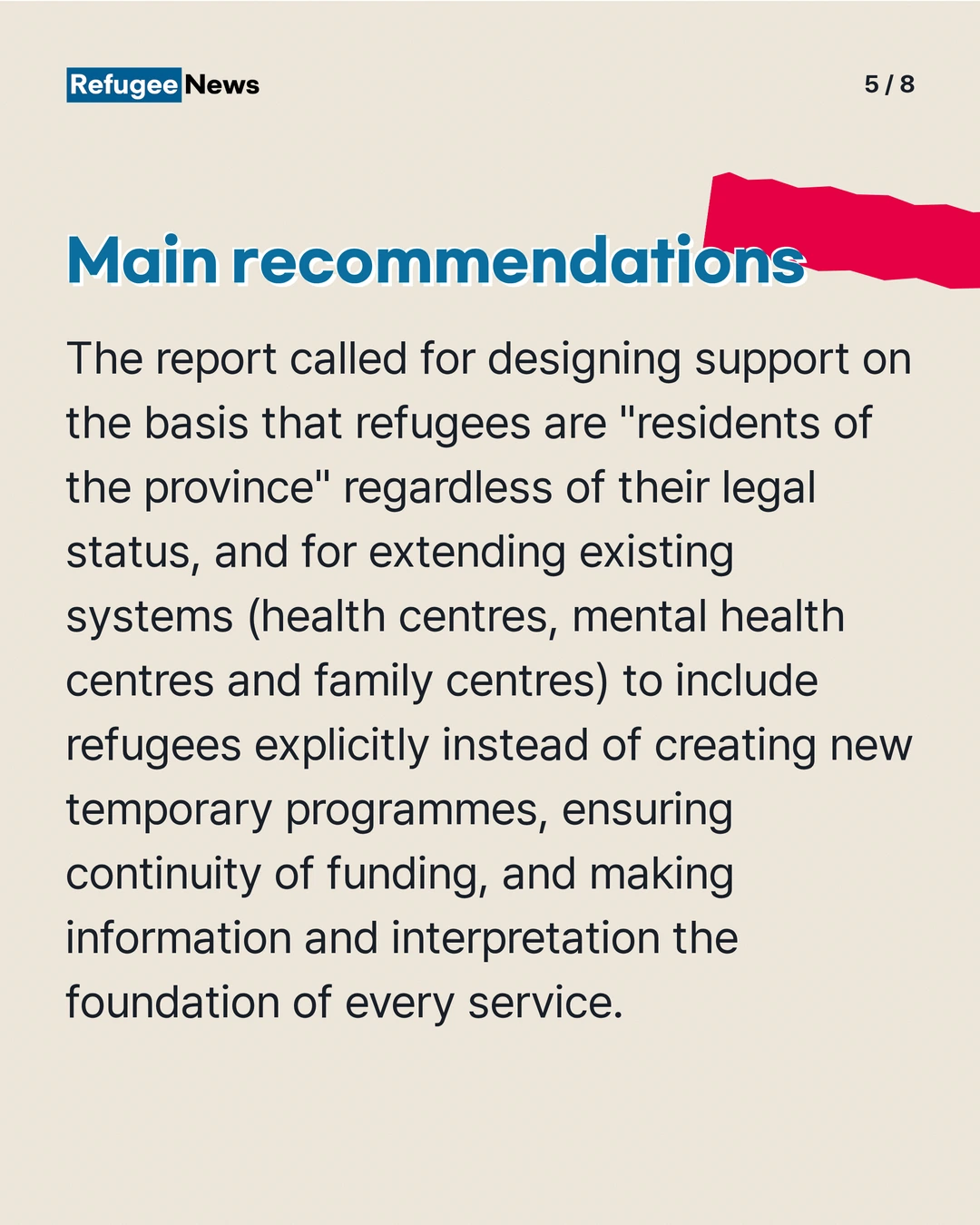
The report called for designing support on the basis that refugees are “residents of the province” regardless of their legal status, and for extending existing systems (health centres, mental health centres and family centres) to include refugees explicitly instead of creating new temporary programmes, ensuring continuity of funding, and making information and interpretation the foundation of every service. Specific proposals include rent and deposit assistance, temporary shelter that does not require a residence status, medical interpreters, legal aid centres run in cooperation with lawyers, training for teachers on refugees’ circumstances, and a mechanism to protect unaccompanied minors. Issues such as work permits, length of stay and guardianship for minors remain the responsibility of the central government.
Comments from UNHCR
Jae Ik Jang, Protection Associate at UNHCR Korea, gave a presentation on reception and early settlement. He cautioned that the sample is not representative and that 68.6% of respondents have lived in Korea for five years or more, so the findings should not be generalised to recent arrivals. Among the 149 adult respondents, 117 chose language, 71 insufficient living expenses and 70 securing housing among their three biggest difficulties in the first six months.
He proposed planning housing before arrival, clear orientation with interpretation, linking Korean-language learning to income support and employment with flexible schedules and childcare, and a clear contact point and settlement plan at the time of referral. His recommendations draw mainly on UNHCR guidance for resettled refugees.
Discussion with attendees
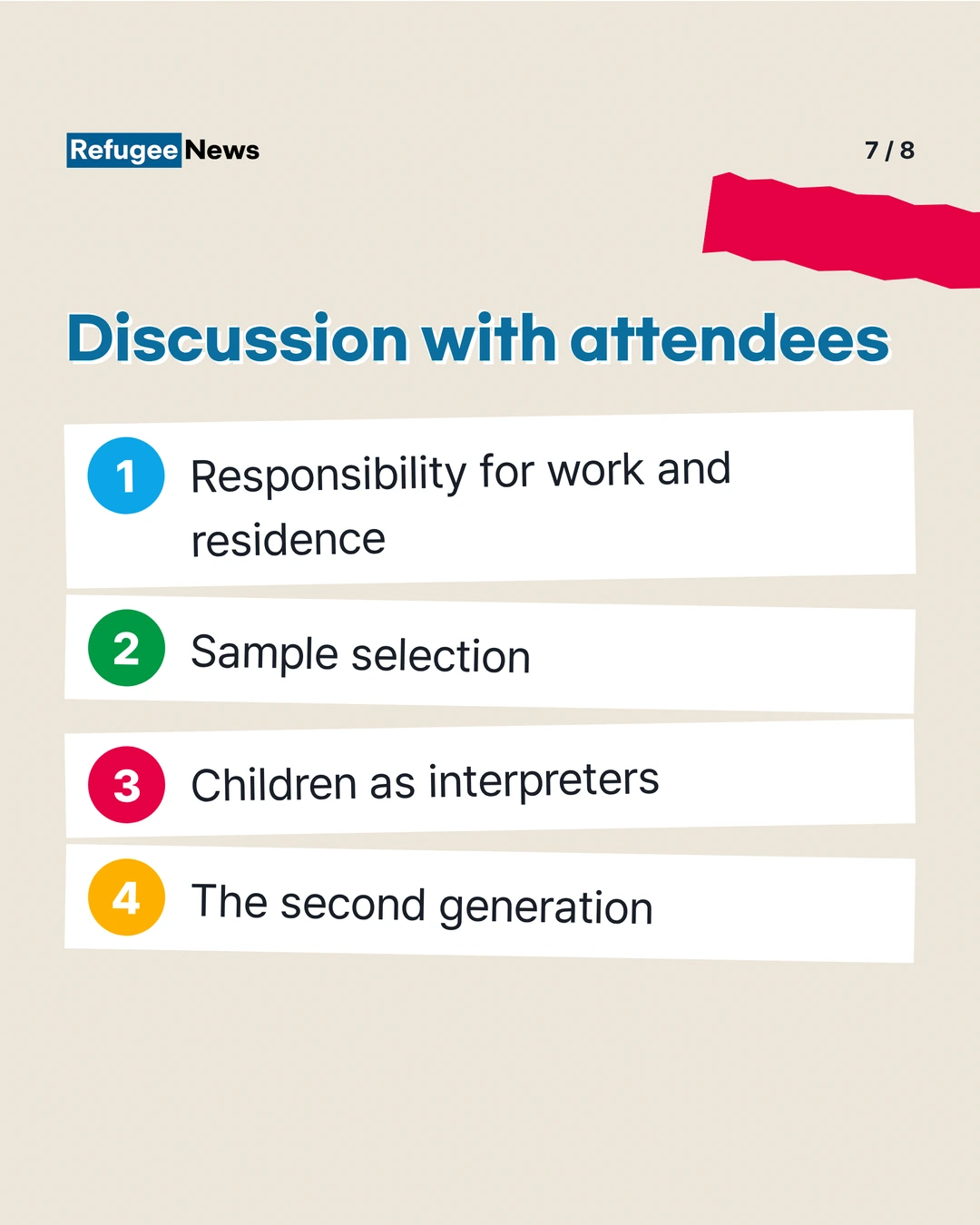
Responsibility for work and residence
Jang Ju-young said that changing the conditions for work is difficult in practice but possible through indirect routes, and that next year the institute will carry out new research on vocational training for refugees to follow up on this point.
Kim Young-ah (김영아) of MAP explained that the matter is in the hands of the Ministry of Justice and that the province cannot bypass it. When asked to allow people with humanitarian status to be self-employed, the ministry answered that it was difficult and referred the matter to the Ministry of Employment and Labor, which “shows no interest at all in the situation of refugees”. She stressed, however, that the province need not negotiate with the ministry alone, since it has departments dealing with workplace injuries among migrant workers. Holders of the G-1-5 visa work in the most dangerous and most precarious jobs, with severe exploitation, workplace injuries among refugees are rising, and periods of forced unemployment wear down the will to be self-reliant and can place a refugee among “people who are hard to support”. People who received even basic early support, such as short Korean lessons, did much better than those who did not, and she called for empowerment and long-term residence programmes.
Sample selection
Ha Jeong-yun (하정윤), a MAP volunteer, asked how refugees without phones or access to media were reached. Jang Ju-young answered that the sample included groups whose rights are guaranteed by law and groups whose rights are not, was distributed evenly across regions, that turnout for the questionnaire was not high, and that the in-depth interviews were used to fill in the picture. She acknowledged that access to media was not among the research topics. Kim Young-ah added that assembling the sample was difficult: some people borrowed other people’s phones, contact was lost with others, and recruiting resettled refugees was unexpectedly hard. Views of the survey were split between those who welcomed it and those who doubted its value after many studies that had changed nothing.
Children as interpreters
Ha Jeong-yun asked what policies are needed for older children who interpret for their mothers in families with many children. Jang Ju-young replied that selecting a sample that specific had not been possible, but that the report did include children at risk, and she suggested training teachers on refugees’ circumstances as a partial solution.
The second generation
Kim Young-ah said young people in their early twenties wept during the interviews. Korea’s history of receiving refugees is short, but a young refugee has now completed military service and the second generation has reached working age. She asked whether current migrant policies include refugees at all, stressing that refugees’ children are “Korean in body and spirit” yet outside any settlement system, and raised the question of priorities when the budget is limited and how to distribute support across life stages.
Foreign credentials and language
Jang Ju-young reported that a recent amendment to the Enforcement Decree of the Refugee Act included recognition of educational qualifications, that the Ministry of Justice internally recognises the need for it, and that she expects a solution soon. Kim Young-ah said that someone who cannot speak the language cannot become self-reliant. Many were highly educated professionals in their home countries, found themselves unable to do any work in Korea, and were not even admitted to university language institutes because their qualifications were not recognised. MAP is approaching universities and language institutes in Gyeonggi, many of which have shown interest; their fees are not high, and this kind of project does not require negotiation with the immigration service. She proposed that the province work with universities and institutes to support refugees’ independence.
Room for provincial action
The study and the discussion point to a gap between rights on paper and actual access to them. Many of the reforms raised, such as language programmes run with universities, involving the departments that handle workplace injuries, and teacher training, do not need to wait for a decision from the central government. The survey is expected to be the baseline for regular monitoring of refugees’ situation in the province.