
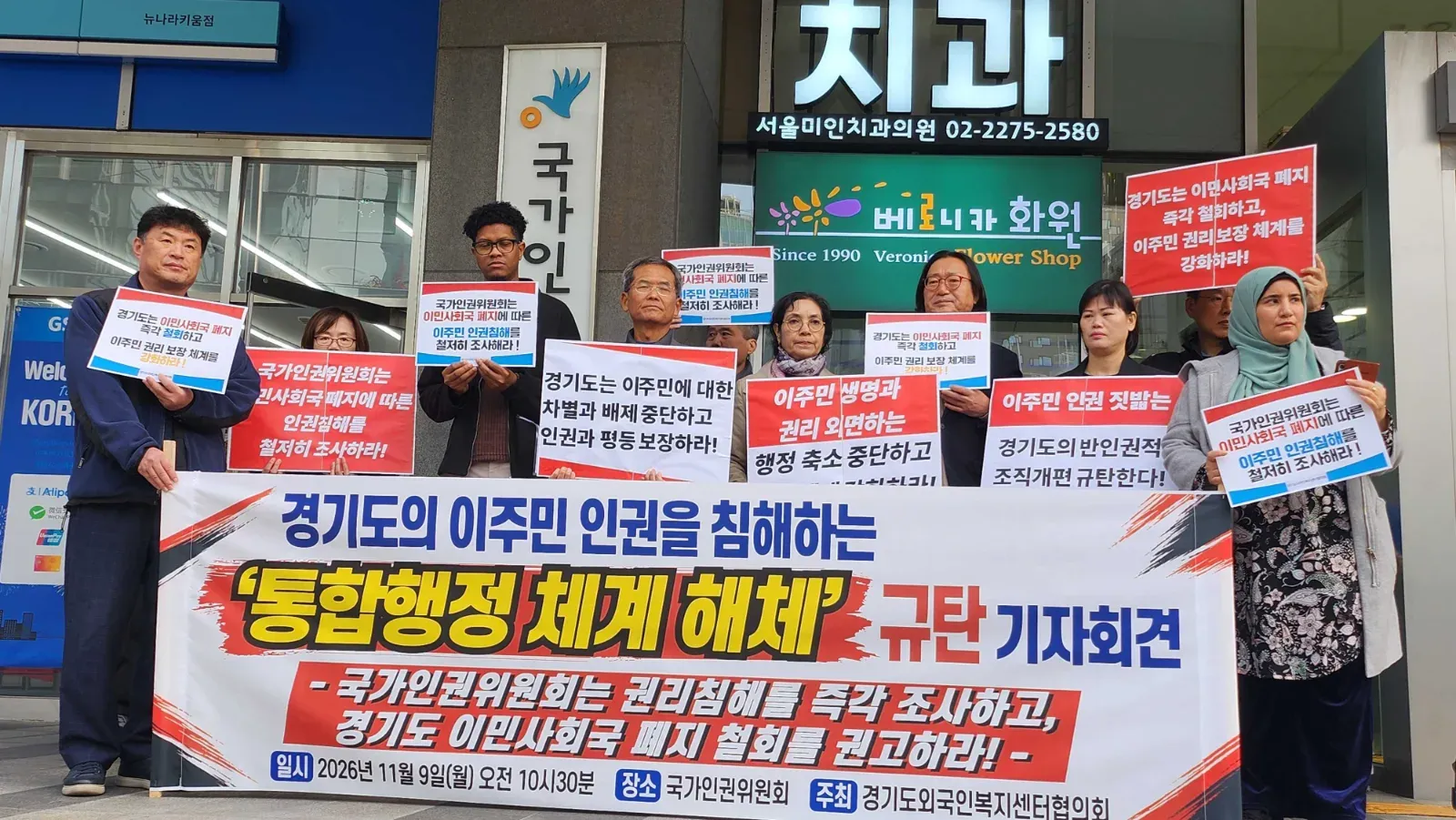
On the morning of Monday, November 9, 2026, representatives of civil society organizations and a number of migrants residing in South Korea held a protest rally and press conference outside the headquarters of the National Human Rights Commission of Korea (NHRCK) in Seoul, opposing the Gyeonggi Provincial Government’s plan to abolish the Immigration and Migrant Society Bureau (이민사회국).
Participants warned that abolishing the bureau could negatively affect the system for supporting migrants and protecting their rights, particularly given the wide range of issues handled by the bureau and their connection to different aspects of migrants’ lives.
Protesters held signs calling on the provincial government to reverse its decision and refrain from reducing services provided to migrants. They stressed the importance of ensuring equality and protecting migrants’ rights. They also called on the National Human Rights Commission of Korea to examine the potential impact of the administrative restructuring and intervene to halt the abolition plan.
The rally was organized at the invitation of the Council of Foreign Resident Support Centers in Gyeonggi Province, in protest against the administrative restructuring plan announced by the provincial government last October.
Abolishing the Bureau: An Administrative Change or a Retreat from the Responsibility to Protect Migrants?
Those opposing the decision argue that the issue is not simply a matter of changing the administrative structure or transferring certain responsibilities from one department to another. Rather, it concerns the future of an integrated system that brought together various issues affecting migrants, including employment, healthcare, education, housing, safety, and legal and social support.
According to statements made by participants during the press conference, the restructuring plan involves abolishing the Immigration and Migrant Society Bureau, while reducing some of its responsibilities or transferring them to the Multiculturalism and Immigration Division under the Gender Equality Bureau.
This approach has raised concerns about reduced coordination among the relevant institutions, the loss of specialized expertise, and the possibility of gaps in responsibility when addressing problems faced by migrants. These concerns are particularly significant in emergency situations that require a rapid response and cooperation between government institutions and local support centers.
During the rally, the organizers stressed that migrant-related issues are not limited to cultural integration or support for multicultural families. They also concern various groups, including migrant workers, refugees, international students, young people from migrant backgrounds, and older people. Each group has different needs, making it necessary to have a specialized institution capable of addressing these issues in a coordinated manner.
Why Abolish a Bureau Established Just Two Years Ago?
During the press conference, Kim Young-guk, Chairperson of the Council of Foreign Resident Support Centers in Gyeonggi Province, questioned the reasons behind the provincial government’s decision to abolish the bureau, despite its establishment in July 2024 and the continued increase in the number of migrants and foreign residents.
He called on the government to clarify the grounds and data on which it had based its decision, arguing that general administrative justifications were insufficient to explain a decision of this scale, particularly when its consequences could affect services provided to a large number of residents.
Kim urged the provincial government to withdraw the abolition plan and instead work to develop an integrated support system that ensures continued cooperation and coordination among the provincial government, local authorities, and foreign resident support centers.
Meanwhile, Kim Won-gyu, former head of the Gyeonggi Immigration and Migrant Society Bureau, spoke about the needs of migrants, noting that they extend beyond family-related or cultural matters. According to him, migrants’ long-term stability is linked to a range of interconnected policies covering employment, housing, healthcare, education, and care for children and older people.
He criticized the tendency to reduce migrant-related issues to cultural integration, explaining that treating migrants as a single group overlooks the differences in their circumstances and needs. He added that genuine integration should not mean expecting migrants alone to adapt to the host society. Instead, it should be based on combating discrimination, guaranteeing rights, and enabling participation in society.
He emphasized the importance of maintaining an independent and specialized bureau, with the necessary budget, personnel, and authority to carry out its responsibilities.
Migrants Are Part of Society, Not Just Temporary Workers
In her remarks at the press conference, Makin Mehta, a representative of the Suwon Migrant Center, emphasized that migrants are not simply workers who come to South Korea for temporary periods. They are people who live in society and contribute to its social fabric, and they are entitled to protection and the enjoyment of their rights.
Drawing on her decades of experience working with migrants in South Korea, Mehta referred to several incidents that have exposed the risks faced by migrant workers and foreign residents. These included the death of a migrant worker in Bucheon and the Aricell factory fire in Hwaseong, which claimed the lives of 18 migrant workers.
She explained that these incidents do not necessarily mean that the absence of the bureau was a direct cause of their occurrence. However, they highlight the need for an integrated government system that protects workers and foreign residents and strengthens institutions’ ability to address risks and violations.
She also noted that the number of migrants in Gyeonggi Province is approximately 860,000, according to figures presented by speakers at the press conference. She argued that this number makes it essential to have clear administrative policies that respond to their needs and protect their rights.
Petition Submitted to the National Human Rights Commission of Korea
Alongside the protest rally and press conference, the organizers announced that they had submitted a petition to the National Human Rights Commission of Korea, calling for an examination of the potential impact of the bureau’s abolition on migrants’ rights and recommending that the Gyeonggi Provincial Government reconsider its decision.
The petition states that migrants residing in the province are entitled to fundamental rights and that the responsibility of local authorities should not be limited to Korean citizens, but should extend to everyone living within their administrative jurisdiction.
It also points out that language barriers and some migrants’ limited familiarity with South Korean laws, institutions, and administrative procedures may make it more difficult for them to access services and protection. This highlights the need for specialized and coordinated administrative services, including information provision, interpretation, and legal and social assistance.
The petition draws on constitutional principles and provisions, as well as several international human rights treaties, including the International Covenant on Civil and Political Rights, the International Covenant on Economic, Social and Cultural Rights, and the Convention on the Rights of the Child, to emphasize the need to protect fundamental rights and ensure non-discriminatory access to services.
The petitioners called on the National Human Rights Commission of Korea to examine how the restructuring could affect the actual level of protection provided to migrants and to recommend maintaining an independent and specialized bureau, while ensuring the budget, personnel, and expertise necessary for its continued operation.
They also stressed the importance of maintaining cooperation with the province’s 31 municipalities, foreign resident support centers, and institutions involved in supporting integration, as well as involving migrants and the organizations working with them in administrative decisions that directly affect their lives and rights.
Refugees Also Face Concerns Over Losing Attention to Their Issues
The concerns raised during the press conference were not limited to services provided to migrants in general, but also extended to policies concerning refugees.
One participant, a recognized refugee, expressed concern about the abolition of the bureau in an interview with “Refugee News”. He noted that many refugees had received little attention in local policymaking before the establishment of this administration.
He added that the bureau had begun addressing their circumstances. One notable example was the first-ever survey on refugees conducted at the provincial level, the results of which highlighted the need for livelihood support policies and programs.
He stressed that maintaining the Immigration and Migrant Society Bureau is not simply about preserving an administrative institution. Rather, it is about ensuring the existence of a specialized body capable of coordinating responses to issues related to employment, healthcare, education, housing, safety, and legal protection, so that the most vulnerable groups are not left without clear institutional support.