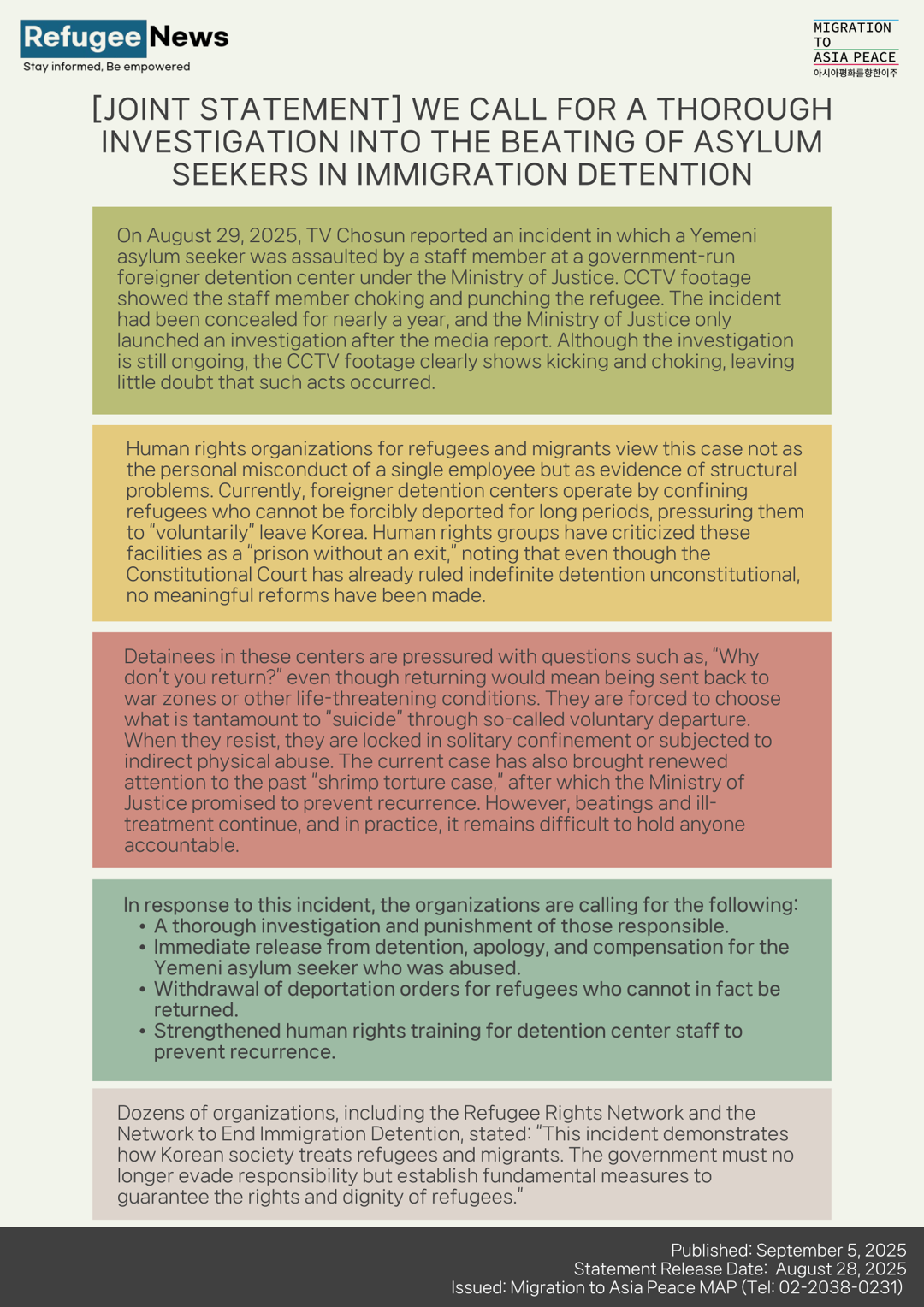
On August 29, 2025, news reports revealed that a staff member at the Cheongju Immigration Detention Center had repeatedly assaulted a Yemeni refugee applicant. CCTV footage showed the staff member choking the applicant and punching them. Refugee and migrant human rights organizations believe this incident is not simply one employee going off the rails, but rather a sign of deep structural problems in how immigration detention facilities are run overall.
What Happened
The incident reportedly took place in September 2024, when a staff member at the Cheongju Immigration Detention Center assaulted a Yemeni refugee applicant multiple times inside the living quarters. However, the Ministry of Justice only launched an investigation on August 29, 2025, after news reports broke the story, and removed the accused staff member (referred to as “Employee A”) from their duties. CCTV footage confirmed acts including kicking and choking. The incident had gone unnoticed by the outside world for nearly a full year.
The Ministry of Justice stated that it “immediately launched a fact-finding investigation into this incident and will take strict action in accordance with law and principle against any unlawful conduct by those involved,” adding that it would “prevent the same incident from occurring again through thorough investigation and institutional reform.” However, because the incident only came to light through media reporting rather than the Ministry’s own discovery, human rights groups say the response is still not good enough.
What Is an Immigration Detention Facility?
Article 63, Paragraph 1 of the Immigration Control Act allows a foreign national who has received a deportation order but cannot leave the country immediately to be detained “until they can be repatriated,” with no maximum time limit. This has led to long-term detention of people who refuse to leave or who simply cannot leave in practice.
On March 23, 2023, the Constitutional Court of Korea ruled six to three that Article 63, Paragraph 1 of the Immigration Control Act was “incompatible with the Constitution.”
However, after the Constitutional Court’s ruling, the government and National Assembly moved to allow detention of up to three years through follow-up legislation, which has drawn strong criticism from civil society groups.
A Pattern of Abuse: Do You Remember the “Shrimp Torture” Case?
As news of this incident spread, an earlier episode of abuse at an immigration detention facility — known as the “shrimp torture” case — has come back into public focus.
“Shrimp torture” (새우꺾기) refers to a method of physical abuse in which a person’s hands and feet are bound behind their back with handcuffs and rope, and then tied together, forcing the body into a bent, shrimp-like position. In 2021, CCTV footage was released showing that a Moroccan refugee applicant, referred to as “M,” had been placed in solitary confinement more than eight times and subjected to this treatment on multiple occasions at the Hwaseong Immigration Detention Center, reportedly for not following instructions. The footage caused widespread shock.
At the time, the court ruled that such conduct “violated the constitutional right to bodily freedom and personal dignity in and of itself, regardless of whether the legal requirements for use of restraints were technically met.” The court also found it “unlawful” that staff had used cable ties and packing tape to restrain the victim.
The Ministry of Justice promised at that time as well to prevent a recurrence. Yet as the Cheongju case now shows, abuse has continued, and holding perpetrators accountable remains extremely difficult in practice.
Why Is This a Structural Problem?
Human rights groups see this incident not as an individual going rogue, but as a problem rooted in how detention facilities themselves are run.
- Pressure to “voluntarily” leave: Even refugee applicants who genuinely cannot return home — because their country is at war, for example — are repeatedly pressured inside the facility to ask why they are not going back.
- Solitary confinement and assault for resistance: Multiple accounts describe a pattern in which applicants who refuse to leave voluntarily or resist in any way are placed in solitary confinement and physically assaulted.
- Indefinite detention: The system is run in a way that keeps refugee applicants who cannot actually be deported detained indefinitely, until they agree to leave on their own. Human rights groups describe this as “a prison with no exit.”
- Lack of oversight: Decisions to begin or extend detention are made internally within the Ministry of Justice without review by an independent judicial body, making outside monitoring extremely difficult.
What Human Rights Organizations Are Demanding
Dozens of organizations, including the Refugee Rights Network Korea and the Immigration Detention Response Network, are calling for the following in response to this incident.
- A thorough investigation and punishment of those responsible: The full facts of this assault must be established and everyone found responsible must be held accountable.
- Release of the victim from detention, a formal apology, and compensation: The person who was assaulted must be released from the detention facility immediately, and must receive a formal apology along with appropriate compensation.
- Withdrawal of deportation orders against refugees who cannot be returned: Deportation orders issued to refugee applicants who genuinely cannot return home must be cancelled.
- Stronger human rights training for detention facility staff: A systematic program of human rights education must be put in place to prevent recurrence.
The organizations emphasize that “this incident is an example of how Korean society treats refugees and migrants,” and that the government must stop avoiding responsibility and take fundamental steps to guarantee the rights and dignity of refugees.
Related Organizations and Support Resources
If you need help or would like to get involved, you can contact the following organizations.
- Refugee Rights Network Korea: www.nancen.org
- Korean Public Interest Lawyers Group (KPIL): www.kpil.org
- APIL (advocates for public interest law): apil.or.kr
- Public Interest Law Group Duroo: duroo.org
If you are facing difficulties related to immigration detention or deportation, you can call the Immigration and Foreigner Civil Affairs hotline at 1345 or reach out directly to one of the human rights organizations above. Rules and procedures are subject to change, so be sure to confirm the latest information with 1345 or your local Immigration and Foreigner Office before taking any steps.
Reference Links
- Ministry of Justice response related to TV Chosun report (Asia Economy, 2025.08.29)
- Ministry of Justice removes staff member from duties (YTN, 2025.08.29)
- Analysis of the “shrimp torture” court ruling (Kyunghyang Shinmun)
- Constitutional Court rules indefinite detention of foreigners incompatible with Constitution (Kyunghyang Shinmun, 2023.03.24)
- Refugee Rights Network Korea original statement (Facebook)