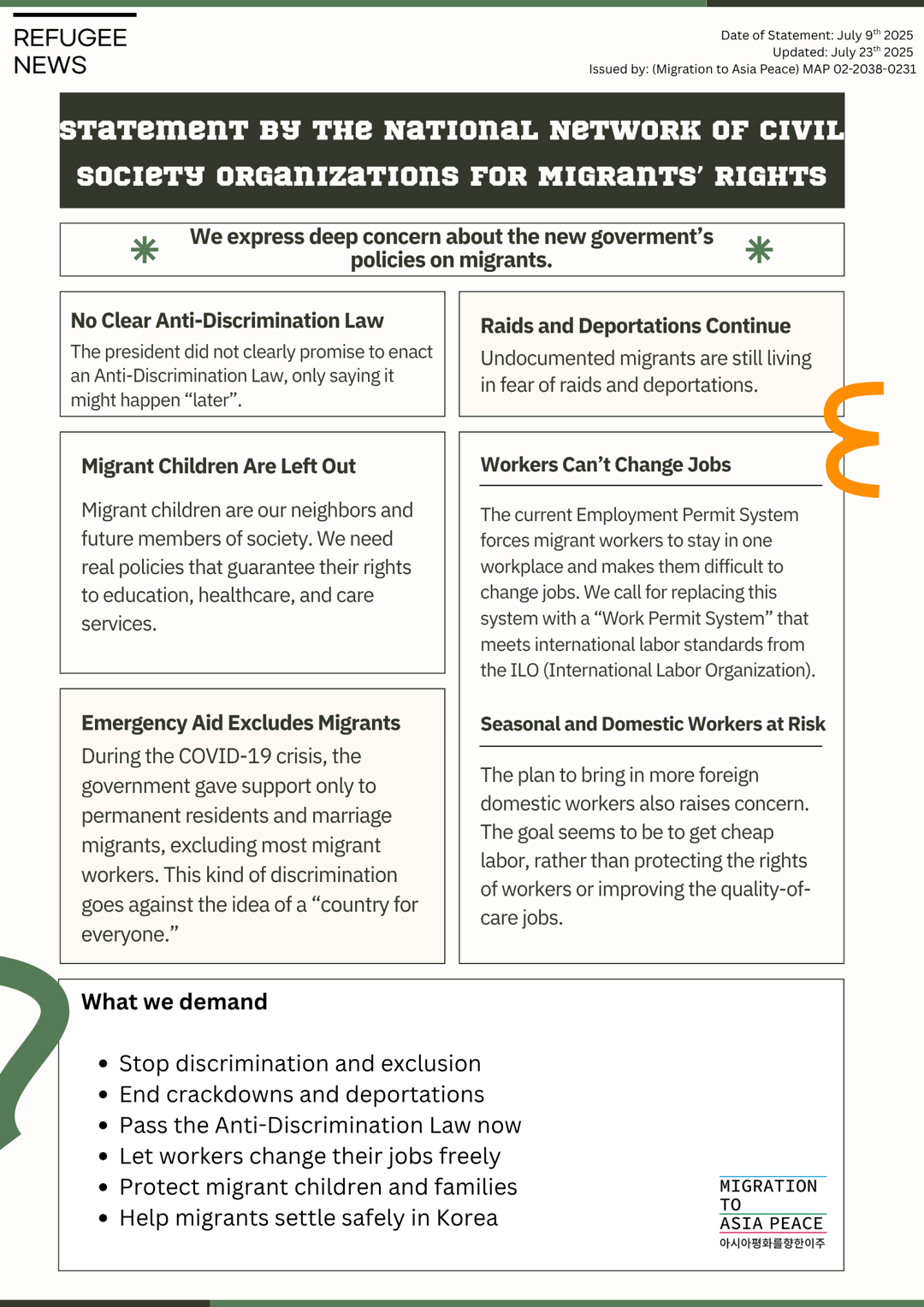
This document is based on a joint statement released on July 9, 2025, by a coalition of organizations that have long worked to protect migrant human rights in Korea. It expresses concerns and demands regarding the policy direction on migrants that emerged from President Lee Jae-myung’s press conference marking his 30th day in office (July 3, 2025).
Why Was This Statement Released?
On July 3, 2025, President Lee Jae-myung held a press conference to mark his first 30 days in office. At that event, no clear commitment was made to enacting a comprehensive anti-discrimination law, only a vague “later” response, and it became clear that the new government would continue its policy of cracking down on and forcibly deporting undocumented migrants. Migrant human rights organizations responded with deep disappointment and raised their voices together.
An Anti-Discrimination Law Is Needed Right Now
Since the illegal martial law crisis under former President Yoon Suk-yeol, discrimination and hatred directed at migrants and migrant workers have spread throughout Korean society. Some politicians have treated openly racist remarks as acceptable, or have even encouraged them.
In this environment, a law that clearly prohibits racial discrimination is essential. Saying “an anti-discrimination law can wait” means turning away from the human rights of migrants and of many other people living as minorities in this society.
Countries around the world regard an anti-discrimination law as a basic requirement of any country that takes human rights seriously. If the government genuinely cares about people’s livelihoods and social integration, it must announce a concrete plan, with a clear timeline and steps, for passing this law, and then follow through.
Crackdowns and Deportations of Undocumented Migrants Must Change
Contrary to hopes that the new government would take a more human-rights-centered approach to migrants, undocumented migrants are still living in fear of raids and forced deportation.
In some areas, including Masok in Gyeonggi Province, the Ministry of Justice and police have burst into migrant workers’ homes and workplaces without warning, breaking down doors and entering without permission. People have been arrested at random without identity checks, and families with young children have been taken away. Some migrant workers have been injured or have lost their lives while trying to flee enforcement operations.
There is also a serious problem with government bodies such as the Immigration Detention Review Committee making decisions without consulting the people affected or human rights organizations, and without disclosing relevant information. This style of enforcement and administration does not meet international standards.
In line with the fundamental human rights principle that no person is illegal, the government must give undocumented migrants a pathway to legal status and shift its policy toward one of inclusion and coexistence. Korea’s economy and daily life cannot function without migrant workers.
Migrant Children’s Rights Must Be Guaranteed Equally for Everyone
Under the UN Convention on the Rights of the Child, every child must have their rights protected equally, regardless of their country of origin or immigration status. To make this real, the government needs to:
- Guarantee birth registration: Establish a system that allows every child to be registered at birth.
- Guarantee access to basic services: Protect by law the right to use daycare, schools, and medical care.
- Prohibit detention and deportation: Not detain or deport children solely because of their immigration status.
Yet practical support for undocumented children who have lived in Korea for a long time, and for their families, remains deeply insufficient. Opportunities for vocational training, counseling, and peer connection also need to be created so that young people with migrant backgrounds can become independent and adapt well to society.
The Migrant Worker System Must Be Reformed Around Human Rights
Problems With the Employment Permit System
The current Employment Permit System ties migrant workers to a single workplace and prevents them from freely changing jobs. This structure makes it hard for workers to respond effectively when they face wage theft or mistreatment, and it violates their human rights. The system should be reformed into a “work permit” model that meets ILO (International Labour Organization) standards, so that migrant workers are free to choose where they work.
Problems With the Seasonal Worker Program
Bills currently before the National Assembly include provisions to give the Seasonal Worker Program a proper legal foundation, strengthen labor conditions and human rights protections, block illegal brokers, and require compulsory insurance covering unpaid wages, illness, and death. In reality, however, many seasonal workers in rural farming and fishing communities are not having their rights adequately protected and are experiencing serious human rights violations. This is rooted in the government’s failure to provide adequate support in rural areas.
Problems With the Foreign Domestic and Care Worker Policy
The government’s policy of bringing in foreign domestic and care workers is essentially a way of increasing cheap labor, which means neither the workers’ rights nor the quality of care are protected. Even though the limitations of Seoul’s pilot program using Filipino domestic workers have been made clear, the government says it will expand the scheme. This is not a genuine solution; it relies on low-wage labor rather than building up public care services. The result is that neither the quality of care work nor the human rights of migrant workers end up being protected.
Do Not Exclude Migrants from Government Support
The government has prepared a supplementary budget of approximately 30.5 trillion won for 2025, with plans to pay each citizen a living support payment of between 150,000 and 500,000 won.
During the COVID-19 pandemic, the government paid support to permanent residents and marriage migrants but excluded migrant workers from those payments. That kind of discrimination contradicts the principle of a government that claims to stand “for everyone.” Migrants pay taxes and share in supporting Korea’s economy and society. The government must create a system that allows all migrants to receive support fairly.
What We Are Calling For
- Stop discriminating against and excluding migrants; create fair, human-rights-centered policies.
- Halt crackdowns and deportation operations immediately, and give undocumented migrants a pathway to legal status.
- Enact a comprehensive anti-discrimination law right now.
- Guarantee migrant workers the freedom to change workplaces.
- Put real systems in place so undocumented children who have lived in Korea for a long time, and their families, can live with stability.
- Create policies that allow refugees to become self-sufficient and live stably within Korean society.
- Provide support so that marriage migrants can settle well and have their human rights protected.
If you have questions or need help, please call the Immigration Contact Center (1345), available 24 hours a day with interpretation support, or visit the Korea Immigration Service website at www.immigration.go.kr. For the most up-to-date figures, deadlines, and eligibility details, always confirm with 1345 or your local Korea Immigration Service office before applying.
Reference Links
- Korea Immigration Service: www.immigration.go.kr
- Immigration Contact Center (1345): www.hikorea.go.kr
- Ministry of Employment and Labor, Employment Permit System guide: www.moel.go.kr/foreign/foreignMain.do
- National Human Rights Commission of Korea (NHRCK): www.humanrights.go.kr