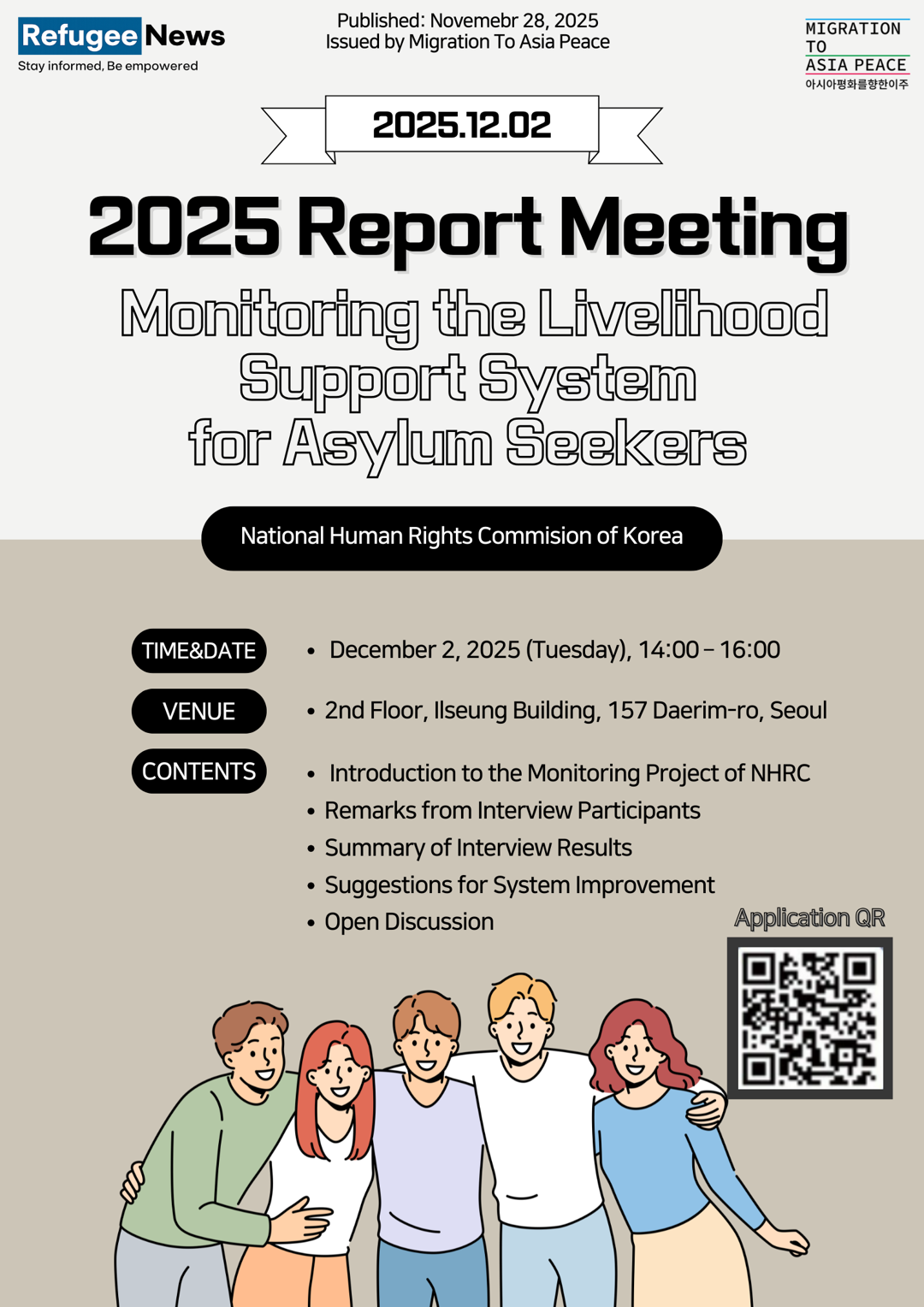
This is a public report event presenting the results of a monitoring project conducted by the Treatment Working Group of the Korea Refugee Rights Network, with support from the National Human Rights Commission of Korea (NHRCK). The team directly interviewed 22 asylum seekers who had been practically unable to work, and took a close look at the accessibility and adequacy of the current livelihood support system.
Event Details
| Item | Details |
|---|---|
| Date & Time | Tuesday, 2 December 2025, 2:00 PM, 4:00 PM |
| Venue | Migrant Center Friend (Ilseung Building, 2F, 157 Daelim-ro, Yeongdeungpo-gu, Seoul) |
| Organiser | Treatment Working Group, Korea Refugee Rights Network |
| Supported by | National Human Rights Commission of Korea (NHRCK) |
Everyone who is interested is welcome to attend. Please register in advance using the link below.
About the Monitoring Project
This monitoring project ran for approximately six months, from May to November 2025. A monitoring team made up of Korea Refugee Rights Network activists and others directly interviewed 22 asylum seekers who had been practically unable to find work and were experiencing serious difficulties making ends meet. The research focused on two main questions: how easy it is to access the livelihood support system (accessibility), and whether the support actually covers real living costs (adequacy).
The National Human Rights Commission of Korea (NHRCK) hopes this report event will help raise public awareness of the survival crisis facing vulnerable refugees and the structural limits of the current system, and will encourage relevant agencies to have meaningful discussions about reform.
Key Findings
1. Crisis in Basic Living Conditions: Food, Healthcare, and Housing
- For the first six months after arrival, asylum seekers are banned from working, and those whose residence status has not been approved can go for extended periods with no income at all.
- Multiple cases were confirmed where people were unable to cover even the basics, including food, rent, and utility bills.
- Situations requiring costly medical care, such as surgery, made hardship significantly worse.
- When other difficulties were layered on top, such as childcare responsibilities, pregnancy, workplace injuries, or disability, the crisis deepened further.
2. Lack of Access to Information About the System
- There were repeated cases where people simply did not know the livelihood support system existed and therefore never applied.
- A large number of applicants reported receiving no direct guidance from immigration authorities.
- Most applicants only found out about the system through informal channels such as NGOs, acquaintances, or community networks.
3. Inconsistency and Inappropriate Conduct at the Application Stage
- Even in identical circumstances, whether an application was accepted and how it was handled varied depending on which counter or officer dealt with it.
- There were confirmed cases of inappropriate remarks during the application process, such as being told to “go get a job” or “leave the country,” as well as wrongful rejections.
- Some applications were unfairly rejected on the grounds that the person had re-applied for refugee status, or that a parent held visa-exempt status.
4. Structural Barriers in the Application Process
- Delays in issuing the Alien Registration Card (외국인등록증)
prevented people from opening bank accounts, which in turn blocked them from actually receiving livelihood payments, since payments are only made by bank transfer.
- There was insufficient interpretation and translation support for languages other than Korean and English, creating difficulties in completing procedures.
- Many applicants could not obtain documents from their home countries, such as family relationship certificates or birth certificates, making the document submission requirement a major barrier.
5. Procedural Rights Not Protected During Assessment and Notification
- Many applicants were not informed of how long the review process would take.
- There were cases where approval or rejection was communicated only through a brief text message, with no explanation of the reasons.
- Applicants repeatedly had to follow up multiple times on their own just to find out the outcome.
6. Inadequate Support Amounts and Duration
- The payment covers only a portion of basic living costs and falls far short in situations involving high expenses such as medical bills, rent, or infant care.
- The Refugee Act sets a maximum support period of six months, but not a single case was found where someone received the full six months. Actual payment periods ranged from two to five months and varied considerably from case to case.
- Even within the same household, different family members received support for different lengths of time, making it impossible to plan ahead.
7. Other Issues
- In some cases, livelihood payments were stopped without any prior notice to the recipient.
- Assessment criteria are not made public, so applicants have no way to understand the outcome or prepare for it.
Attending and Getting in Touch
This report event is open to everyone. We warmly welcome citizens, activists, researchers, and representatives of relevant organisations who care about refugee support.
- Register: Google Form
- Organiser: Treatment Working Group, Korea Refugee Rights Network
- Related Organisation: National Human Rights Commission of Korea (NHRCK)
Details such as figures and deadlines may change. Please check the latest information with the Immigration Contact Center (1345) or your local Korea Immigration Service office.