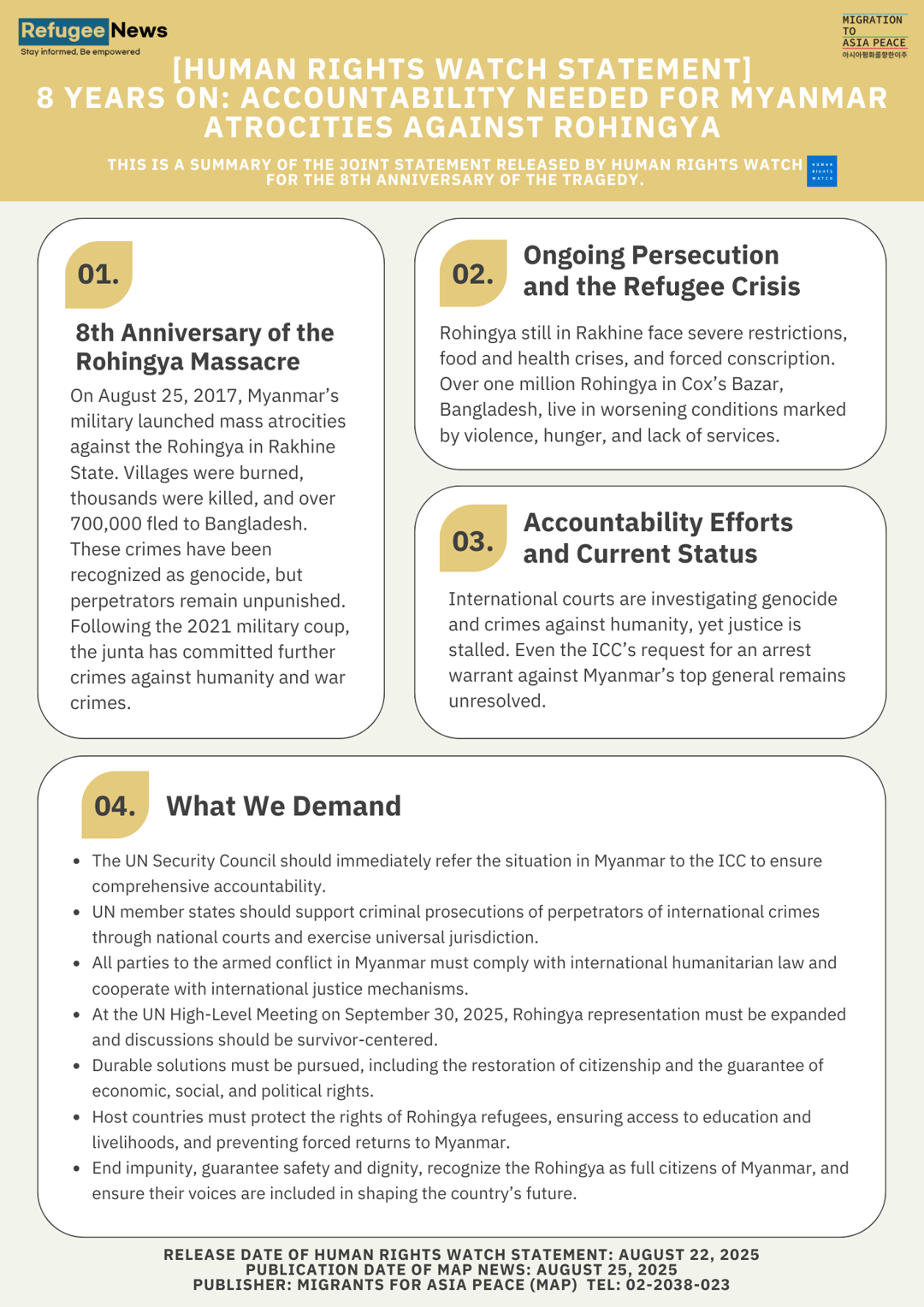
August 25, 2025 marks exactly 8 years since the Myanmar military and authorities launched a campaign of mass atrocities against the Rohingya people of Rakhine State. This article is a Korean-language summary of a joint statement published by Human Rights Watch to mark the eighth anniversary. It covers the current situation of the Rohingya and the calls being made to the international community. The full translated text is available on the MAP (Migration to Asia Peace) website.
What happened in 2017?
From August 2017, Myanmar security forces burned hundreds of Rohingya villages in northern Rakhine State and killed Rohingya women, men, and children. At least 700,000 people were forced to flee to Bangladesh. The Independent International Fact-Finding Mission on Myanmar, an independent expert body established by the United Nations, documented evidence of genocide and crimes against humanity in connection with these events.
Where are Rohingya people now?
Those still in Rakhine State, Myanmar
Rohingya people who remain in Rakhine State continue to face grave danger and ongoing persecution. The military junta that came to power after the 2021 coup restricts freedom of movement and blocks humanitarian aid, worsening food shortages and health crises.
Both the Myanmar military junta and Rohingya armed groups have been forcibly conscripting Rohingya people into their ranks, sending them into conflict against the Arakan Army, an ethnic armed group. The Arakan Army has also used forced conscription and, in recent years, has committed serious abuses against Rohingya people, including extrajudicial killings, torture, forced labour, and large-scale arson. Since mid-2024, around 150,000 more people have fled to Bangladesh.
Refugee camps in Bangladesh
More than one million Rohingya refugees currently live in camps in the Cox’s Bazar area of Bangladesh. Conditions there are deteriorating, with kidnappings, sexual violence, and cuts to humanitarian aid deepening crises in healthcare, education, and food access.
International accountability efforts
Eight years on, no one has been meaningfully held to account for the crimes committed against the Rohingya in Myanmar. Even so, legal efforts at the international level continue.
International Criminal Court (ICC)
The International Criminal Court (ICC) is investigating atrocity crimes that occurred in Myanmar and Bangladesh. In November 2024, the ICC Prosecutor formally requested an arrest warrant for Myanmar’s Commander-in-Chief, Min Aung Hlaing. As of August 2025, that request is being reviewed by a Pre-Trial Chamber.
International Court of Justice (ICJ)
The International Court of Justice (ICJ) is hearing a genocide case brought by The Gambia against Myanmar. The Court has already issued provisional measures (emergency protection orders), and the hearing on the merits of the case is scheduled to begin in January 2026.
Key demands in the joint statement
The organisations that signed this joint statement call on the international community to do the following.
- The UN Security Council should immediately refer the situation in Myanmar to the ICC, so that comprehensive accountability can be pursued for crimes committed against all affected communities.
- UN member states should exercise universal jurisdiction, meaning they should use their own domestic courts to prosecute those responsible for crimes under international law, as Argentina has done.
- All parties to armed conflict in Myanmar should comply with international humanitarian law and cooperate with international justice mechanisms, including the Independent Investigative Mechanism for Myanmar (IIMM).
UN General Assembly High-Level Meeting, September 2025
On 30 September 2025, a high-level meeting of the UN General Assembly on “the situation of Rohingya Muslims and other minorities in Myanmar” is scheduled to take place at UN Headquarters in New York. The organisations behind the joint statement hope the meeting will draw the attention the crisis deserves, but they also raise an important concern.
That concern is the lack of direct participation by Rohingya communities themselves. They call for broader inclusion of the voices of Rohingya women, youth, and the diverse Rohingya-led civil society organisations active in Myanmar, Bangladesh, and diaspora communities around the world.
Rohingya community members must be at the centre of discussions about their own future. The statement therefore urges that the high-level meeting be run in a more inclusive, victim-centred way and that it focus on sustainable solutions, including:
- Restoration of citizenship
- Guarantees of economic, social, and political rights for all people of Myanmar
Requests to countries hosting refugees
All countries that have taken in Rohingya refugees are urged to do three things.
- Protect the rights of Rohingya refugees.
- Ensure access to education and means of livelihood.
- Prevent forced return to Myanmar.
Conclusion of the joint statement
All organisations that signed the statement stand together in calling for four things.
- An end to impunity
- The right of Rohingya people to live in safety and dignity
- Full legal recognition of the Rohingya as citizens of Myanmar
- Inclusion of the Rohingya voice in shaping Myanmar’s future
Organisations that signed the joint statement
| 원문 명칭 | 한국어 명칭 |
|---|---|
| Al-Arakan Integrity Foundation | 알아라칸 정직 재단 |
| Amnesty International | 국제앰네스티 |
| Anonymous Rohingya Organization | 익명 로힝야 단체 |
| Arakan Rohingya Committee | 아라칸 로힝야 위원회 |
| Arakan Rohingya National Council | 아라칸 로힝야 국민회의 |
| Arakan Rohingya National Union | 아라칸 로힝야 국민연합 |
| Arakan Youth Peace Network | 아라칸 청년 평화 네트워크 |
| Asia Pacific Refugee Rights Network | 아시아태평양 난민권리 네트워크 |
| Assistance Association for Myanmar-based Independent Journalists | 미얀마 내 독립 언론인 지원 협회 |
| Beyond Borders Malaysia | 말레이시아 국경을 넘어 |
| British Rohingya Community UK | 영국 로힝야 공동체 |
| Burma Campaign UK | 영국 미얀마 캠페인 |
| Burma Human Rights Network | 미얀마 인권 네트워크 |
| Burma War Crimes Investigation | 미얀마 전쟁범죄 조사단 |
| Burmese Rohingya Organisation UK | 영국 미얀마 로힝야 기구 |
| Chin Human Rights Organization | 친족 인권 기구 |
| Coalition for the Rights of Refugees and Stateless Persons | 난민 및 무국적자 권리 연대 |
| Community Rebuilding Center | 공동체 재건 센터 |
| Comrades of Rohingya Youths | 로힝야 청년 동지회 |
| Counter Foto | 카운터 포토 |
| Education and Wisdom Development for Rohingya Women | 로힝야 여성 교육 및 지혜 개발 |
| Education Garden for Rohingya | 로힝야를 위한 교육의 정원 |
| European Rohingya Council | 유럽 로힝야 회의 |
| Fortify Rights | 권리 강화 |
| Free Rohingya Coalition | 자유 로힝야 연대 |
| Future of Rohingya | 로힝야의 미래 |
| Geutanyoe Malaysia | 게우타노에 말레이시아 |
| Human Rights Foundation of Monland | 몬족 인권 재단 |
| Human Rights Watch | 휴먼라이츠워치 |
| Kachin Human Rights Watch | 카친족 인권 감시 |
| Kachin Women’s Association Thailand | 태국 카친 여성 연합 |
| Kaladan Press Network | 칼라단 언론 네트워크 |
| Karen Human Rights Group | 카렌족 인권 단체 |
| Karenni Human Rights Group | 카렌니족 인권 단체 |
| Mayu Region Human Rights Documentation Center | 마유 지역 인권 기록 센터 |
| Myanmar Ethnic Rohingya Human Rights Organization in Malaysia | 말레이시아 미얀마 로힝야 인권 기구 |
| Next Gen Rohingya Network | 차세대 로힝야 네트워크 |
| Odhikar | 오디카르 |
| Refugees International | 국제난민 |