
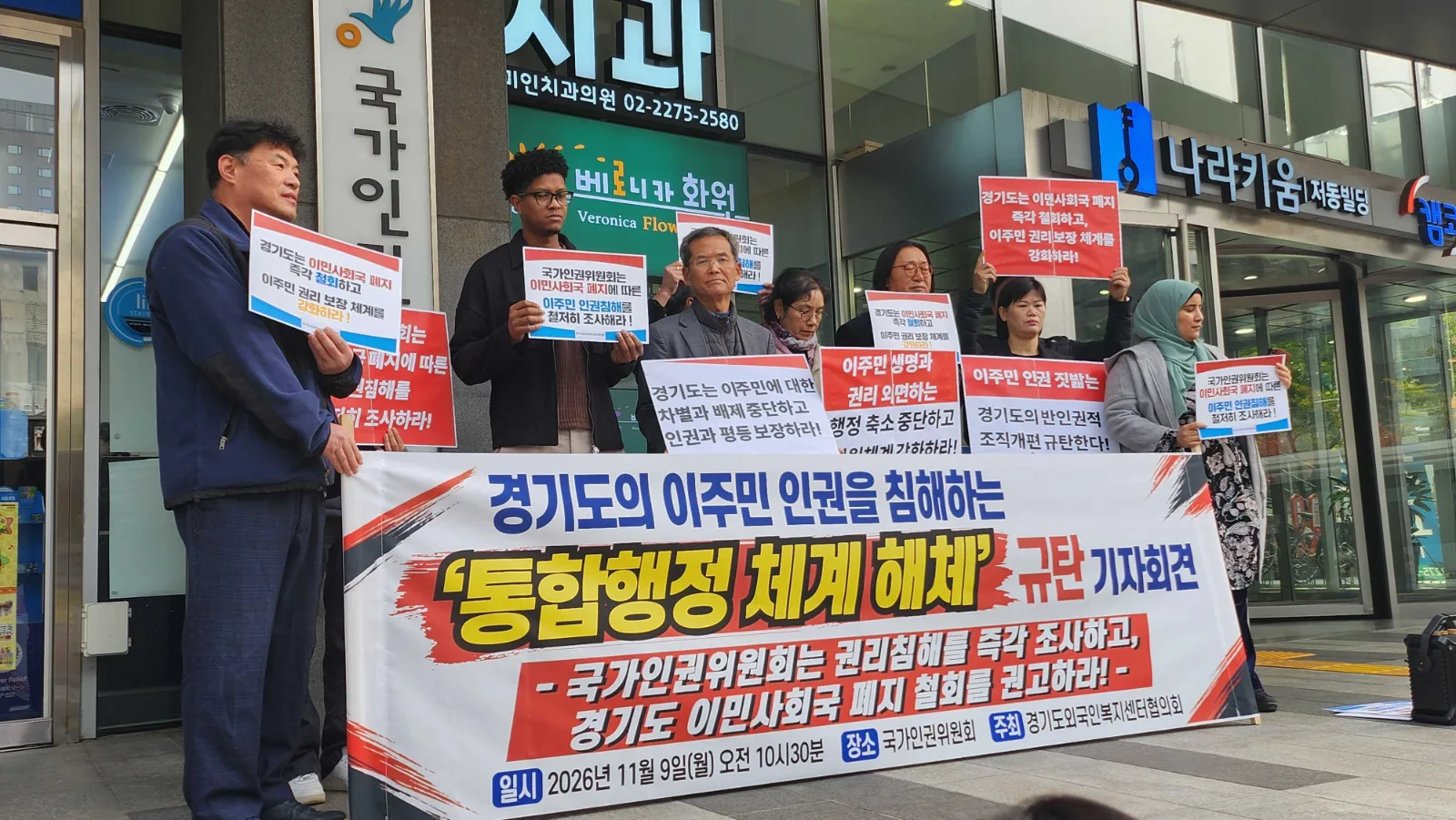
The National Human Rights Commission of Korea issued a decision on November 17, 2026, containing a formal opinion addressed to Gyeonggi Province Governor Choo Mi-ae, expressing its concern over the plan to abolish the “Migrant Community Bureau.”
According to the statement, a copy of which was obtained by “Refugee News”, the Commission formally dismissed the petition filed against the governor (on the grounds that administrative restructuring falls within the province’s own authority and that no concrete harm has yet occurred). However, it issued a warning that a human rights impact review must be conducted before implementation, and that an administrative vacuum weakening the protection of migrants must be avoided.
The Commission had earlier cautioned that attaching migrant affairs to the family bureau could marginalize broad groups with differing protection needs, such as migrant workers, international students, and refugees, and called for treating them as equal rights-holders in matters of work, safety, and health.
The Commission also called for clearly designating the responsible bodies, so that local ordinances enacted to protect migrants (such as the ban on racial discrimination and support for refugees and unregistered children) do not become mere words on paper after the bureau is dismantled.
On November 9, an official petition signed by 1,359 people (including 1,298 migrants) was submitted to the National Human Rights Commission, demanding that it recommend the province reconsider its decision.
The Gyeonggi provincial government, headed by Governor Choo Mi-ae, had announced on October 20 a plan for organizational restructuring that would abolish the “Migrant Community Bureau” just two years after its founding.
The province had established the bureau in July 2024 as the first specialized migrant affairs department among regional local governments in the country, following the Aricell factory fire in Hwaseong in June of that year, which killed 23 people, including 18 migrant workers.
The province justified the abolition by citing financial difficulties and the desire to streamline overlapping posts and improve administrative efficiency. Under the new plan, the bureau’s duties will be divided among three bodies: a “Multicultural Immigrant Community Division” will be created under the “Gender Equality and Family Bureau” to oversee settlement affairs, while employment, visa, and rights protection matters will be transferred to the “Labor and Industrial Safety Bureau,” and the recruitment of international students will be handed to the “Future Generations Bureau.”