
The public programs where you can learn Korean differ by organization in who can join, what they cost, and how to apply. Please check each organization’s notices for the application schedule, which changes every term.
Comparison at a Glance
| Route | Who can use it | Cost | How to apply |
|---|---|---|---|
| Online King Sejong Institute | Any foreign learner who wants to learn Korean | Free online learning service | Sign up on the website, then register for a course each term |
| Korea Immigration and Integration Program (KIIP) | Foreigners legally staying in Korea who have completed Alien Registration, and naturalized citizens within 3 years of acquiring nationality | Level 0 free, fee from Level 1 | Apply through the Social Integration Information Network (Socinet) |
| Korean education at Family Centers | Marriage migrants and children who came to Korea in mid-childhood | Group classes follow the center’s guidance; home-visit education has a co-payment based on income | Ask your nearest Family Center |
| Korean classes at local government foreign resident centers | Foreign residents as defined by each center (for example, adults with a Residence Card) | Differs by center | The center’s website or the local government portal |
Online King Sejong Institute
The Online King Sejong Institute is run by the King Sejong Institute Foundation, a public institution under the Ministry of Culture, Sports and Tourism. Its website describes the Online King Sejong Institute as a free online Korean learning service you can study on a PC or mobile device anytime and anywhere, and it lists the target learners as any foreign learner who wants to learn Korean.
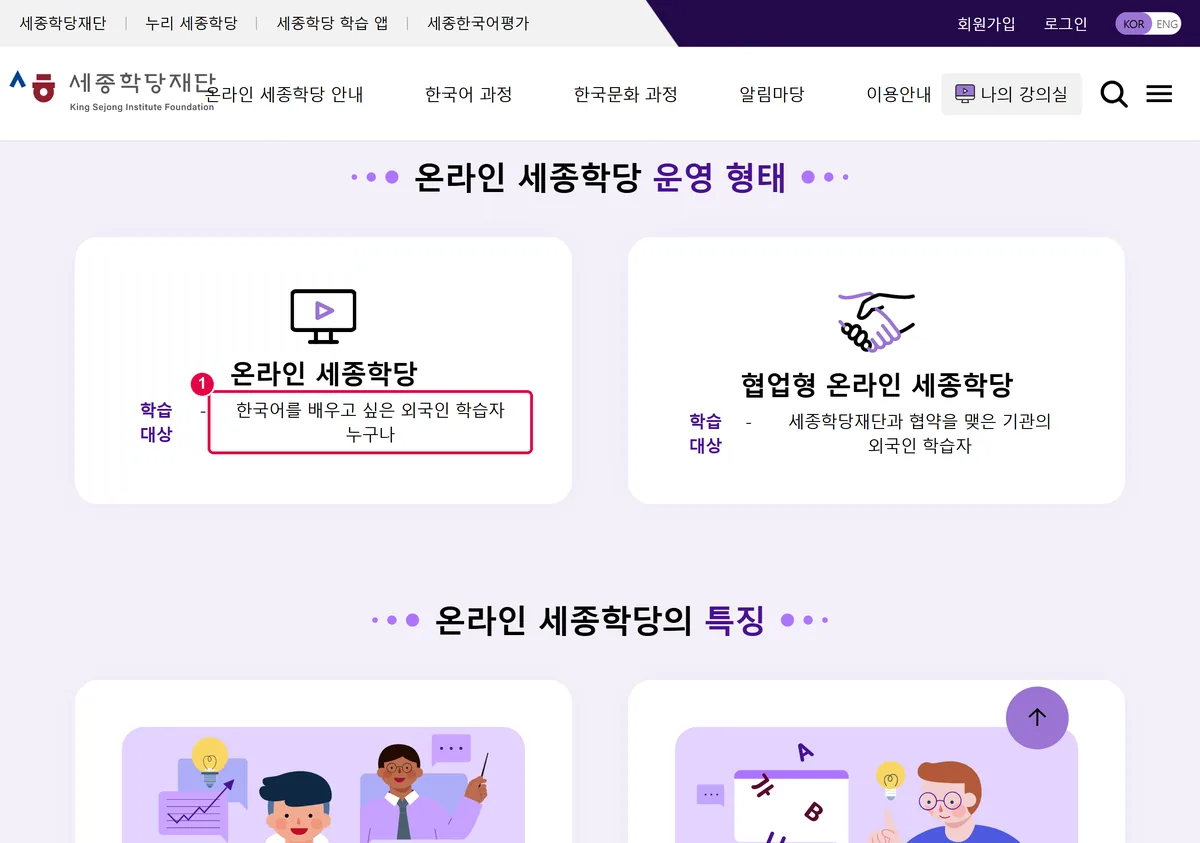
- In the target learners field, check any foreign learner who wants to learn Korean.
Course Types
The Online King Sejong Institute offers three types of courses: lecture, assignment, and self-study.
- Lecture type: You learn from online video lectures (VOD) and practice with a Korean teacher in live video classes (Zoom). The beginner, intermediate, and advanced courses consist of 10 live video classes, 2 assignments, and an online achievement test. The introductory course has 5 live video classes.
- Assignment type: In the beginner and intermediate courses, you do reading, writing, and speaking assignments with a teacher.
- Self-study type: You study alone with online video lectures, with no fixed schedule. You can register and study whenever you want.
Class timetables differ by course, so please check the schedule on each course page before you register. The completion requirements also differ by course. For the beginner, intermediate, and advanced lecture types, you receive a completion certificate if you reach 70% progress in the video lectures, 70% attendance in the live video classes, and the required assignment and achievement test scores. For the introductory course, you receive a certificate of attendance if you reach 70% or more in the video lectures and the live video classes. The requirements are summarized in a diagram in the term schedule notice.
How to Apply
- Sign up on the website. You can download the sign-up and course registration procedure from the user manual as files in Korean, English, Chinese, Spanish, Arabic, and Vietnamese.
- Check your level with the Korean placement test. The placement test has beginner and intermediate levels and tests listening and reading.
- During the registration period for each term, register for a course that matches your level and course type. You can cancel or change a registration during a separate period announced each term.
The advanced, business Korean, and reading/writing lecture types are open only to learners who have completed the earlier level. For example, the advanced course is for learners who have completed intermediate 2B or higher. The term schedule notice states that a placement test result alone does not meet this condition.
Checking the Schedule for a New Term
Lecture-type and assignment-type courses open in four terms a year. In 2026, the annual schedule was announced at the beginning of the year, and each term had its own registration period. The schedule below is for 2026. The schedule for the following year may differ, and the same notice states that all registration periods and study periods may change.
| 2026 term | Beginner, intermediate, advanced registration | Introductory registration |
|---|---|---|
| Term 1 | February 2 to February 15 | March 9 to March 22 |
| Term 2 | April 20 to May 3 | May 25 to June 7 |
| Term 3 | July 6 to July 19 | August 10 to August 23 |
| Term 4 | September 21 to October 4 | October 26 to November 8 |
Notices for new terms are posted on the website’s term start notice board. The article this site wrote for a single term is the Term 4 guide for 2026.
App and Textbooks
The King Sejong Institute Foundation provides the King Sejong Institute learning app. According to the app’s introduction page, it has level-based learning from beginner to advanced, a level test, and Korean conversation practice with an AI teacher. The introduction page does not state a usage fee, so please check the app store page before you install it. The user manual page explains that the Online King Sejong Institute course textbooks are available free of charge at Nuri Sejong Institute.
Korea Immigration and Integration Program (KIIP)
The Korea Immigration and Integration Program (KIIP) is education in which you learn Korean and Korean society step by step at an operating institution designated by the Ministry of Justice. It is for foreigners legally staying in Korea who have completed Alien Registration, and for naturalized citizens whose nationality was acquired less than 3 years ago. The operating institutions include universities, local governments, Family Centers, and private organizations.
Some levels became paid from January 1, 2025. Level 0 is free, Levels 1 to 4 cost 100,000 won each, and Level 5 costs 70,000 won for permanent residence and 30,000 won for naturalization. According to the fee notice in the same document, recipients under the National Basic Living Security Act and their families, persons with severe disabilities, and others are exempt, and diligent participants who attend 100% of a level receive a 50% reduction. This exemption list does not separately name Recognized refugees, Asylum seekers (refugee applicants), or Humanitarian status holders. Please check with the Social Integration Information Network (Socinet) or the Immigration Contact Center (1345) whether you qualify for an exemption or reduction.
The order of sign-up, pre-evaluation, and class registration, and how to find an operating institution, are explained in How to apply for the Korea Immigration and Integration Program (KIIP) and its levels. That article also covers whether Recognized refugees, Asylum seekers (refugee applicants), and Humanitarian status holders can take part.
Family Centers
The Family Center is the former Multicultural Family Support Center. The Ministry of Gender Equality and Family describes the Family Center’s capacity-building program for marriage migrants as a program that helps multicultural families build Korean communication skills and adjust to social life, and it lists marriage migrants and children who came to Korea in mid-childhood as the target users. For families who find it hard to use a center, there is a home-visit education service. Its target users are marriage migrants, children who came to Korea in mid-childhood, and children of multicultural families (ages 3 to 12), and a co-payment applies depending on the household’s income level.
Therefore, Asylum seekers (refugee applicants) and Recognized refugees who are not married to a Korean national may not be eligible for this program. If you are married to a Korean national or have a child aged 18 or under, please ask the center whether a program applies to you. According to the same Ministry of Gender Equality and Family guidance, bilingual education support is for multicultural families with a child aged 18 or under and is free of charge.
You can find your nearest center and the classes it offers by calling the Family Center and Multicultural Family Support Center inquiry number, 1577-9337. The Ministry of Gender Equality and Family guidance gives the centers’ website as www.familynet.or.kr. There is also the Ministry of Education’s Korean learning system that is used through Family Centers.
Local Government Foreign Resident Centers
Foreign resident centers and Global Village Centers run by local governments also offer Korean classes. In February 2025, the Seoul Metropolitan Government announced that it runs Korean classes at 16 foreign resident facilities across Seoul. These include the Seoul Foreign Resident Center, the Eastern Foreign Resident Center, the Seoul Global Center, the Seoul Global Youth Education Center, regional foreign resident centers, and Global Village Centers. They offer level-based courses from beginner to advanced and preparation classes for the Test of Proficiency in Korean (TOPIK).
Applications are made on the Seoul foreigner portal MY SEOUL+ (global.seoul.go.kr). The Seoul Metropolitan Government announced that from September 1, 2026, applications for each facility’s Korean education programs and counseling reservations can be handled on this portal. The portal supports Korean, English, Chinese, and Vietnamese, and other languages can be viewed with automatic translation.
Fees and eligibility differ by center. As one example, the Itaewon Global Village Center’s Korean classes for the fourth quarter of 2026 were for foreigners aged 18 or older who hold a Residence Card (Alien Registration Card), and the classes were free of charge. If you live outside Seoul, please ask the foreigner support department of your city, county, or district office, or 1345, whether Korean classes are available. Many of the KIIP operating institutions above are also local governments and Family Centers.
Self-Study Materials from Public Institutions
The National Institute of Korean Language’s Basic Korean Dictionary is an online dictionary for Korean learners, and you can look up words directly on its website. The self-study courses of the Online King Sejong Institute, the King Sejong Institute learning app, and the Ministry of Education’s “Everyone’s Korean” are also self-study materials provided by public institutions.
Contact
- Immigration Contact Center 1345: Ask which programs you can take with your status of stay (residence status)
- Online King Sejong Institute course inquiries: 02-6970-5000, onse1@ksif.or.kr
- Family Centers and Multicultural Family Support Centers: 1577-9337