
TOPIK (Test of Proficiency in Korean) is a test that measures the Korean language ability of overseas Koreans and foreigners whose native language is not Korean. It is administered by the National Institute for International Education of the Ministry of Education. The test is held at least once a year under Article 42-5 of the Enforcement Decree of the Higher Education Act.
The test schedule, registration, and score checking are all done on the official website, topik.go.kr. Please do not trust advertisements that offer to register for you or guarantee that you will pass. The website’s home page carries a notice that illegal advertisements on social media are increasing, offering proxy test-taking, test questions, registration services, or guaranteed passing in exchange for money, and that those caught will face restrictions on taking the test and criminal charges.
Levels and Scores
The test levels are TOPIK I and TOPIK II, and there are 6 assessment levels, from Level 1 to Level 6. Under the basic operating regulations, TOPIK I gives Level 1 and Level 2, and TOPIK II gives Level 3 to Level 6. The level is decided by the total score, which adds up the scores of each section. TOPIK I is the beginner level, and TOPIK II is the intermediate and advanced level.
The paper-based test (PBT) and the internet-based test (IBT) have different maximum total scores, so the score cutoffs for each level also differ.
| Test | Level | Total score |
|---|---|---|
| TOPIK I paper-based test (PBT) | Level 1 | 80 to 139 points |
| TOPIK I paper-based test (PBT) | Level 2 | 140 to 200 points |
| TOPIK II paper-based test (PBT) | Level 3 | 120 to 149 points |
| TOPIK II paper-based test (PBT) | Level 4 | 150 to 189 points |
| TOPIK II paper-based test (PBT) | Level 5 | 190 to 229 points |
| TOPIK II paper-based test (PBT) | Level 6 | 230 to 300 points |
| TOPIK I internet-based test (IBT) | Level 1 | 121 to 235 points |
| TOPIK I internet-based test (IBT) | Level 2 | 236 to 400 points |
| TOPIK II internet-based test (IBT) | Level 3 | 191 to 290 points |
| TOPIK II internet-based test (IBT) | Level 4 | 291 to 360 points |
| TOPIK II internet-based test (IBT) | Level 5 | 361 to 430 points |
| TOPIK II internet-based test (IBT) | Level 6 | 431 to 600 points |
| TOPIK Speaking test | Level 1 | 20 to 49 points |
| TOPIK Speaking test | Level 2 | 50 to 89 points |
| TOPIK Speaking test | Level 3 | 90 to 109 points |
| TOPIK Speaking test | Level 4 | 110 to 129 points |
| TOPIK Speaking test | Level 5 | 130 to 159 points |
| TOPIK Speaking test | Level 6 | 160 to 200 points |
The same score cutoffs appear in the 2026 implementation plan notice and in the table in the test regulations. Scores are valid for 2 years from the results announcement date. You print the score report yourself from the website, and it is not sent by mail, fax, or email.
Test Types
The website describes three tests. All three measure Korean communication ability, and the institution you submit the score to decides which test’s score it accepts.
- TOPIK PBT (paper-based test): You write your answers on the test paper. TOPIK I has only Session 1 (listening and reading), which takes 100 minutes. TOPIK II has Session 1 (listening and writing) for 110 minutes and Session 2 (reading) for 70 minutes. The guide is on the TOPIK PBT introduction page.
- TOPIK IBT (internet-based test): You take it on a PC or tablet at a test center with an internet connection. According to the TOPIK IBT introduction, it has the same validity and the same level system as the paper-based test. TOPIK I takes 70 minutes and TOPIK II takes 125 minutes, with no break in the middle.
- TOPIK Speaking test: This is a separate 30-minute test of speaking only, with 6 questions. You can see the question format and the scoring criteria in the TOPIK Speaking test introduction. The website’s schedule marks some sessions of this test as a pilot.
Which test to take depends on the requirements of the school or institution where you will submit your score. Please check with them first.
How to Register
For tests taken in Korea, you can register only on the website. This follows Article 7 of the basic operating regulations. If you take the test abroad, follow the method of the administering organization in that country. The steps below are for registration in Korea.
- Sign up and log in on the website (topik.go.kr).
- During the registration period, choose the test (PBT, IBT, or Speaking test) and the level (TOPIK I or II).
- Enter your basic information and choose a test center.
- Upload a photo and enter your information.
- Pay the test fee.
- Check the details on the registration complete screen.
The official guide on the how to apply for the test page lists 8 steps (accessing the registration system, logging in, selecting the test and level, entering basic information, selecting a test center, uploading a photo and entering information, paying the test fee, and registration complete). The menu is under “TOPIK Introduction” at the top of the website.
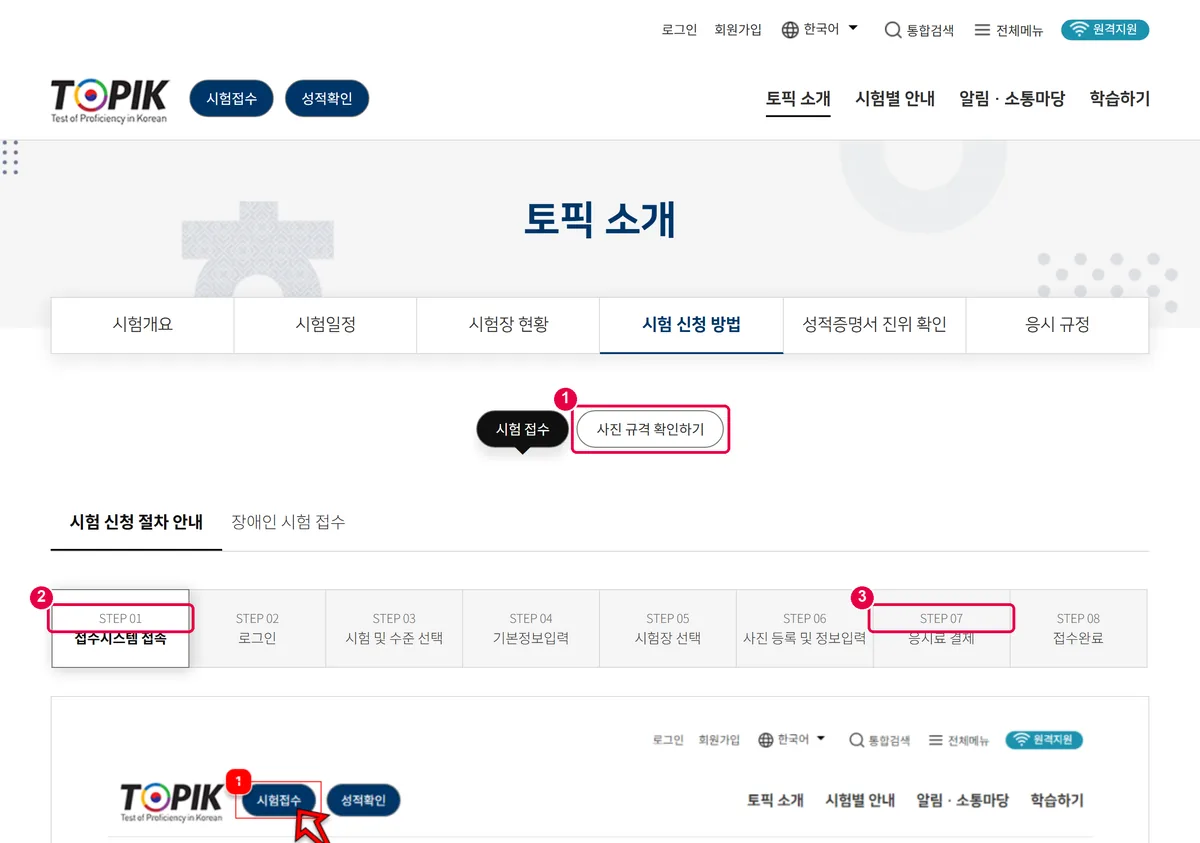
- First look at the specifications of the photo to upload under Check photo specifications.
- You can see examples of the registration screens in order, starting from STEP 01.
- STEP 07 is the test fee payment step.
Photo
You must upload a photo. According to the photo specification guide, the photo must be 413x532 pixels, 200 KB or less, and taken within the last 6 months. It follows the Ministry of Justice’s photo specifications for Alien Registration. If the photo does not meet the specifications, you may not be able to take the test, and if the face in the uploaded photo differs from your face on the test day, you may be penalized.
Choosing and Changing the Test Center
You choose a test center when you register. You can see the list of test centers on the test center status page. If you want to change your registration information, you can apply for a correction of applicant information, and you can change the test center only during the registration period and only within the number of people that center can accept. You can take the test only at the test center where you registered. The website does not state in what order seats are assigned. For details, please contact the TOPIK Center (02-3668-1331).
The website notes that registering with a macro program can lead to cancellation of the registration and suspension of the account.
ID
On the test day, you must bring the original of a designated ID, and without it you cannot take the test. For test takers in Korea, the designated IDs include a passport that has not expired, a Residence Card (Alien Registration Card), a Report of Domestic Place of Residence certificate for foreign-nationality Koreans, a permanent residence card, and a welfare card (disability registration card). The 2026 implementation plan notice also has a note that if you have submitted your ID to an Immigration Office or similar for a change of status of stay or a visa extension application, you can take the test by bringing a confirmation of application for permission to stay or a visa issuance confirmation that shows your name, date of birth, and photo. The information you registered, such as your English name, must be the same as on your ID, and it cannot be corrected on the test day.
Priority Registration for People with Limited Mobility
People with difficulty walking, such as persons with disabilities, older adults, pregnant women, and young children, can apply under the priority registration system for people with limited mobility. You must send the application form and supporting documents to the TOPIK Center by registered mail. Test registration for persons with disabilities is explained on a separate tab of the how to apply page.
Test Fees and Refunds
The test fees in Korea set by the test fee regulations are as follows. Fees abroad differ by country, so please check with the local administering organization.
| Test | Test fee |
|---|---|
| TOPIK I paper-based test (PBT) | 40,000 won |
| TOPIK II paper-based test (PBT) | 55,000 won |
| TOPIK I internet-based test (IBT) | 70,000 won |
| TOPIK II internet-based test (IBT) | 95,000 won |
| TOPIK Speaking test | 80,000 won |
You pay the test fee within the set period after registering, by virtual account or credit card (for use in Korea). If you cancel your registration after paying, the refund amount depends on when you cancel.
- From the start of registration until before 10:00 on the registration deadline: full refund
- From 10:00 on the registration deadline until 7 days later: 50% refund
- From the next day until 13:00 the day before the test: 40% refund
If you simply do not take the test, you do not receive a refund. For special circumstances listed in the regulations, such as the death of yourself or an immediate family member, an accident and hospitalization on the test day, a legally designated infectious disease, or a natural disaster, a full refund may be given after separate review, and the special refund application form and supporting documents must reach the TOPIK Center within 7 days of the test end date. The application form is on the test fee regulations page. The TOPIK Center decides whether to give a refund.
Test Dates
The schedule is posted by test type on the website’s test schedule page. The Ministry of Education is required to announce the next year’s implementation plan by the end of October each year, and the 2026 implementation plan notice was posted on the website on October 31, 2025. The notice states that the test schedule may change depending on the circumstances of the administering organizations in Korea and abroad, so please check the website again before you register. The registration period in Korea is usually about one week.
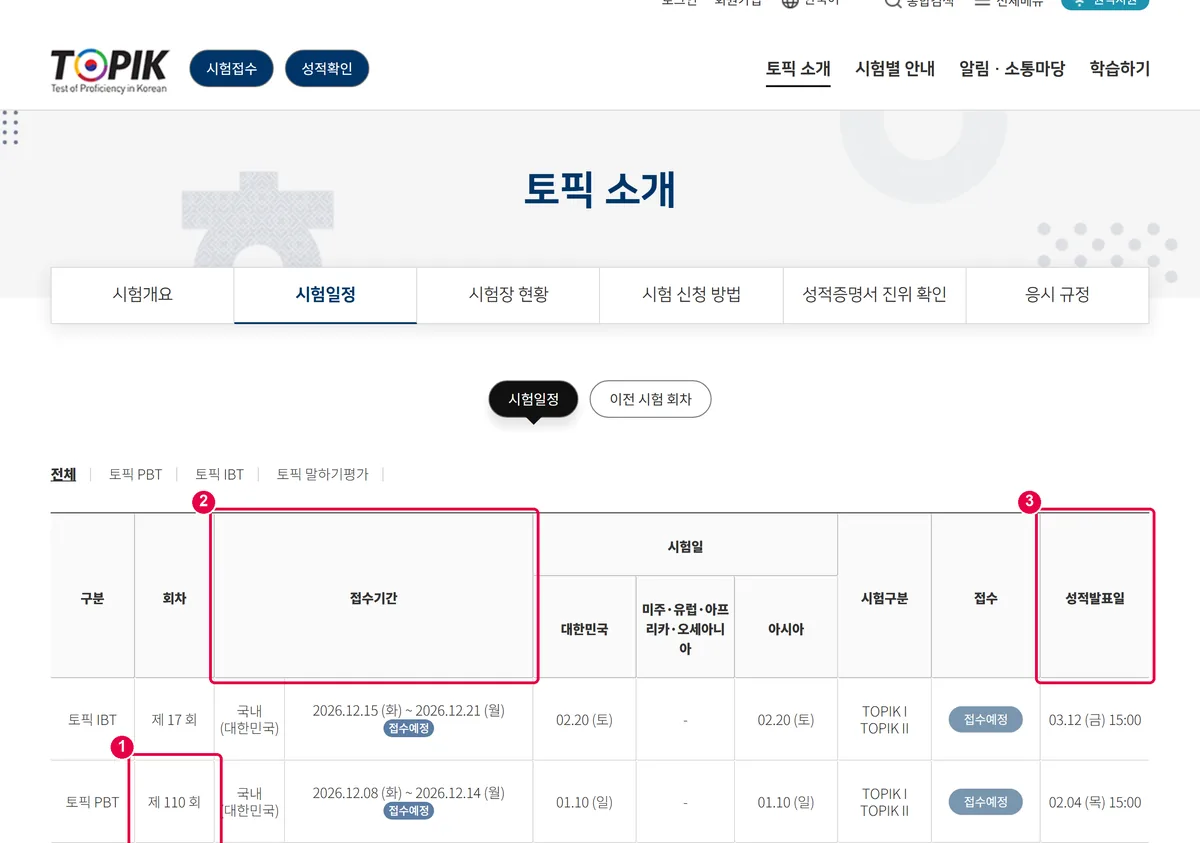
- The session in each row is the test number. Find the session of the test you want among TOPIK PBT, IBT, and Speaking test.
- The registration period shows the registration period in Korea.
- The results announcement date shows the date and time when scores are released.
As of November 19, 2026, the next sessions on the TOPIK website schedule are below. The first test in 2027 is PBT Session 110, held only in Korea.
| Test | Registration period (Korea time) | Test date | Results announcement |
|---|---|---|---|
| TOPIK Speaking test (pilot) Session 6 | December 1 to 2, 2026 | December 5, 2026 | December 7, 2026 |
| TOPIK PBT Session 110 | December 8 to 14, 2026 | Sunday, January 10, 2027 | Thursday, February 4, 2027, 15:00 |
| TOPIK IBT Session 17 | December 15 to 21, 2026 | Saturday, February 20, 2027 | Friday, March 12, 2027, 15:00 |
In the same table, registration has closed for TOPIK IBT Session 16 (November 28) in 2026. The test schedule page also shows overseas schedules, but it says to check the overseas registration period with the local administering organization.
Uses of TOPIK Scores
The test overview on the TOPIK website lists the main uses as follows.
- Admission to and graduation from universities and graduate schools in Korea for foreigners and overseas Koreans
- Employment at companies and public institutions in Korea and abroad
- Obtaining permanent residence and work-related stay visas
- Admission to and academic management of government-invited foreign scholarship programs
- Credits and graduation requirements for Korean-related departments at universities abroad
The TOPIK Speaking test introduction lists as uses the selection of Global Korea Scholarship (GKS) outstanding self-funded students (3 bonus points for Level 4 or higher), admission to universities in Korea and scholarship selection, selection by Korean companies, and applications for stay visas, with a note to ask each institution about university admission, employment, and stay visas. What level a university or institution requires depends on that university’s or institution’s admission guidelines. For university admission and scholarships for students with a refugee background, see Guide to university admission and scholarships for refugees.
Status of Stay
The Ministry of Justice sometimes uses TOPIK scores in procedures related to status of stay that check Korean language ability. Which level is needed for which status of stay differs by status and by period and may change. Please check the requirements and required documents for the status of stay you want to apply for with your Immigration Office or the Immigration Contact Center (1345). University admission for Asylum seekers (refugee applicants) (G-1) and the change to D-2 are explained in the related guide.
In its press release of June 23, 2023, the Ministry of Justice stated that international students can also use completion of the Korea Immigration and Integration Program and the King Sejong Institute Korean standard, in addition to TOPIK scores, to prove their Korean ability.
Relationship with the Korea Immigration and Integration Program
The Korea Immigration and Integration Program (KIIP) and TOPIK are different systems. KIIP is an education program run by the Ministry of Justice, and TOPIK is a test administered by the National Institute for International Education under the Ministry of Education. The KIIP level evaluation and the TOPIK level are obtained separately. Article 4 of the Enforcement Rule of the Nationality Act lists people who have completed KIIP as those who can be exempted from the comprehensive evaluation in a naturalization application, and TOPIK does not appear in this provision. For KIIP applications and levels, see the KIIP guide.
Test Fee Support
The TOPIK website’s test fee regulations have no provision that reduces or waives the test fee, and only have refund provisions. To find out whether a test fee support program is available, please ask your school or organization, or the TOPIK Center.
There has been a support program run by a private organization. The notice of the 2026 TOPIK test fee support program for young people and workers with a migrant background posted by the Labor Human Rights Center closed applications at 17:00 on October 7, 2026. The eligibility, amounts, and documents are summarized in 2026 guide to job training fees, interview fees, savings matching, and TOPIK test fee support for refugees and migrants. Please check the Labor Human Rights Center website for the next notice.
Contact
Inquiries about test registration, refunds, and scores are handled by the TOPIK Center of the National Institute for International Education (main number 02-3668-1331; paper-based test topik@korea.kr; internet-based test kitopik@korea.kr). For inquiries about status of stay, please use the Immigration Contact Center 1345.