
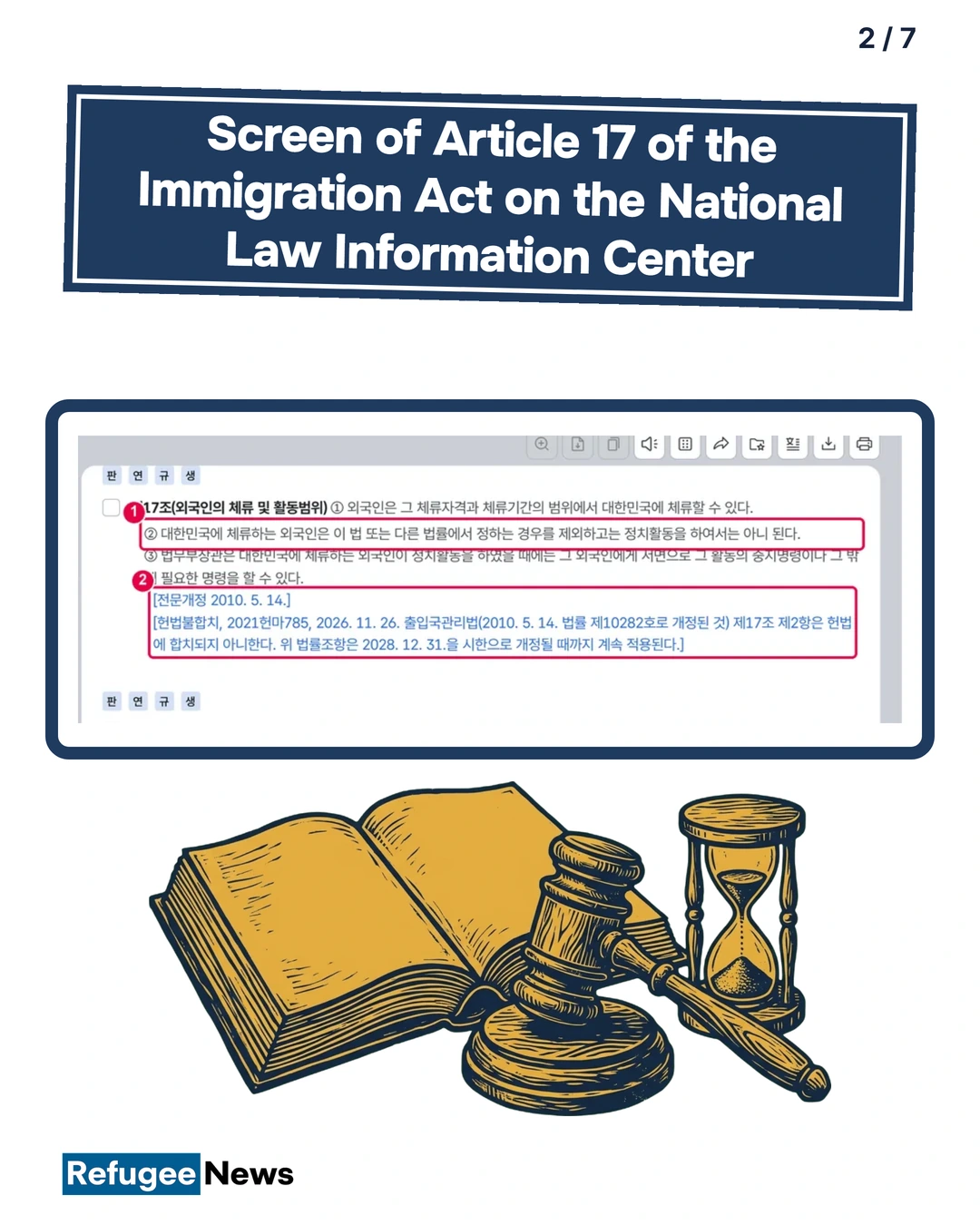
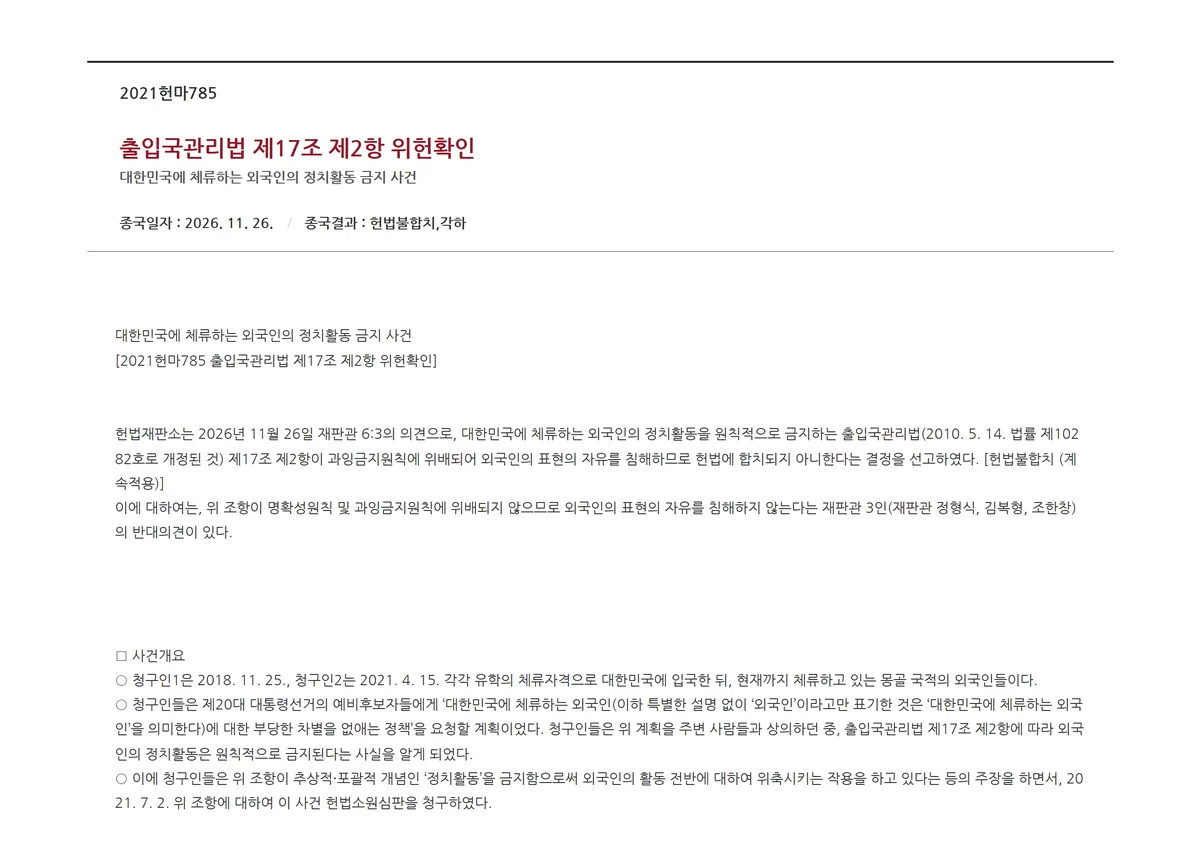
South Korea’s Constitutional Court ruled on Thursday, 26 November 2026, that Article 17(2) of the Immigration Act does not conform to the Constitution (case 2021헌마785). The provision says that foreigners staying in Korea must not engage in “political activity” except where the law provides otherwise. The court found that, because the provision bans “political activity” in general terms without saying which activities are banned, it restricts foreigners’ freedom of expression more than necessary.
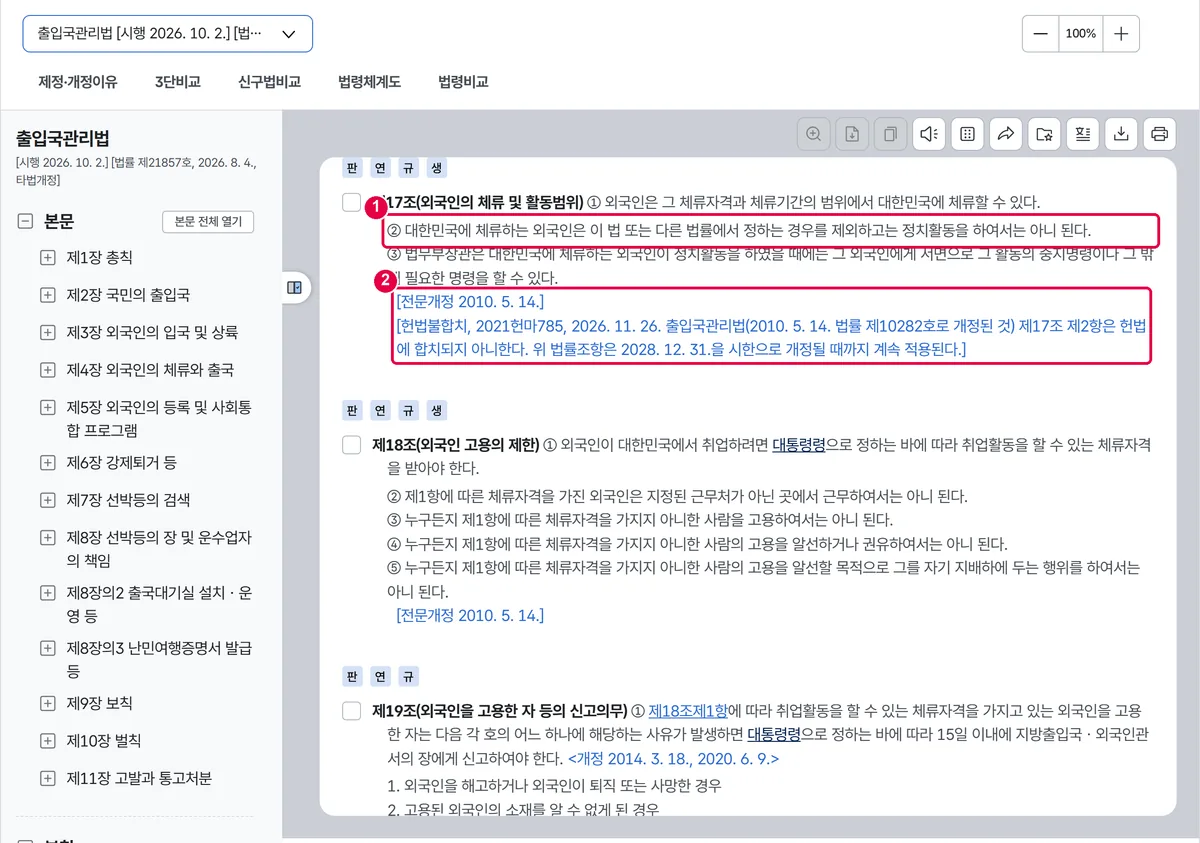
- Paragraph 2. It says foreigners staying in Korea must not engage in political activity except where the law provides otherwise.
- The note on the decision of nonconformity. It says the provision continues to apply until it is amended, by 31 December 2028 at the latest.
The ban still applies for now
The court did not strike the provision down with immediate effect. It issued a decision of nonconformity to the Constitution (헌법불합치) and ordered that the provision continues to apply until the National Assembly amends it, by 31 December 2028 at the latest. The court explained that removing the provision at once would leave no rule at all on political activity by foreigners, and that the National Assembly should decide which activities to list as banned. Under paragraph 3 of the same article, the Minister of Justice can order a foreigner who engaged in political activity, in writing, to stop the activity or give other necessary orders, and this paragraph also remains in place.
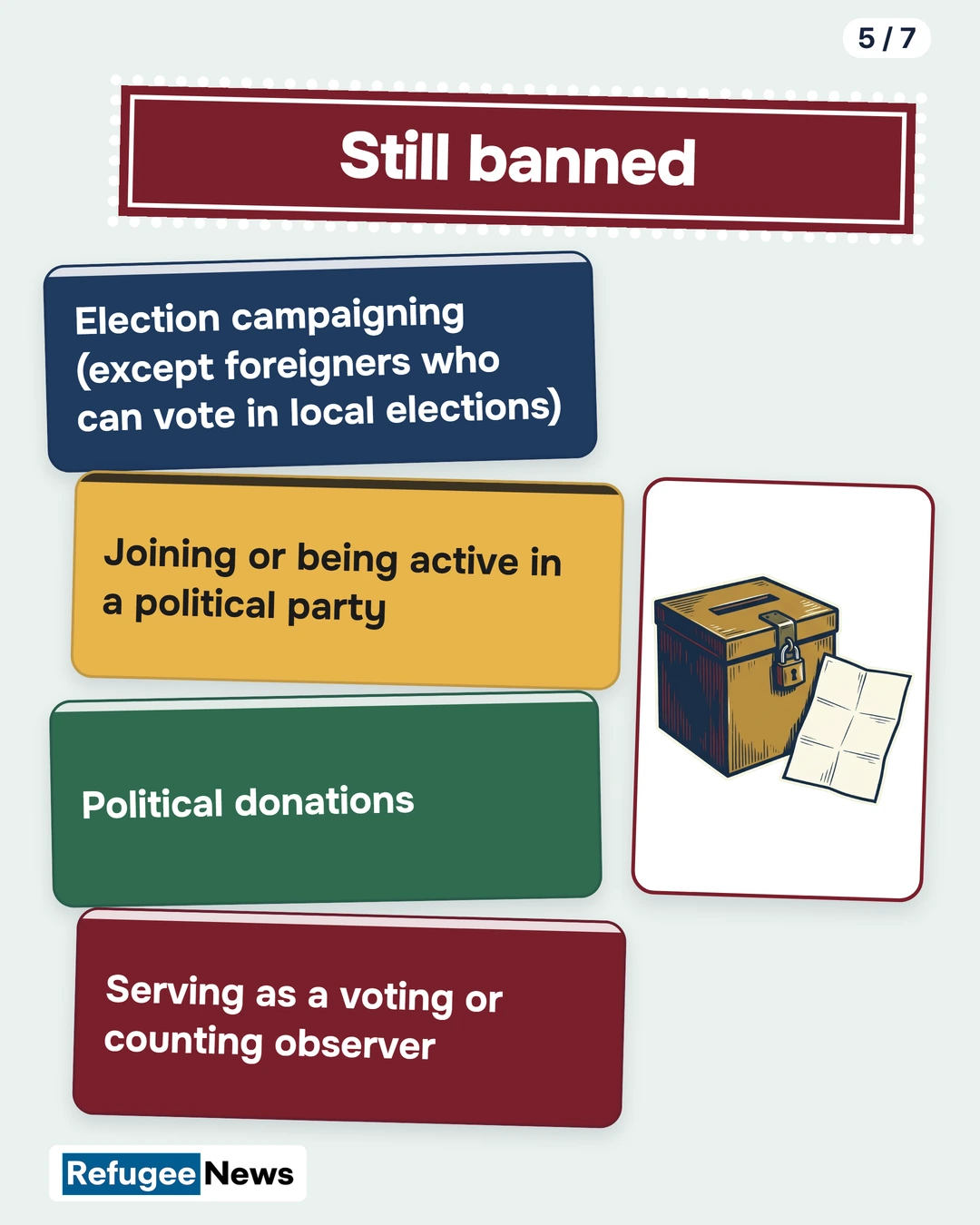
The court also stated that the decision does not mean that all political activity by foreigners must be allowed. Separately from this decision, foreigners still cannot do the following under other laws:
- campaign in elections (Public Official Election Act, Article 60(1)), except where the law allows it, for example for foreign residents who have the right to vote in local elections
- join or be active in a political party (Political Parties Act, Article 22(2))
- donate political funds (Political Funds Act, Article 31(1))
- serve as voting or counting observers
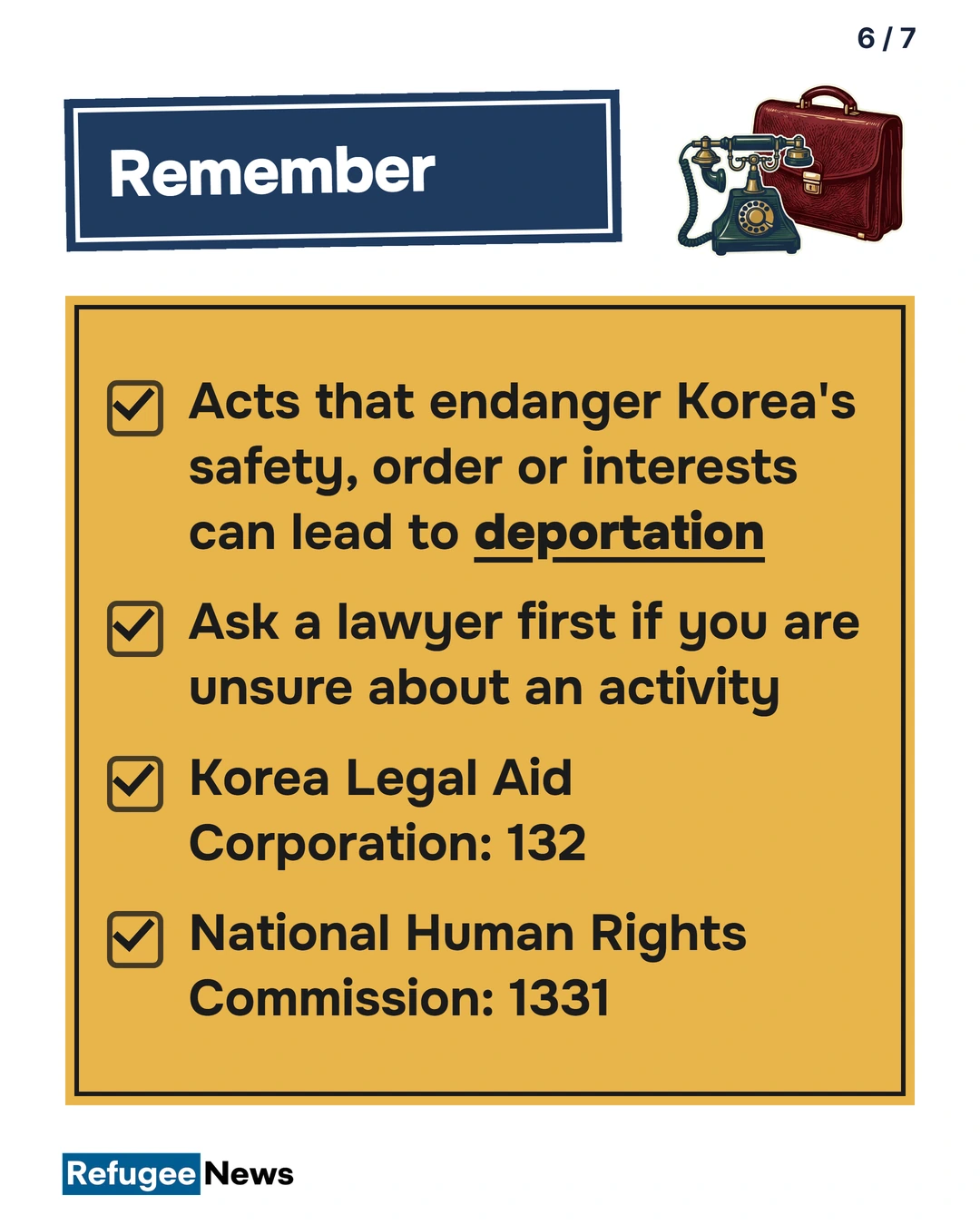
Any act by a foreigner that reaches the level of endangering Korea’s safety, order or interests can still lead to sanctions under other articles of the Immigration Act, up to deportation (Articles 11(1) and 46(1)). If you are unsure whether an activity you plan is allowed, ask a lawyer first, for example through the Korea Legal Aid Corporation (132).
Local election voting rights for foreigners
Under Article 15(2)(3) of the Public Official Election Act, foreigners who received permanent residence (F-5) status at least three years ago and are listed in the foreigner registration records of the local government can vote in local elections. Foreigners who meet this condition can also campaign in that election. Recognized refugees (F-2-4), humanitarian status holders and asylum seekers (G-1) do not meet this condition and do not have the right to vote in local elections. Foreigners cannot vote in presidential or National Assembly elections. Related article: June 3 Presidential Election Day Holiday Q&A
The case
The ruling was decided 6 to 3. It followed a constitutional complaint filed on 2 July 2021 by two Mongolian nationals who came to Korea on student visas in November 2018 and April 2021. They had planned to ask preliminary candidates in the 20th presidential election for policies to end unfair discrimination against foreigners in Korea, and then learned that the Immigration Act bans political activity by foreigners as a general rule. The court dismissed the complaint of the student who arrived in 2018 because it was filed more than one year after the provision began to apply to him, and decided the case on the complaint of the second student.
In its reasoning, the court said that almost any social issue can become a political one, so the word “political activity” can cover activities about foreigners’ own treatment related to their purpose of stay and even a simple opinion stated in speech or writing. Because breaking the provision can lead to deportation, foreigners are likely to give up such activities instead of taking the risk and waiting for a court to decide later. The court pointed to Germany, whose Residence Act (Section 47) allows political activity by foreigners in principle and lists the activities that can be restricted.
Three justices (Chung Hyung-sik, Kim Bok-hyung and Cho Han-chang) dissented. They found that “political activity” in the provision can be read narrowly, as activity on matters in which foreigners have no direct interest that could influence Korean citizens’ exercise of sovereignty and that reaches the level of endangering Korea’s safety, order or interests, and that the provision therefore does not violate the Constitution.
The court also stated that, under the principle of popular sovereignty, foreigners do not hold a constitutional right to vote or run for office, and that the freedom to engage in party activities or election campaigns, which are closely tied to the exercise of sovereignty, is not a basic right of foreigners. It noted that the right to vote in local elections, granted to some eligible foreign residents under current law, is a right given by statute and not a basic right guaranteed by the Constitution, according to Law Times.
A provision from 1977
According to the Constitutional Court’s summary of the decision, the general ban on political activity by foreigners was introduced in 1977, when the Immigration Act was fully revised. Concerns were raised in the National Assembly at the time that the vague notion of “political activity” could have a chilling effect and could be interpreted arbitrarily. A 2005 amendment added the exception for cases provided by other laws, but the core of the provision remained unchanged for nearly 50 years, even as the number of foreign residents in Korea grew. The court noted that there had been cases in which international students gave up publishing a declaration and foreigners gave up stating simple opinions about their status and discrimination because of this provision.
Where to ask
- Korea Legal Aid Corporation: 132 (no area code). You can ask whether an activity you plan is allowed under the law.
- National Human Rights Commission of Korea: 1331 (no area code). You can get counseling and file a petition if you are discriminated against because of your nationality or status of stay.
- Immigration Contact Center: 1345 (no area code). You can get information about your stay.
Related article: G-1 Visa and F-2 Visa: Comparing the Status of Stay and Rights of Asylum Seekers, Humanitarian Status Holders and Recognized Refugees, How to Report Discrimination and Racial Discrimination