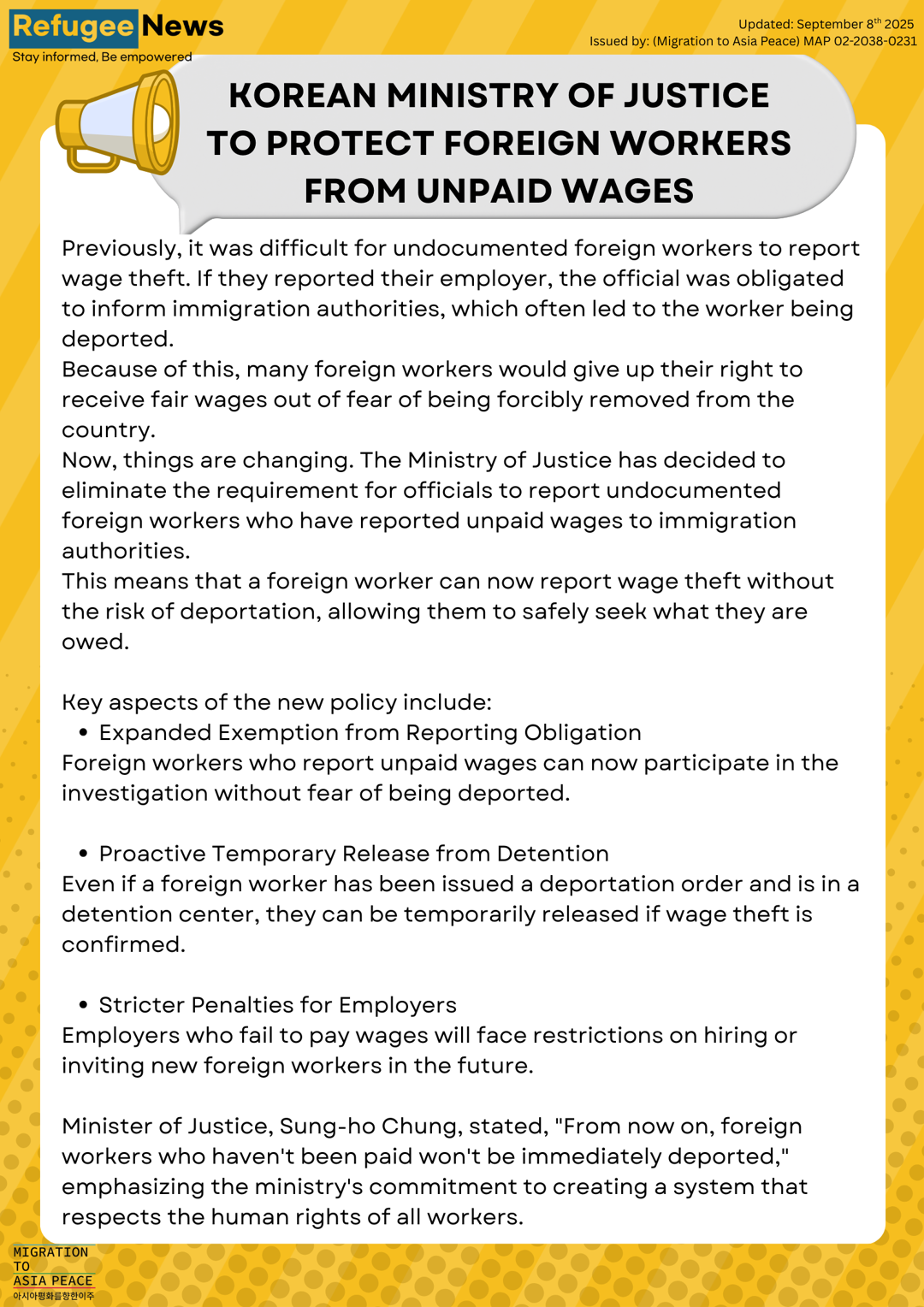
The Ministry of Justice has amended the Enforcement Rules of the Immigration Control Act so that foreign workers who have experienced wage theft can file a complaint and recover their unpaid wages without worrying about being forcibly deported, even if they are undocumented (irregularly staying).
The Ministry of Justice revised the Enforcement Rules of the Immigration Control Act to create a more stable working environment for foreign workers and to minimize the harm caused by wage theft. The new policy is called the Notification Duty Exemption for Foreign Workers Affected by Wage Theft, and it has been in effect since 6 November 2025.
Why Was This Policy Created?
For a long time, foreign workers who had suffered wage theft and other workplace abuses were reluctant to file complaints or seek help, because they were afraid that doing so would trigger deportation. This problem was raised repeatedly by advocates and international bodies.
Previously, the notification duty exemption already applied to a limited set of groups: children enrolled in kindergartens and primary or secondary schools, patients at public health and medical institutions, children in child welfare facilities, children receiving counseling at youth counseling and welfare centers, and victims of crimes or human rights violations. Unpaid foreign workers were not included, which meant many left the country without ever receiving the wages they were owed.
In July 2024, the National Human Rights Commission of Korea (NHRCK, Korea’s independent government body that investigates human rights complaints and issues policy recommendations) recommended to the Minister of Justice that the notification duty exemption be extended to cover investigations and labor inspections by Regional Employment and Labor Offices into violations of labor laws, including wage theft, so that undocumented workers could seek redress.
In May 2025, the UN Committee on the Elimination of Racial Discrimination also noted in its concluding observations on Korea’s government report that a high proportion of migrant workers experiencing wage theft are undocumented and are especially vulnerable to exploitation. The Committee recommended that Korea expand the notification duty exemption so that undocumented migrants can safely report labor rights violations and emergency situations.
What Has Changed
1. Expanded Notification Duty Exemption
Through this amendment, the Ministry of Justice has exempted labor inspectors from the obligation to report undocumented foreign workers who come forward about wage theft or other labor violations. In practical terms: if you are undocumented and you report unpaid wages, the authorities handling your complaint will not notify the Korea Immigration Service. You can assert your rights more safely.
The legal basis is the newly added Item 5 of Article 70-2 (Exemption from the Notification Duty) of the Enforcement Rules of the Immigration Control Act (Ministry of Justice Ordinance No. 1103), which took effect on 6 November 2025. It also applies to cases that were already in progress when the rule took effect (transitional provision).
2. Automatic Temporary Release from Immigration Detention
For workers who are already being held in an immigration detention facility, the authorities will now proactively issue a temporary release from detention so those workers can go through the process of recovering their wages.
3. Stronger Penalties for Employers Who Withhold Wages
Employers found to have withheld wages will face restrictions on hiring or sponsoring foreign workers in the future.
4. Cooperation Between the Ministry of Justice and the Ministry of Employment and Labor
These measures build on the notification duty exemption and the automatic temporary release policy, with the aim of ensuring that foreign nationals, regardless of their immigration status, can receive help recovering unpaid wages.
The on-site consultations at detention facilities (the dispatch of labor inspectors) are a separate measure from the notification duty exemption. These visits took effect on 29 December 2025. The Ministry of Employment and Labor is sending labor inspectors to five detention facilities located in Hwaseong, Cheongju, Yeosu, Incheon, and Ulsan, areas with large numbers of detained foreign nationals. Inspectors visit each facility once every two weeks to provide wage theft consultations and to accept and investigate cases on the spot. After the program’s results are evaluated, the authorities are considering expanding it to detention facilities under all 14 Immigration Offices nationwide.
How to Report Wage Theft
If you have not been paid what you are owed, here is how you can report it.
- Call the Ministry of Employment and Labor helpline: dial 1350 (hours: weekdays 09:00-18:00, excluding lunch 12:00-13:00; no area code needed; multilingual assistance is available, though the exact languages covered are)
- File online at the Ministry of Employment and Labor civil complaints portal: https://minwon.moel.go.kr
- Visit your local Regional Employment and Labor Office or branch office in person
To file a complaint, you submit a “wage theft complaint form” (임금체불 진정서). It helps to write down how much you were supposed to be paid, and the dates for which you did not receive payment. After you file, a labor inspector will investigate. If it emerges during that process that you are undocumented, the inspector will no longer be required to report you to the Korea Immigration Service.
Good to Know
- This policy applies not only to wage theft but also to other violations of labor laws, including unfair treatment at work.
- If you would like legal advice before filing, migrant support organizations and free legal aid services can help you.
- Details such as procedures and the scope of support may change over time. Before you take action, please confirm the latest information by calling the Immigration Contact Center (1345) or contacting your local Korea Immigration Service office.
Reference Links
- Korean Government Policy Briefing: Foreign workers affected by wage theft exempt from notification duty starting the 6th
- Korean Government Policy Briefing: Ministry of Justice and Ministry of Employment and Labor cooperate to quickly help foreign workers recover unpaid wages
- NHRCK: Statement welcoming the notification duty exemption for migrant workers affected by wage theft
- Ministry of Employment and Labor civil complaints portal (file a wage theft complaint)