
Whether you may work as a freelancer, take a side job, work on a platform, or earn money from YouTube or overseas clients depends on your status of stay, and the money you receive comes with a duty to file taxes.
Related article: How to Work Legally by Visa (Status of Stay) Type
What Is Permission for Activities Outside the Status of Stay?
Permission for activities outside the status of stay is a permission you receive in advance so that, while keeping your current status of stay, you can carry out activities that fall under another status of stay (Immigration Act Article 20). Asylum seekers and humanitarian status holders must receive this permission before they start working.
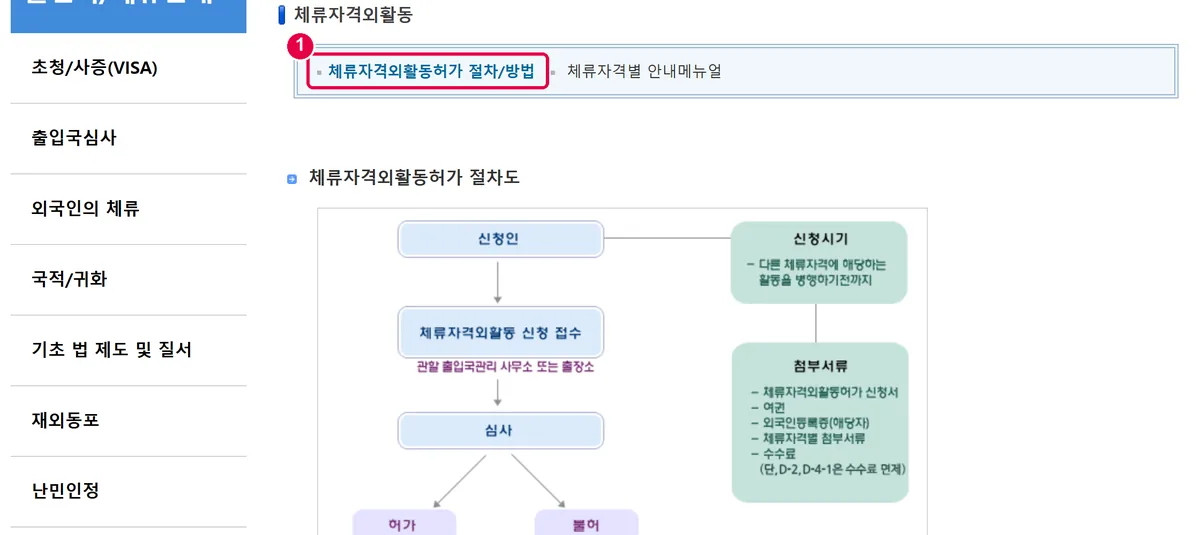
- In the 체류자격외활동허가 절차/방법 (Procedure and method of permission for activities outside the status of stay) tab, read the procedure chart. In the chart, the 신청시기 (Application timing) is "before you carry out activities that fall under another status of stay at the same time," and the 첨부서류 (Attached documents) lists the application form for permission for activities outside the status of stay, passport, Residence Card (if you have one), documents required for each status of stay, and the fee.
Summary by status of stay
| Status of stay | Freelance work and side jobs | Conditions |
|---|---|---|
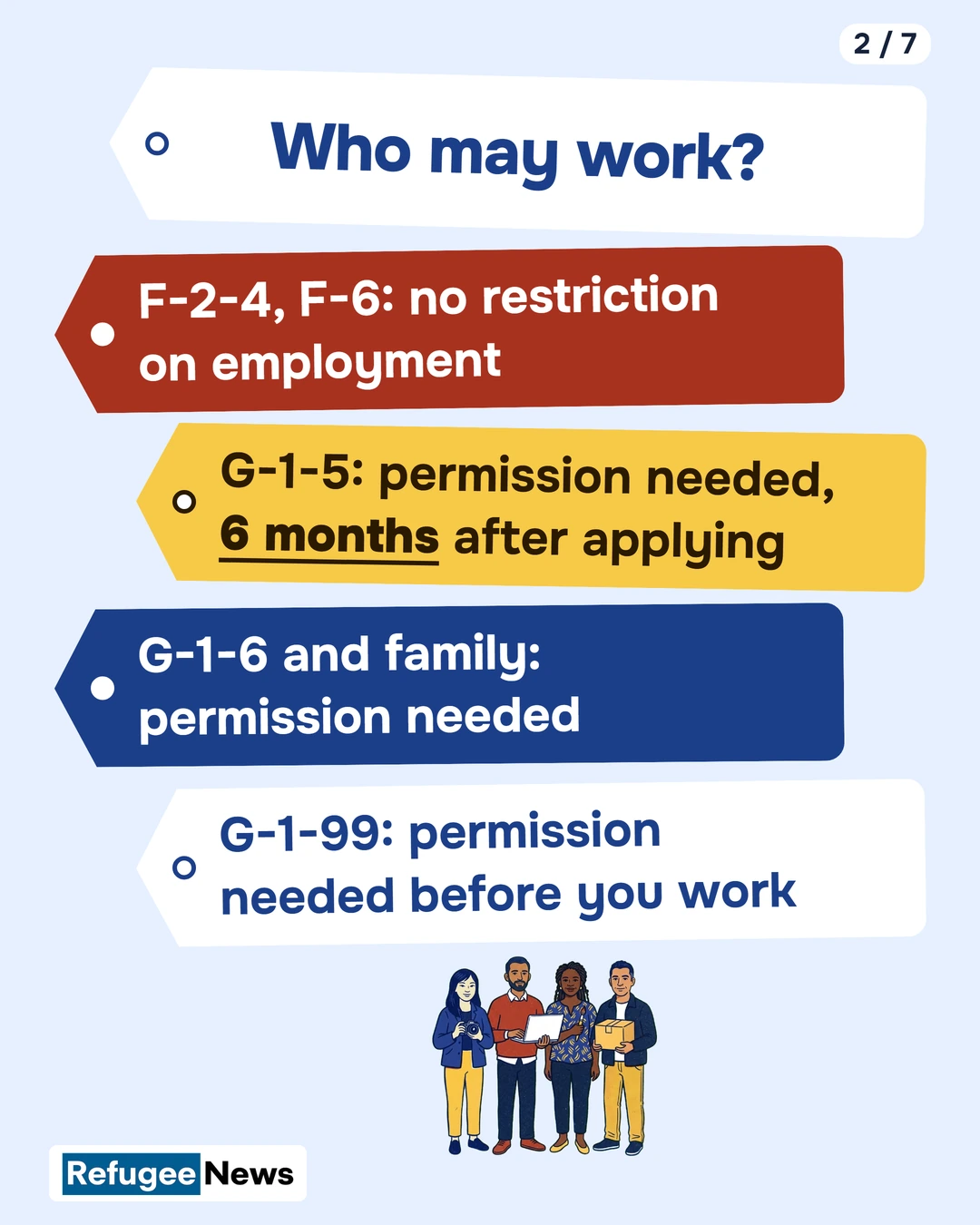
| Recognized refugee (F-2-4) | Possible | There is no restriction on employment activities. |
| Marriage migrant (F-6) | Possible | There is no restriction on employment activities. |
| Asylum seeker (G-1-5) | Possible after permission is granted | 6 months must have passed since you applied, and you must receive permission before you work. |
| Humanitarian status holder (G-1-6), family of a humanitarian status holder (G-1-12), family of a recognized refugee (F-1-16) | Possible after permission is granted | You must receive permission before you work. |
| Others (G-1-99) | Possible after permission is granted | Permission is required before you work. Guide to the Others (G-1-99) status of stay |
Recognized refugee (F-2-4) and marriage migrant (F-6)
Article 23, paragraph 2 of the Enforcement Decree of the Immigration Act (출입국관리법 시행령) provides that holders of Resident (F-2) items (가) to (다) and Marriage Migrant (F-6) “are not subject to restrictions on employment activities.” The Ministry of Justice Manual for Stay-Related Applications by Status of Stay lists recognized refugees as F-2-4. Therefore you may do freelance work, take a side job, or run a business without separate permission. A family member of a recognized refugee (F-1-16) holds a Visit Cohabiting status, so you need permission, as in the humanitarian status holder section below.
You must report your occupation and annual income. According to a Ministry of Justice press release, holders of Resident (F-2), Marriage Migrant (F-6) and similar statuses who carry out profit-making activities, including the self-employed, must report their occupation and income amount, and must report again within 15 days when these change. The method is in Online Reporting of Employment Information by Foreigners.
Related article: Guide to Business Start-Up and Business Registration for Foreigners and Refugees
Asylum seeker (G-1-5)
Article 40, paragraph 2 of the Refugee Act (난민법) provides that “if 6 months have passed from the date of the application for recognition of refugee status, employment may be permitted to a refugee applicant in accordance with the Presidential Decree.” The Ministry of Justice manual names two groups eligible for permission.
- People for whom 6 months have passed since they applied for refugee recognition. Periods caused by the applicant (delay in submitting supporting materials, whereabouts unknown, detention) are not counted in the 6 months.
- People whom the immigration office recognizes as having a special need, for example because they must support a dependent who cannot work due to a disability or similar reason. They are eligible for permission even before 6 months.
The manual states the scope of permission as follows.
- Simple labor work, excluding industries where employment is restricted.
- The industries where employment is restricted are construction, gambling-type business premises (사행행위 영업장소), hostesses at karaoke bars and entertainment bars, businesses relating to public morals (풍속영업) that are contrary to good morals, private tutoring, and similar. If the business type on the business registration certificate is construction only, you cannot be employed; if it is a combined business type such as construction and manufacturing, permission is granted on the condition that “Construction work not permitted” is stamped on the permission sticker.
- Required documents are the application form, passport, Residence Card (Alien Registration Card), employment contract, and workplace-related documents such as a copy of the business registration certificate.
- The fee for permission to engage in activities outside the status of stay is 120,000 won (Article 72 of the Enforcement Rule of the Immigration Act). A change of workplace is also 120,000 won.
- If your workplace changes, you must receive new permission.
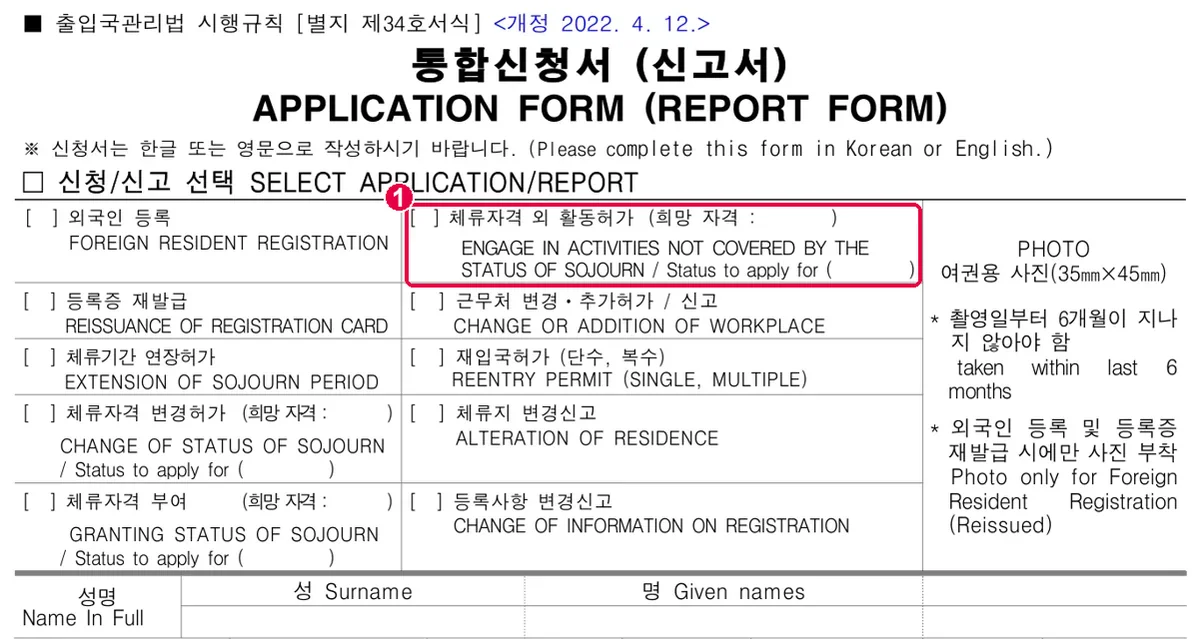
- In the 신청/신고 선택 (Select application or notification) section of the Integrated Application Form (Notification Form; Enforcement Rule of the Immigration Act, Annex Form No. 34, revised 12 April 2022), there is a 체류자격 외 활동허가 (Permission for activities outside the status of stay) item. This is a blank form, and you can download it from the HiKorea civil service forms list.
Permission is granted for each workplace on the basis of an employment contract and workplace documents. Whether a freelance arrangement in which you take work job by job falls within this scope is not stated in the law or the manual.
Related article: G-1 Visa and F-2 Visa Comparison
Humanitarian status holder (G-1-6) and family members
Article 39 of the Refugee Act provides that “the Minister of Justice may grant permission for employment activities to a humanitarian status holder.” Eligible are humanitarian status holders, their family members (G-1-12), and family members of recognized refugees (F-1-16). F-1-16 is the Visit Cohabiting status given to the spouse and minor children of a recognized refugee.
The manual states the permitted scope as “same as asylum seekers; however, construction work is allowed.” To work in construction, you must complete the “Basic Safety and Health Training for Foreign Workers in Construction” after receiving permission. The permission period is up to 1 year within your period of stay. The HiKorea guide states that you may work only in the permitted industry and for the permitted period, and that you must receive permission again if your workplace changes. The same guide also contains a sentence saying that you may work in all fields except those where employment is restricted, which words the scope differently from the manual, so you must confirm the scope when you apply for permission.
Others (G-1-99)
G-1-99 requires permission before you work. The details of the status are in the Guide to the Others (G-1-99) status of stay.
Steps for finding work
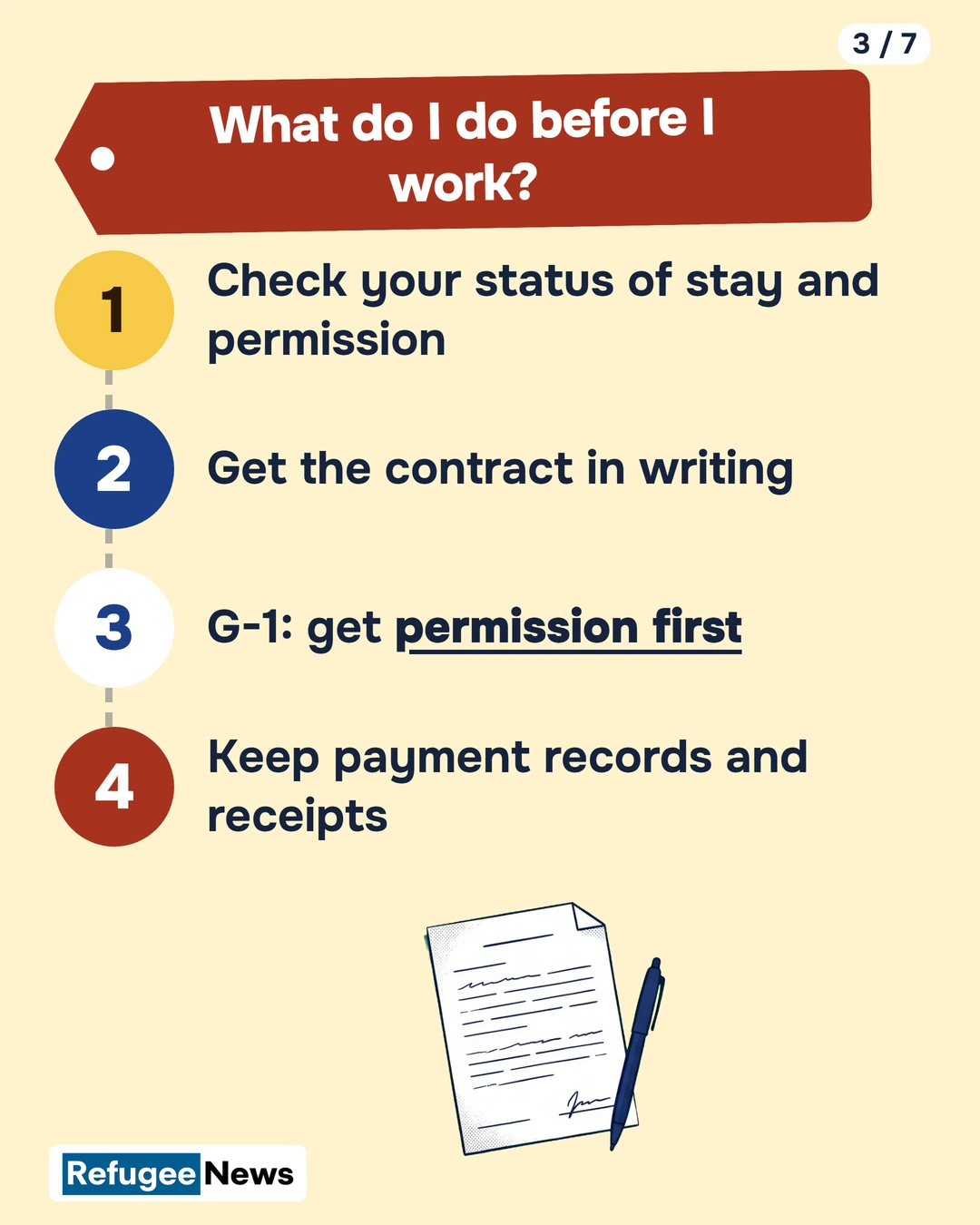
- Check your status of stay and whether you have permission. Permission is marked with a permission stamp or sticker in your passport, and a permit document is issued if needed (Article 25, paragraph 3 of the Enforcement Decree of the Immigration Act). It may also be written on your Residence Card (Alien Registration Card) (HiKorea). With a G-1 status, you must not start work before you receive permission.
- Check before you pay any placement fee. Even a registered fee-charging employment placement business may not receive money or goods beyond the announced fees (Article 19, paragraph 3 of the Employment Security Act). Article 18, paragraph 4 of the Immigration Act prohibits arranging or soliciting employment for a person whose status of stay does not allow employment. If someone asks for a placement fee or a deposit, or tells you to hand over your passport, check with 1345.
- Get the contract in writing and check whether it is an employment contract or a service contract.
- With a G-1 status, apply for permission using the contract and workplace documents, and check your permission again each time the work changes.
- Keep records of payments received and receipts for expenses. You need them for the May filing.
Related articles: Beware of Brokers Offering Seasonal Work, Labor Rights Basics for Foreigners and Refugees
Platform work and delivery
The National Tax Service global income tax guide includes “delivery riders” among the personal-service income earners from whom 3.3% is withheld. A person with personal-service business income is someone who provides services continuously in an independent capacity, without physical facilities or an employment relationship, and is paid according to results (National Tax Service). Whether delivery income is business income or earned income depends on whether the contract is an employment relationship.
The place where the Ministry of Justice manual lists riders as a restricted field is the part on part-time employment for Student (D-2) holders. Delivery work is not among the industries where employment is restricted for asylum seekers and humanitarian status holders. However, G-1 permission is granted for each workplace on the basis of an employment contract, and rider contracts are often independent contracts. F-2-4 and F-6 have no restriction.
Overseas commissions and online income
The Ministry of Justice manual has no sentence stating whether work commissioned by overseas clients or YouTube income counts as employment activity under the Immigration Act. F-2-4 and F-6 have no restriction on employment activities.
Tax applies regardless of your status of stay. The National Tax Service guide for one-person media creators provides as follows.
- If you make video content “continuously and repeatedly” and earn revenue, you must register as a taxable business or a tax-exempt business.
- If you do not hire workers and operate without physical facilities, you are a tax-exempt business (business type code 940306). You have no duty to file value-added tax, but you must submit the business place status report by 10 February of the following year.
- Both taxable and tax-exempt businesses must file global income tax.
- Donations received through the account shown on the broadcast screen are also subject to reporting.
- To receive credit for tax withheld by Google in the United States, you must submit the documents for the foreign tax credit.
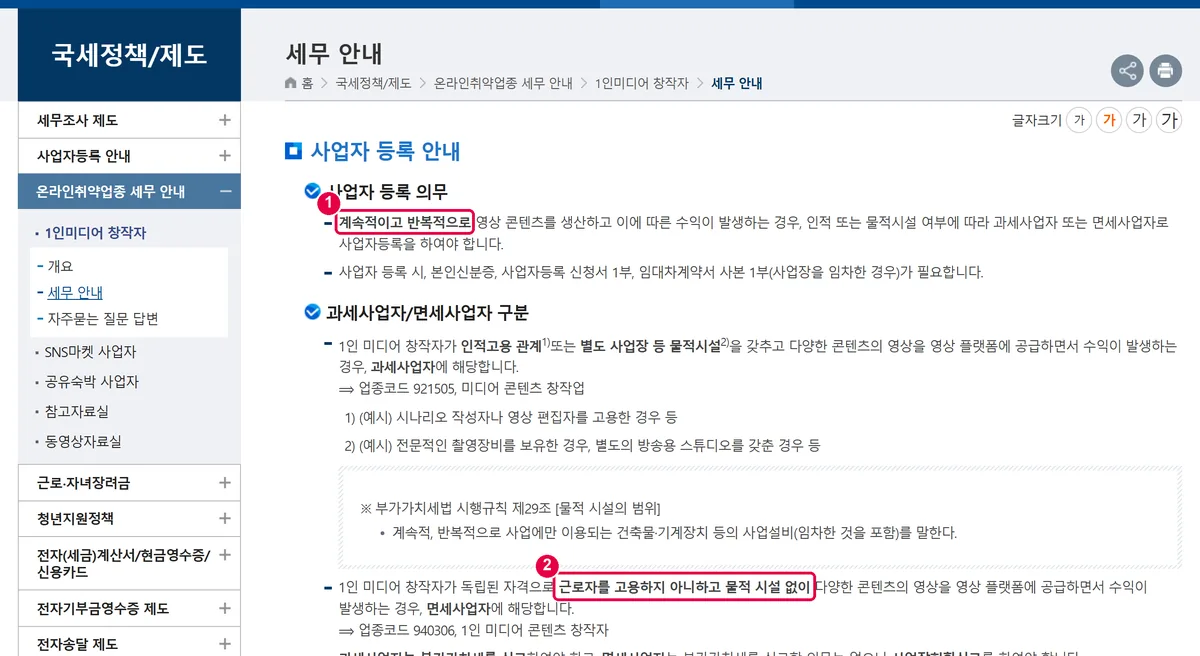
- The guide says that if you produce video content 계속적이고 반복적으로 (continuously and repeatedly) and earn revenue, you must register as a business.
- If you work 근로자를 고용하지 아니하고 물적 시설 없이 (without hiring workers and without physical facilities), you are a tax-exempt business (business type code 940306).
Business registration
F-2-4 and F-6 may register a business. The procedure is in the start-up guide. For G-1 statuses, whether business registration in your own name falls within the scope of permission is not stated in the law or the manual.
3.3% business income withholding
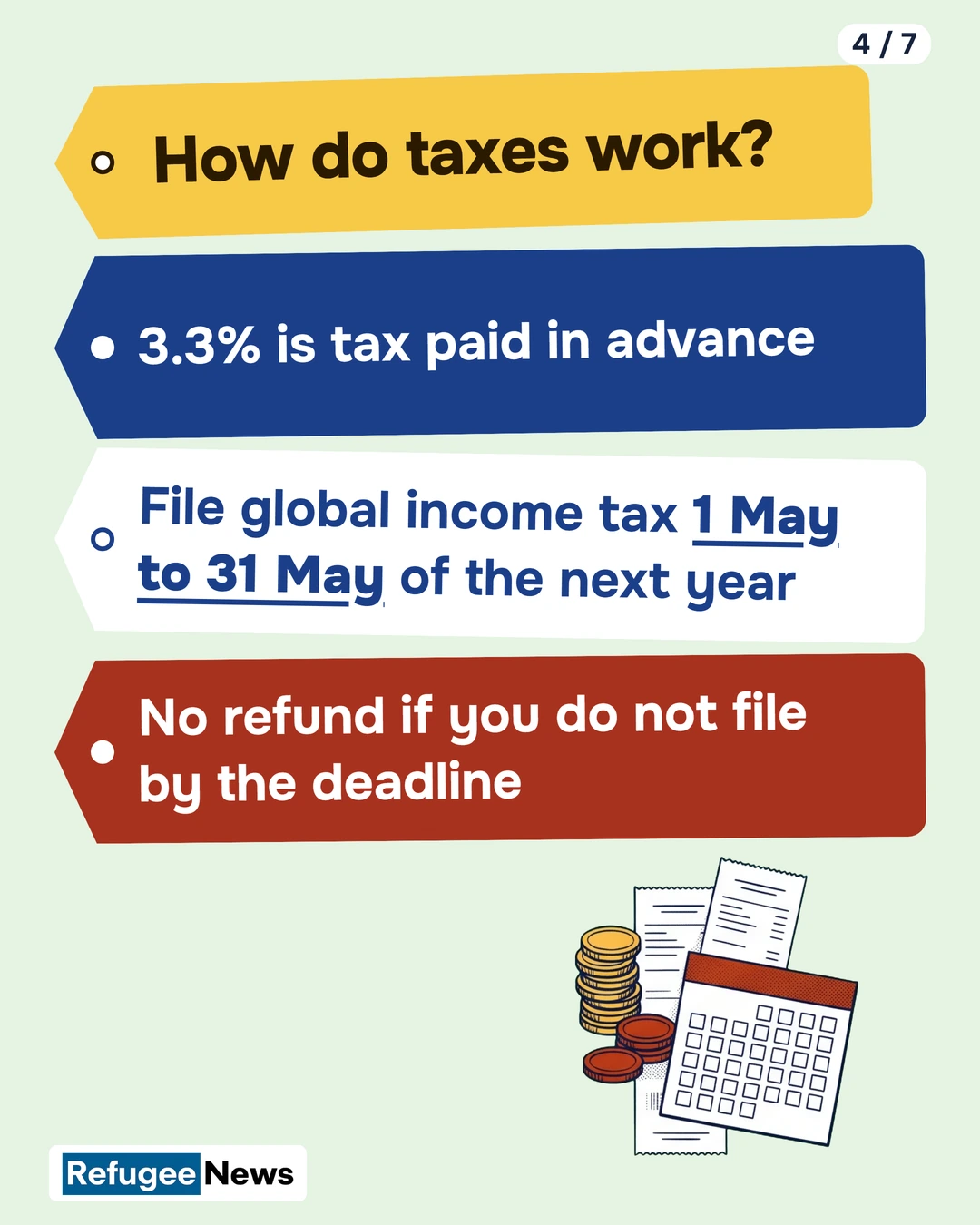
This is a method in which the party that gives you the work deducts 3.3% (3% business income tax and 0.3% local income tax) when it pays you and pays that amount to the National Tax Service in advance.
The 3.3% is tax paid in advance and does not replace filing. If you do not file within the deadline, no refund is paid. In the National Tax Service example, 330,000 won was withheld from income of 10 million won, and because the actual tax was 220,000 won, filing returns 110,000 won to you.
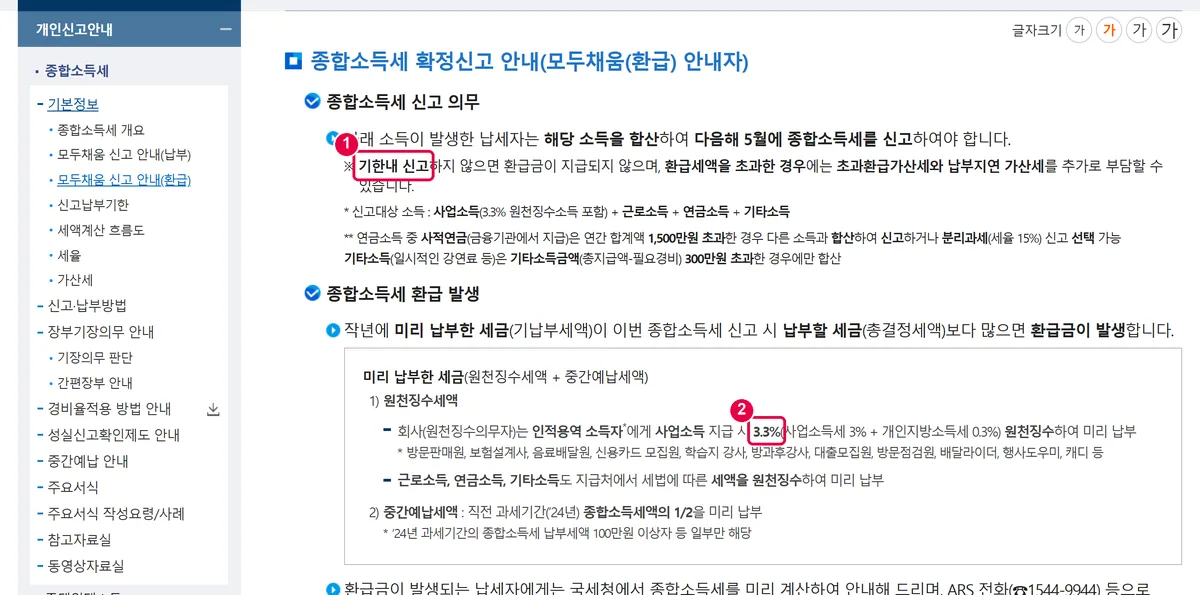
- The guide says that if you do not file 기한내 신고 (within the deadline), no refund is paid.
- It states that 3.3% is withheld from the business income of personal-service income earners.
Income from working in an independent capacity without an employment relationship is business income, and money received for work done under an employment relationship is earned income (National Tax Service). Even if the contract says you are a freelancer, your income may be earned income if you take instructions from a company and work set hours, so you must check with 1345.
Global income tax filing in May
Global income tax adds up 1 year of income, and you file and pay it on Hometax or at a tax office from 1 May to 31 May of the following year (until 30 June for those who must submit a faithful-reporting confirmation (성실신고확인서)). Business income from which 3.3% was withheld is also subject to filing. Freelance income that was not included in the year-end tax settlement must also be filed in May. Business owners must keep their account books and supporting documents for 5 years.
Related articles: How Foreigners File Global Income Tax, How Foreign Workers Do the Year-End Tax Settlement
Consequences of working without permission
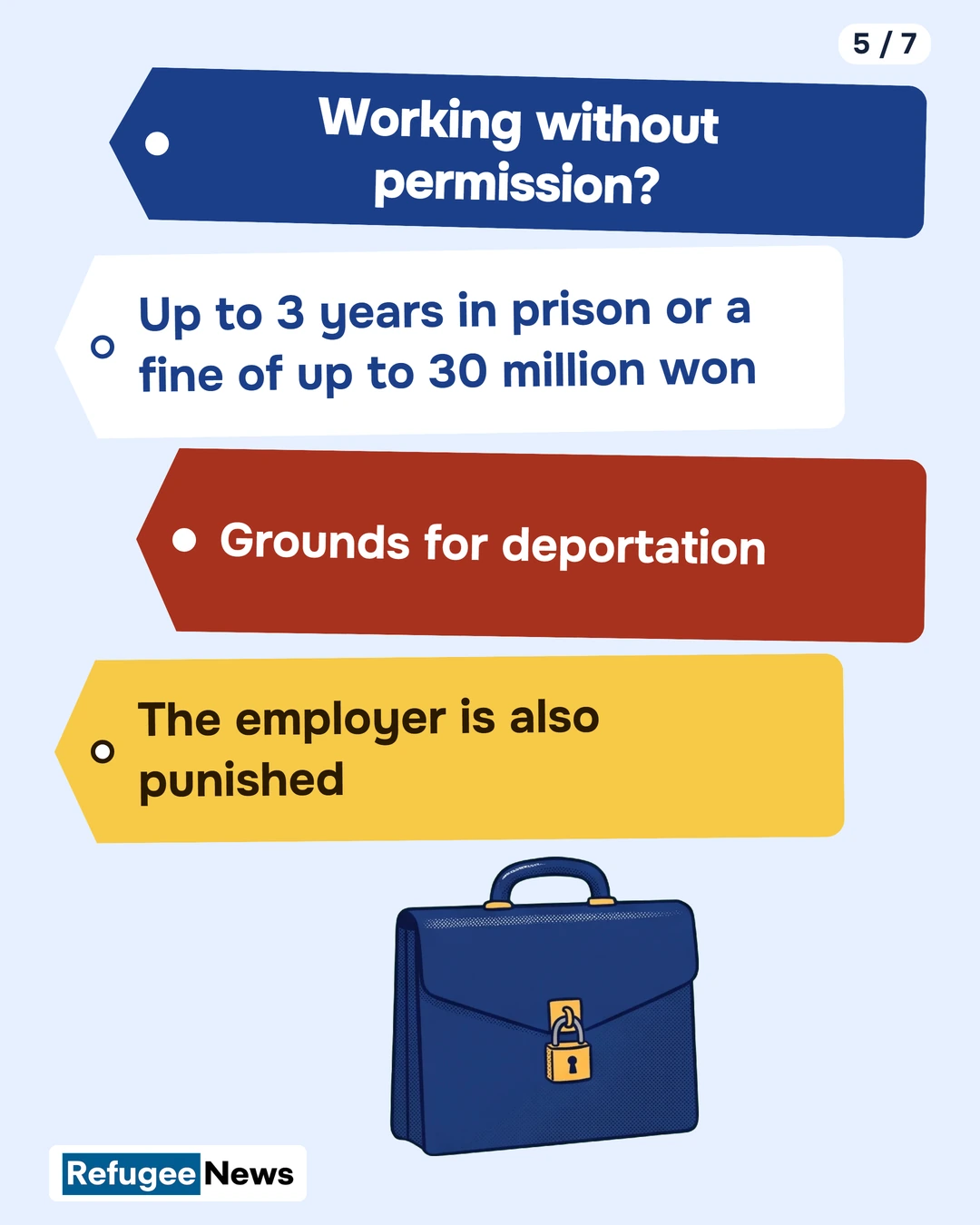
Article 20 of the Immigration Act provides that a foreigner who intends to engage in activities that correspond to a different status of stay must receive permission for activities outside the status of stay from the Minister of Justice “in advance.” If you work before you receive permission, you violate this provision.
- Article 94, item 12: a person who engages in activities without permission in violation of Article 20 is punished by imprisonment for up to 3 years or a fine of up to 30 million won. A person who engages in employment activities in violation of Article 18, paragraph 1 receives the same penalty under item 8.
- Article 46, paragraph 1, item 8: a person who violates Article 18 or Article 20 is subject to deportation.
- Article 102: when it obtains conclusive evidence of an offense, the immigration office may issue a notice requiring payment of a penalty (범칙금) equivalent to a fine.
- An employer who hires a person who works without permission also receives the same penalty under Article 94, item 9 (Article 18, paragraph 3).
Points to confirm with the immigration office
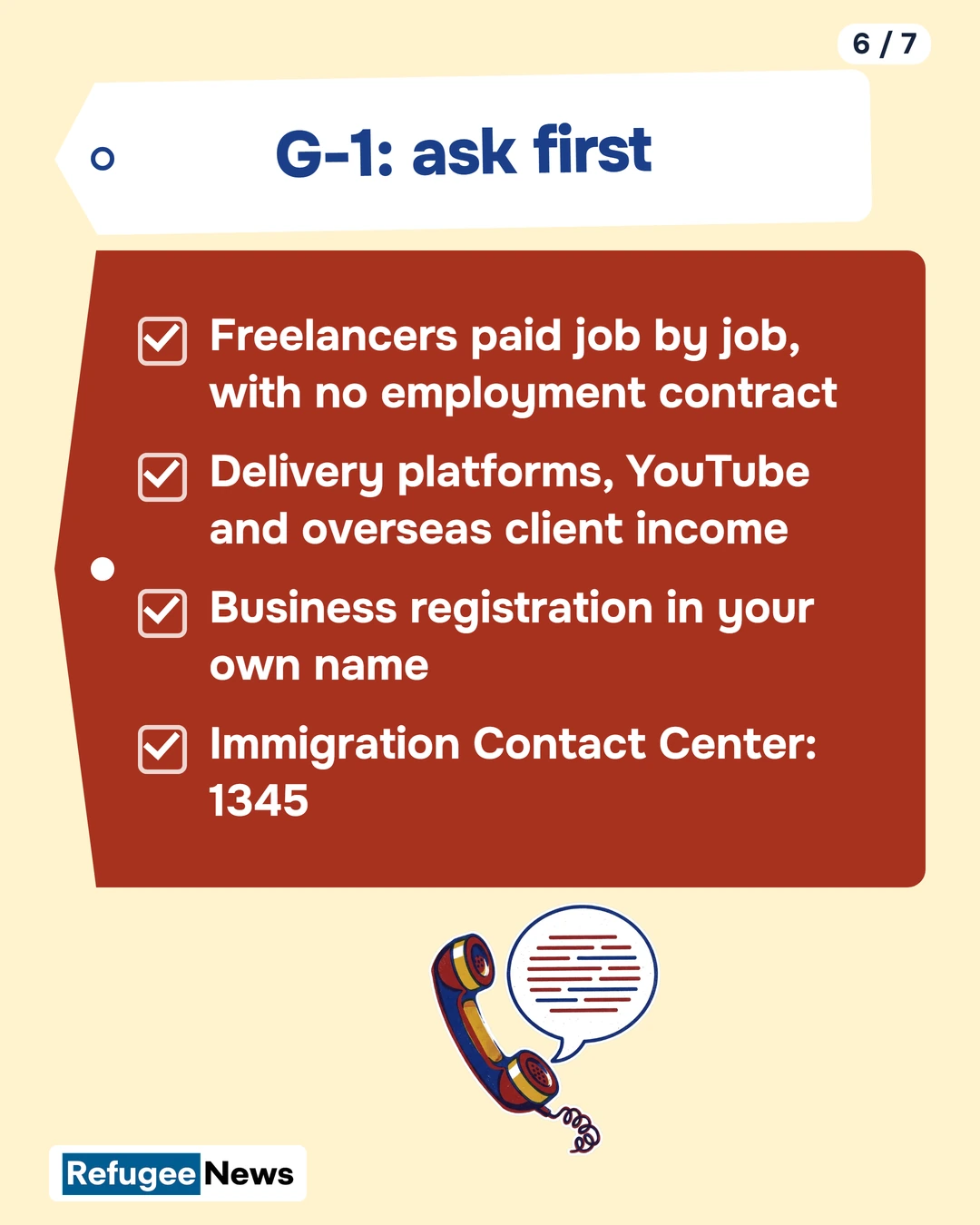
The following are not in the law or the manual, so before you start work you must confirm with the immigration office that has jurisdiction over you, or with 1345, whether you can receive permission.
- Whether asylum seekers (G-1-5) and humanitarian status holders (G-1-6) can work as freelancers who take work job by job without an employment contract
- Whether you can work on a delivery platform with a G-1 status
- Whether YouTube income and income from overseas clients’ commissions count as employment activity
- Whether business registration in your own name falls within the scope of permission