
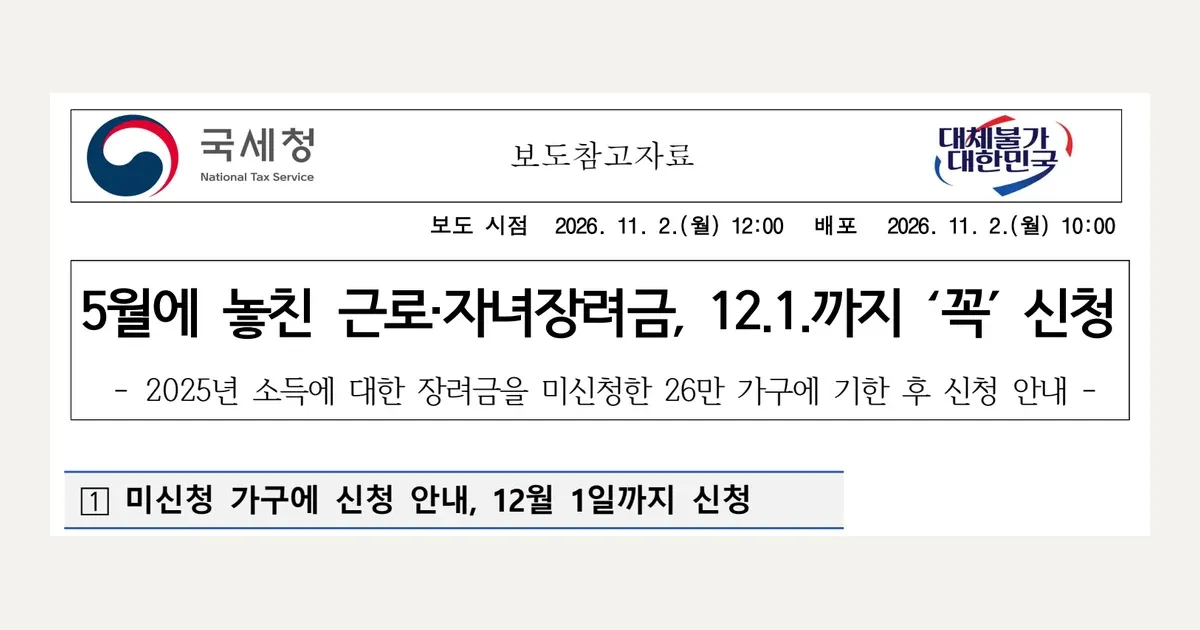
The National Tax Service (NTS) is notifying households that have not yet applied for the Earned Income Tax Credit and the Child Tax Credit on their 2025 income that they can still apply after the deadline. According to the NTS press reference material (November 2, 2026), notices were sent to about 260,000 households.
The application deadline is Tuesday, December 1, 2026. After this date, you can no longer apply.
Whether a foreigner can apply depends on nationality and family relationships. Please check the conditions below before you apply.
Earned Income Tax Credit and Child Tax Credit
The Earned Income Tax Credit is a system in which the National Tax Service pays money to households that work but have low income. The Child Tax Credit is paid to low-income households raising children under 18.
You do not need to apply for the two credits separately. If you apply once, the National Tax Service reviews your application and pays the credit that applies to you. The credits are paid per household, so only 1 person in a household can receive them.
Eligibility for Foreigners and Refugees
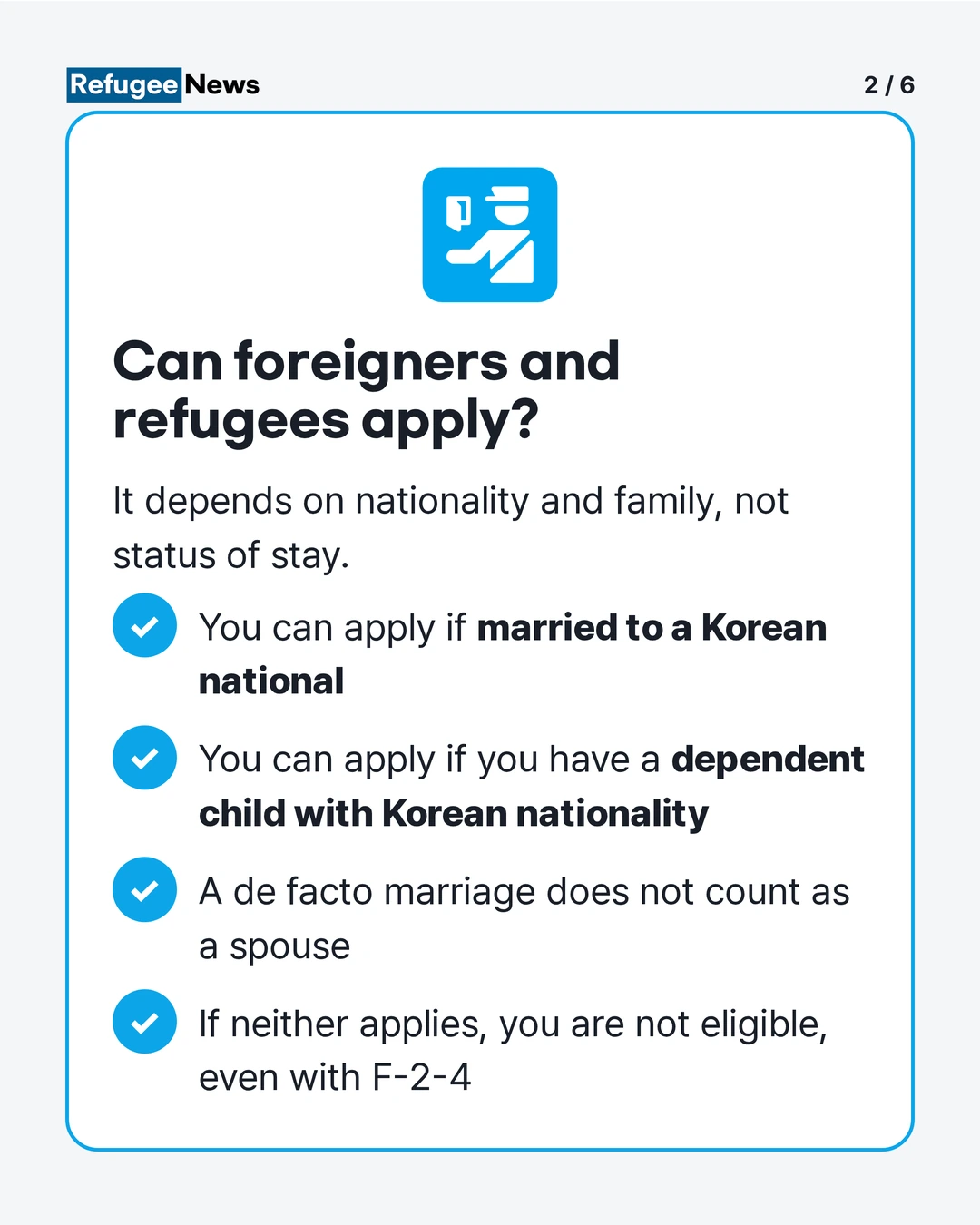
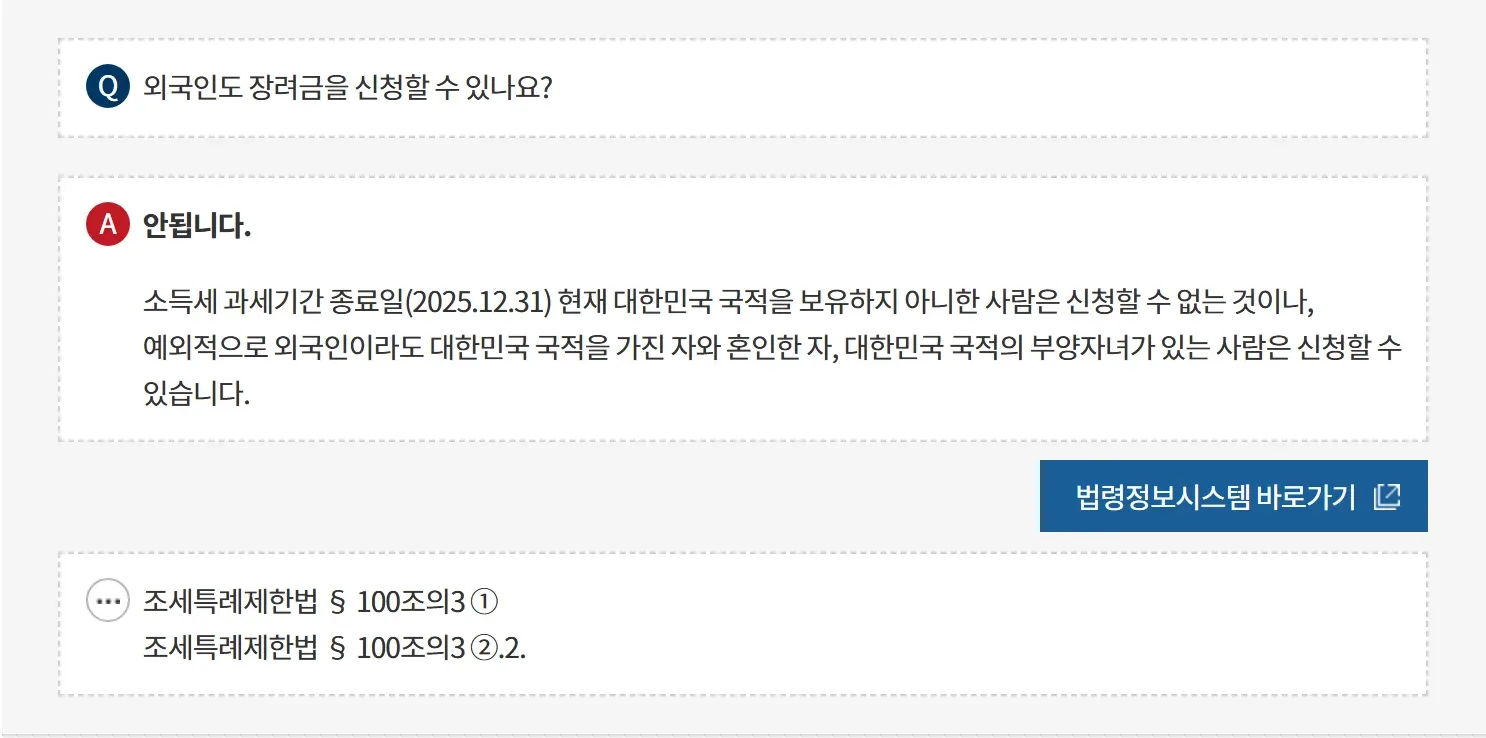
According to Article 100-3 of the Restriction of Special Taxation Act, a person who does not hold Korean nationality as of December 31, 2025 cannot apply for the Earned Income Tax Credit. However, a foreigner who meets one of the following can apply.
- A person married to a person with Korean nationality
- A person with a dependent child who has Korean nationality
The National Tax Service Counseling Center frequently asked questions also explain that, in principle, foreigners cannot apply for the credits, and that only the two cases above are exceptions in which they can apply.
This standard is judged by nationality, regardless of status of stay (residence status). The National Tax Service guidance has no separate exception for Recognized refugees, Humanitarian status holders, or Asylum seekers (refugee applicants). So if you do not meet one of the two conditions above, you are not eligible even if your status of stay is F-2-4.
Please also check the following.
- Spouse: This means a legal spouse. A de facto marriage is not included.
- Child’s nationality: Under Article 2 of the Nationality Act, in principle, a child obtains Korean nationality only if one of the parents was a Korean national at the time of the child’s birth. If both parents are foreigners, the child usually does not have Korean nationality, even if the child was born in Korea.
- If you were naturalized: If you obtained Korean nationality through Naturalization before December 31, 2025, you can apply as a Korean national.
- Residing in Korea: Only residents living in Korea can apply.
If you are not sure whether you are eligible, please ask the Tax Credit Counseling, consultation Center (1566-3636) before you apply. The final decision depends on the National Tax Service review.
Other cases in which you cannot apply
Even if you meet the nationality, income, and asset conditions, you cannot apply in the following cases.
- If you were another person’s dependent child during 2025
- A person who runs a professional business, or that person’s spouse
- A regular employee who continues to work as of December 31, 2025 and whose average monthly wage income is 5,000,000 won or more, or that person’s spouse (Earned Income Tax Credit only)
For detailed eligibility, please contact the National Tax Service.
Income and Asset Conditions
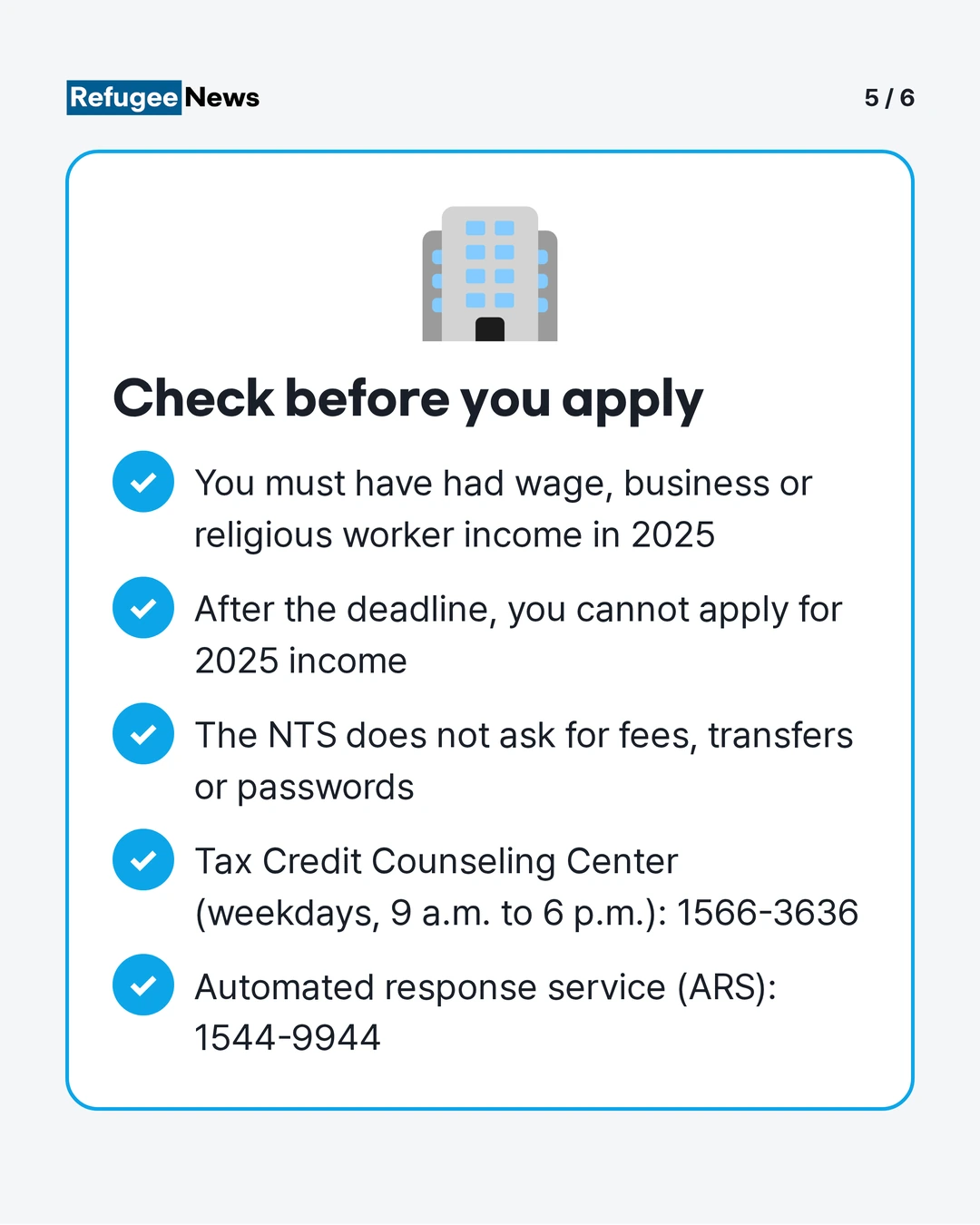
You must have had wage income (including daily wage work), business income, or religious worker income in 2025. If you have none of these, for example if you have only interest income, you are not eligible.
| Category | Household type | 2025 combined spouse income limit |
|---|---|---|
| Earned Income Tax Credit | Single-person household (no spouse, no dependent child under 18, and no direct ascendant aged 70 or older) | Less than 22,000,000 won |
| Earned Income Tax Credit | Single-earner household (a household where the spouse’s total salary, etc. is less than 3,000,000 won, or, even without a spouse, a household with a dependent child or a direct ascendant aged 70 or older who meets certain income and cohabitation requirements) | Less than 32,000,000 won |
| Earned Income Tax Credit | Dual-earner household (a household where the applicant’s and the spouse’s total salary, etc.* are each 3,000,000 won or more) | Less than 44,000,000 won |
| Child Tax Credit | Household with a child under 18 | Less than 70,000,000 won |
*Here, “total salary, etc.” is an amount calculated based on wage income, business income, religious worker income, and so on, as set by the National Tax Service. Additional requirements such as income and cohabitation apply to dependent children and direct ascendants aged 70 or older.
There are also asset conditions.
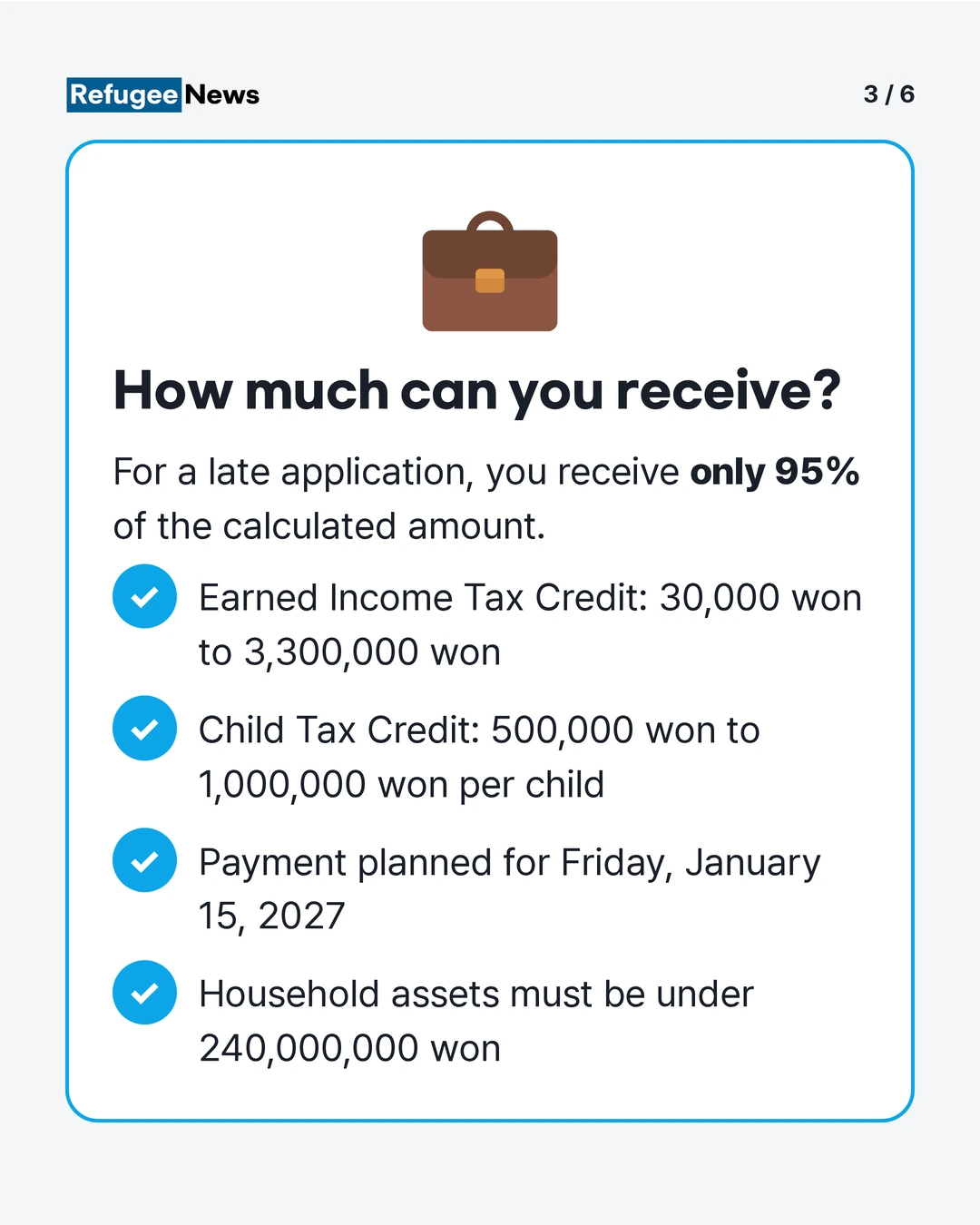
- The combined assets of all household members must be less than 240,000,000 won. The reference date is June 1, 2025.
- Debts are not subtracted from assets.
- If assets are 170,000,000 won or more but less than 240,000,000 won, you receive only 50% of the calculated amount.
- Assets include real estate, passenger cars, apartment purchase rights, Jeonse (lump-sum deposit lease) money (lease Deposit (refundable lease deposit)), bank deposits, stocks, and memberships.
Amount You Can Receive and Payment Timing
- The Earned Income Tax Credit ranges from a minimum of 30,000 won up to 1,650,000 won for a single-person household, 2,850,000 won for a single-earner household, and 3,300,000 won for a dual-earner household.
- The Child Tax Credit is a minimum of 500,000 won up to a maximum of 1,000,000 won per dependent child.
- For a late application, you receive only 95% of the calculated amount. It is reduced by 5%.
- The National Tax Service plans to pay on Friday, January 15, 2027, after review.
The amount you actually receive is decided by the results of the income and asset review. Even if you applied after receiving a notice, you may not receive the credit, or the amount may differ, depending on the review result.
When you apply, you can choose to receive the money in a bank account or in cash. If you choose cash, you receive it at a nearby post office by bringing the tax refund notice that arrives by registered mail and your ID card. If the account you entered is under seizure, you may not be able to withdraw the money.
How to Apply
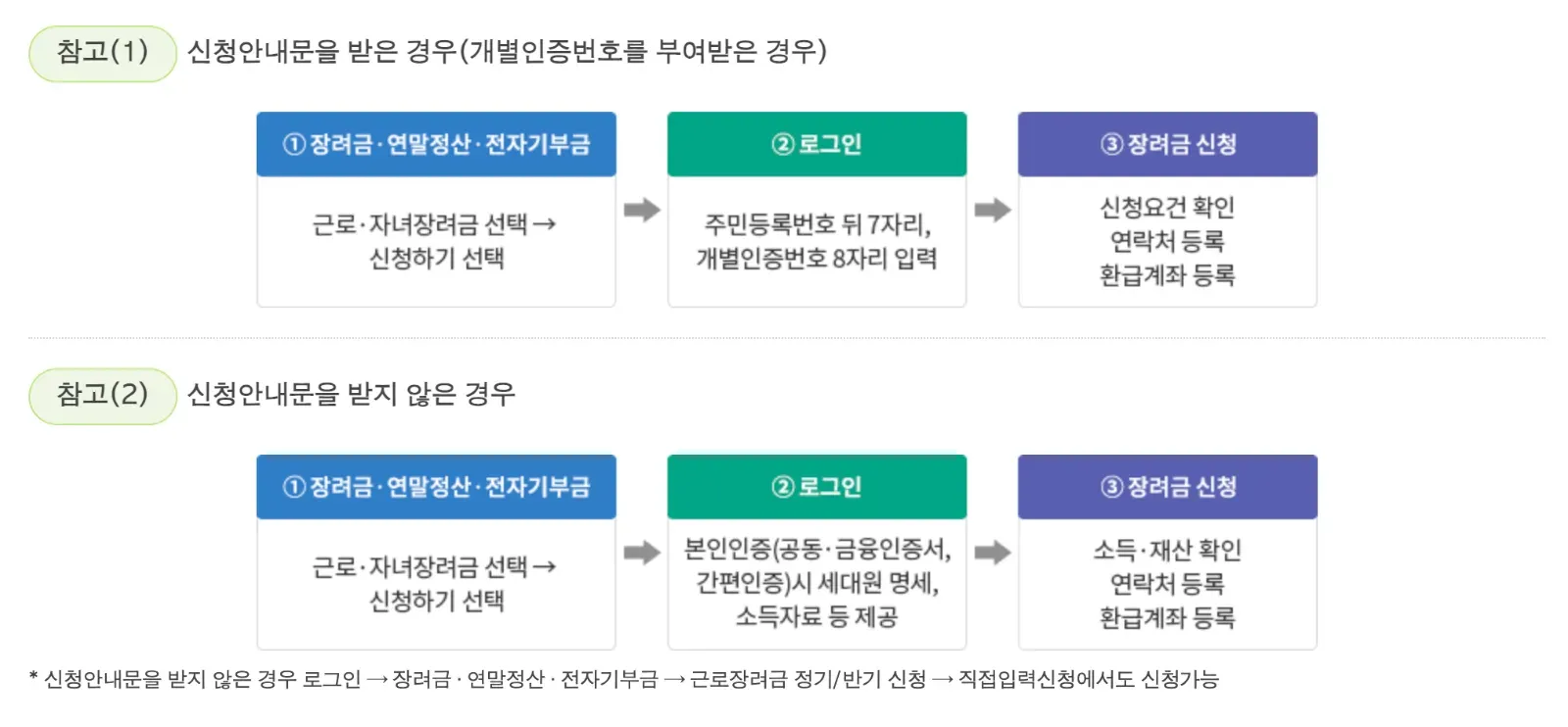
If you received a notice
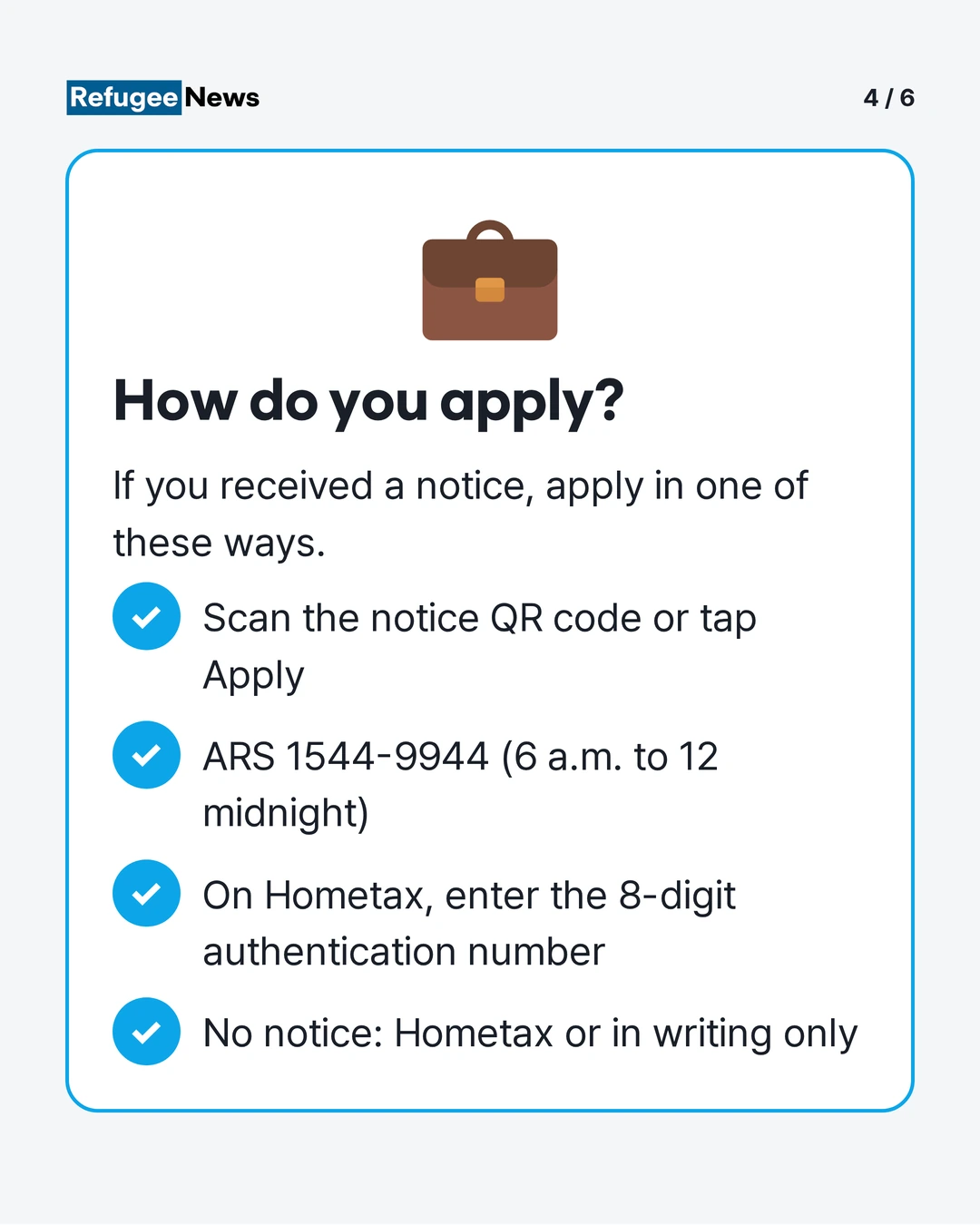
The National Tax Service sent late-application notices to about 260,000 households this time. If you received a notice, you can apply in one of the following ways.
- Scan the QR code on the mailed notice with your mobile phone and apply
- Tap “Apply” (신청하기) in the mobile notice and apply
- Call the automated response phone service (ARS) at 1544-9944 and apply (from 6 a.m. to 12 midnight)
- If it is difficult for you to use a mobile phone or computer, call the Earned Income Tax Credit and Child Tax Credit Counseling, consultation Center (1566-3636) and ask for help with applying (weekdays, 9 a.m. to 6 p.m.)
- Go to Hometax and enter the last 7 digits of your resident registration number and the 8-digit individual authentication number printed on the notice. Then check the eligibility requirements, register your contact information and your refund account, and complete the application.
Mobile notices show the safety mark of the Korea Internet & Security Agency. Please check for this mark first. If you are worried about text message fraud, do not tap the link. You can instead apply through the ARS (1544-9944) by entering the individual authentication number from the notice.
If you did not receive a notice
Even if no notice arrived, you can apply yourself if you believe you meet the conditions. In this case you cannot apply through the ARS. You can apply only through Hometax or in writing.
-
Hometax: Go to Hometax and select “Credits, Year-end Tax Settlement, Electronic Donations (장려금·연말정산·전자기부금) → Earned Income and Child Tax Credit (근로·자녀장려금) → Apply (신청하기)”. When you verify your identity with a Joint Certificate (digital signature), a Financial Certificate or Simple authentication, the details of your household members, income data and similar information are provided. Then check your income and assets, register your contact information and your refund account, and complete the application. If the National Tax Service data shows no income for you, attach supporting documents such as an income confirmation issued by your workplace.
-
In writing: Fill out the Earned Income Tax Credit and Child Tax Credit Application Form (Enforcement Rule of the Restriction of Special Taxation Act, Annex Form No. 64-2, PDF) and submit it to the tax office that has jurisdiction over your address.
If you have difficulty logging in to Hometax or verifying your identity, please ask the Earned Income Tax Credit and Child Tax Credit Counseling, consultation Center or a nearby tax office for help.
In Hometax, you can use the menu “Credits → Check whether you are a notice recipient (장려금 → 안내대상자 여부 조회)” to see whether you are among the people who receive a notice. You can also check through the ARS (1544-9944) and the Counseling, consultation Center (1566-3636).
The application period and methods are also shown on the page National Tax Service: Earned Income and Child Tax Credit Application Period and Method.
Application Deadline and What to Do If You Miss It
According to the National Tax Service application period notice, the late-application period for 2025 income is from June 2, 2026 to December 1, 2026. Article 100-6 of the Restriction of Special Taxation Act provides that you can apply within 6 months from the day after the regular application period ends.
Applications may be crowded, so please apply as early as you can.
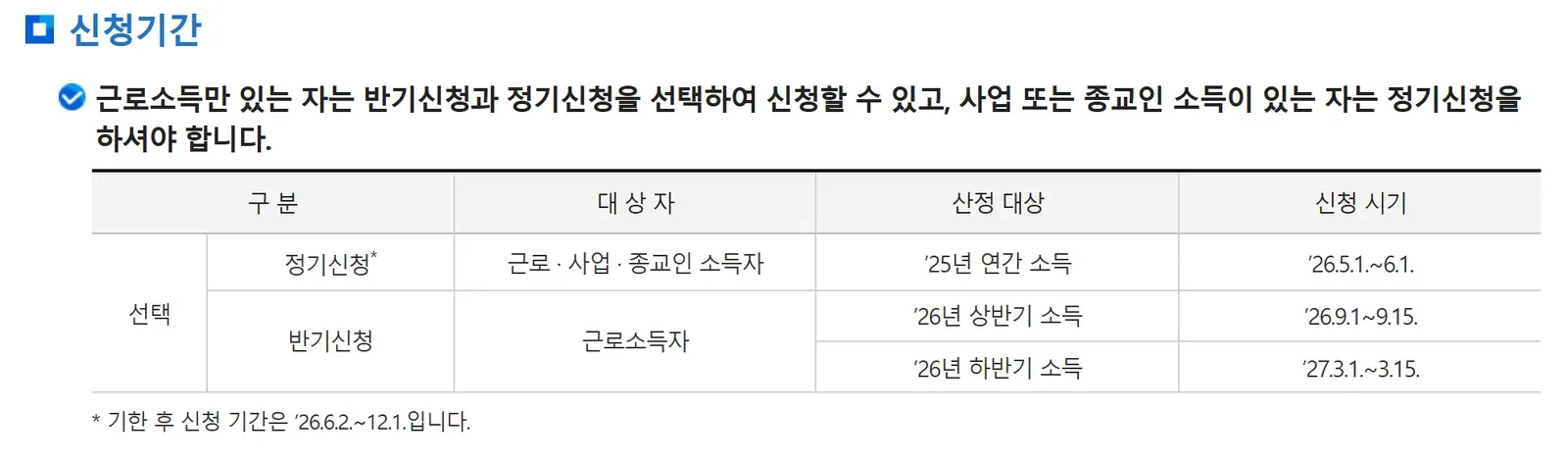
After the deadline, you can no longer apply for the credit for 2025 income. The credit for 2026 income must be applied for separately during the regular application period of the following year. Please check the National Tax Service announcements for the exact schedule.
Points to Note
- The National Tax Service does not ask you to pay a fee, transfer money, or give your account password. A contact that asks for these things in the name of the credit may be a scam.
- If you or your spouse must file a final comprehensive income tax return, you must file it by the date the credit is decided in order to receive the credit.
- If you apply with falsely obtained income documents, you must return the credit, and payment may be restricted for 2 years or 5 years.
Inquiries
- Earned Income Tax Credit and Child Tax Credit Counseling, consultation Center: 1566-3636 (weekdays, 9 a.m. to 6 p.m.)
- Automated response service (ARS): 1544-9944 (24-hour counseling, consultation; applications from 6 a.m. to 12 midnight)
- National Tax Service Counseling, consultation Center: 126 (tax law counseling, consultation; select the credit menu)
- Nearby tax office: written applications and in-person counseling, consultation
- General inquiries about status of stay (residence status) or nationality: Immigration Contact Center 1345
If you are a foreign national and are unsure whether you can apply because of your marital relationship or your child’s nationality, explain your situation to the Earned Income Tax Credit and Child Tax Credit Counseling, consultation Center and get confirmation before you apply.
참고 링크
- National Tax Service: Earned Income and Child Tax Credit application period and method
- National Tax Service press release: Earned Income and Child Tax Credits missed in May, be sure to apply by 1 December (Korea Policy Briefing, 2 November 2026)
- Earned Income Tax Credit of up to 3,300,000 won to be paid… apply by 1 June (Korea Policy Briefing, 30 April 2026)
- National Tax Service: Introduction to the Earned Income Tax Credit
- National Tax Service: Review and payment of Earned Income and Child Tax Credits
- National Tax Service: Main forms for Earned Income and Child Tax Credits
- National Tax Service Counseling, consultation Center: Frequently asked questions on Earned Income and Child Tax Credits
- Restriction of Special Taxation Act, Article 100-3 (Eligibility to apply for the Earned Income Tax Credit)
- Hometax