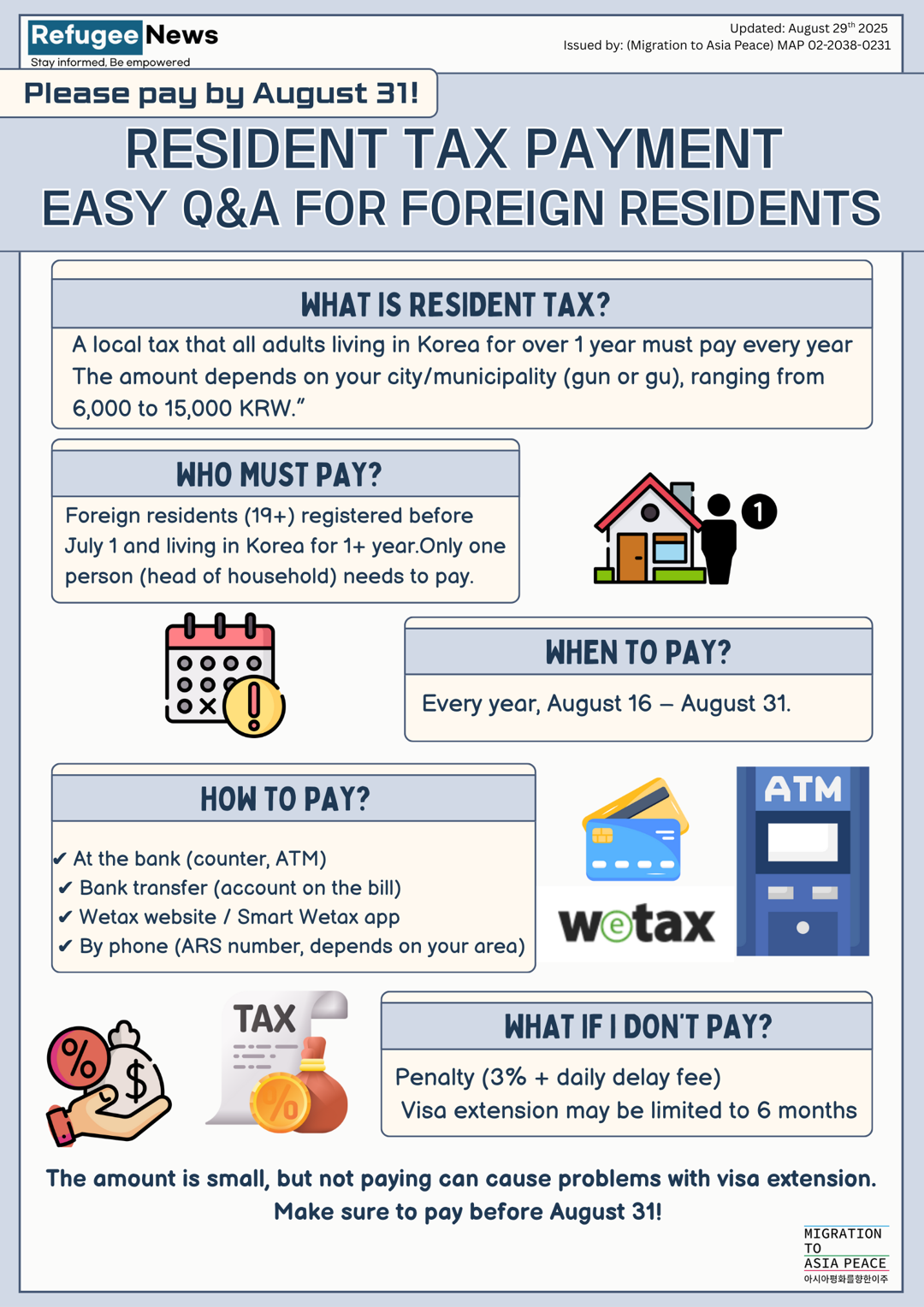
Resident tax (주민세, juminse) is a local tax that foreigners who have lived in Korea for one year or more must pay every year. The amount itself is not large, but failing to pay can create disadvantages when extending your visa status, so please make sure you take care of it. The Q&A below will help you understand everything without difficulty.
Step-by-Step Overview
- 1. Check whether you are required to pay
If you have completed foreigner registration and have lived in Korea for one year or more as of July 1, you are required to pay. Only one person per household -- the head of household -- needs to pay.
- 2. Check the amount due
The amount ranges from approximately 6,000 to 15,000 Korean won depending on your region. Confirm the exact amount for the current year through Wetax, your local community center (주민센터, *juminsenteo*), 1345 (Immigration Contact Center), or the Korea Immigration Service office responsible for your area.
- 3. Receive your tax bill or look it up yourself
A tax bill will be sent to your home address, but if you do not receive it, you can look up your bill directly through the Wetax website (wetax.go.kr) or by visiting your local community center.
- 4. Choose a payment method and pay
You can pay using a bank ATM, bank transfer (virtual account), the Wetax website or app, or by phone using the automated ARS system -- whichever is most convenient for you.
- 5. Complete payment by August 31
The payment period runs from August 16 to August 31 each year. If you miss the deadline, you may be charged a penalty and your visa status extension may be limited to six months or less.
What Is Resident Tax?
Resident tax is a type of local tax collected by local governments (cities, counties, and districts) to fund community welfare and administrative operations. Any adult aged 19 or older living in Korea must pay it, regardless of nationality. It is not a tax imposed only on foreigners — the same conditions and the same amount apply to Korean citizens and foreigners alike.
Who Is Required to Pay?
Anyone who meets both of the following conditions as of July 1 each year is required to pay resident tax.
- You have completed foreigner registration.
- You have lived in Korea for one year or more.
If family members live together at the same address, only one person — the head of household — needs to pay. Other household members do not need to pay separately.
How Much Do You Pay?
The amount of resident tax depends on the region where you live. It is generally in the range of 6,000 to 15,000 Korean won. The table below shows some examples for reference.
| Region | Amount (example) |
|---|---|
| Seoul | approximately 6,000 won |
| Namyangju | approximately 11,000 won |
| Siheung | approximately 12,500 won |
The amount may change each year based on local government regulations. Before paying, please confirm the current amount with the 1345 Immigration Contact Center or the Korea Immigration Service office responsible for your area.
When Is the Deadline?
Payment is due between August 16 and August 31 each year. August 31 is the final deadline, so please make a note of that date.
How Do You Pay?
You can choose whichever of the following four methods is most convenient for you.
1. Bank CD or ATM Machine
You can visit a bank branch or use an ATM machine to pay in person.
2. Bank Transfer (Account Transfer)
You can transfer the payment to the virtual account number printed on your tax bill, or make a deposit directly to that account number without a bankbook.
3. Online Payment (Wetax)
You can pay through the Wetax website or the Smart Wetax mobile app. You will need to register for an account and have a joint certificate (공동인증서, gongdong injeungseo) ready.
4. Phone ARS (Automated Response System)
You can pay by calling the ARS phone number for your region. The number varies by area, so please check your tax bill or the website of your local district office for the correct number.
What Happens If You Do Not Pay?
If you do not pay by August 31, two types of penalties apply.
- Penalty surcharge: An additional charge equal to 3% of the original amount due, multiplied by the number of days payment is overdue, will be added.
- Visa status extension restriction: If you continue to have unpaid taxes, your visa status extension may be limited to six months or less.
Problems with visa renewal can have a significant impact on your life in Korea as a whole. Even though the amount is small, please make sure to pay before the deadline.
What Is Resident Tax Used For?
Resident tax is used for local government administration and community welfare. It is also used for programs that support the settlement, employment, and wellbeing of foreign residents — which means the tax you pay directly benefits you and other foreigners living in Korea.
Key Points to Remember
- Payment period: August 16 to August 31 every year
- Even if you did not receive a tax bill, you can look up and pay through Wetax or at your community center
- Not paying results in a penalty surcharge and a possible restriction on visa status extensions
- For the most up-to-date figures and deadlines, please check with 1345 or the Korea Immigration Service office responsible for your area
If you have any questions or run into difficulties during the payment process, please feel free to contact MAP at any time. We are happy to help you work through it.
- Phone: 02-2038-0231
- Email: map@mapcast.org
Useful Links
- Wetax Official Website (online local tax payment)
- Immigration Contact Center 1345 (phone: 1345)
- MAP (Migration to Asia Peace) Official Website