
If you are a recognized refugee or humanitarian stay holder and have lived in Korea for six months or more, you are automatically enrolled in the National Health Insurance Service (NHIS) as a community (local) subscriber. Not paying your premiums can lead to penalties for both residence extension and hospital access. Because the rules and amounts change often, please check the latest information directly with the National Health Insurance Service (NHIS, 1577-1000), the Immigration Contact Center (1345), or the Korea Immigration Service (KIS) office that covers your area.
What happens if you do not pay your health insurance premiums?
Who is required to join community health insurance?
Recognized refugees and humanitarian stay holders who are not enrolled in workplace health insurance and are not registered as a dependent of a workplace subscriber must join community health insurance. If you have lived in Korea for six months or more, you are enrolled automatically, regardless of whether you apply.
Unpaid premiums can restrict your residence extension
The National Health Insurance Service (NHIS) shares information about unpaid premiums (the amount owed, payment reference numbers, and so on) with the Ministry of Justice (MOJ). Korea Immigration Service (KIS) uses this information when reviewing applications to extend your period of stay (in effect since August 2019). The information below is based on official materials including the Ministry of Health and Welfare (MOHW) and Ministry of Justice (MOJ) guidelines on “Health Insurance Coverage Standards for Long-Term Overseas Koreans and Foreigners.” The specific criteria and amounts are subject to change, so please verify the current details with the sources linked below and with the relevant authorities.
- If unpaid premiums are found, your residence extension may be limited to six months at a time.
- Up to the third instance of arrears, extensions may be granted in these six-month increments, but from the fourth instance onward, a residence extension may be denied.
- When your residence extension is restricted, the following permits are also restricted at the same time: permission to engage in activities outside your status of residence, permission to change or add a workplace, permission to be granted or change your status of residence, and applications for alien registration (or notification of place of residence).
Unpaid premiums can also restrict your access to health insurance benefits (hospital care)
Under rules that apply from April 2025, if you have one month or more of unpaid premiums, your health insurance benefits may be suspended for that period of arrears. This means that when you visit a hospital or pharmacy, you may have to pay the full cost yourself rather than having the NHIS cover its share. Once all unpaid premiums are cleared, the suspension on benefits is lifted. Paying your premiums on time is the most important way to avoid these problems.
You can pay arrears on the spot during your extension appointment
When you apply to extend your period of stay, an immigration officer will check whether you have any unpaid premiums. If arrears are found, you may be asked to pay them right there at the office, and paying at that point may result in the extension being approved. However, whether the extension is approved depends on your individual circumstances and the outcome of the review. Please check directly with your local Korea Immigration Service (KIS) office or call the Immigration Contact Center (1345) before your appointment to understand how this is handled.
Refugees and humanitarian stay holders receive a partial premium reduction
Recognized refugees and humanitarian stay holders may receive a partial reduction on their community health insurance premiums. The reduction rate and eligibility conditions can change, so please contact the National Health Insurance Service (NHIS, 1577-1000) to find out the amount that applies to you.
If you have family members, you may be able to reduce your premiums
Community insurance: registering family members in the same household
If you have a spouse or children under 19 years of age, you can register them as members of the same household. When you do, your family’s premiums are calculated together as one unit rather than each person being charged separately, which can reduce your total cost.
Visit your nearest National Health Insurance Service (NHIS) branch office in person and submit one of the following documents to confirm your family relationship.
- Alien Registration Confirmation Certificate: A certificate issued by the main community office (주민센터/행정복지센터)
or by the Korea Immigration Service (KIS). The certificate must list the names of all family members living with you.
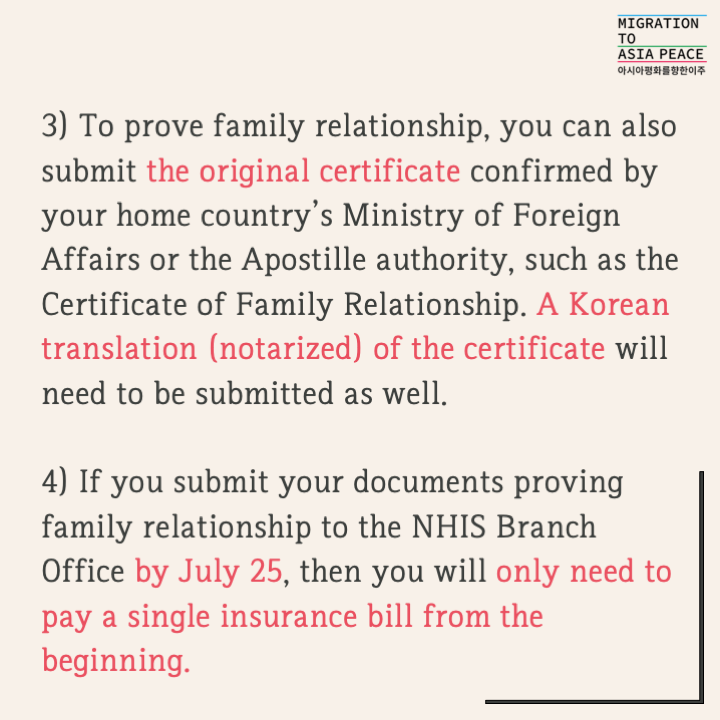
- Family relationship document issued by your home country: Submit the original document issued by your home country’s Ministry of Foreign Affairs or an Apostille-certifying authority, along with a notarized Korean translation.
Until you submit these documents, each family member is billed individually. Once you submit them, all members are consolidated into a single household premium from that point forward. If you have already paid individual premiums, you may receive a refund. Any individual premiums that have not yet been paid will be cancelled and re-issued as a single household bill. Check with the NHIS in advance about how long the documents remain valid from their date of issue.
Workplace insurance: registering as a dependent
If a family member is enrolled in workplace health insurance, you may be able to register as that person’s dependent, which lets you receive health insurance benefits without paying a separate premium.
From April 2024, foreigners registering as dependents are generally required to have lived in Korea for at least six months. However, children under 19 and spouses may register immediately regardless of how long they have been in Korea. In addition, if the head of your household is a recognized refugee (F-2-4) or a family member of a recognized refugee (F-1-16), the same criteria that apply to Korean nationals are used.
Permit fees and employment
When asylum seekers, humanitarian stay holders, or recognized refugees apply to extend their period of stay or apply for activity permits, they pay the same fees as other foreign nationals. Amounts can change, so please confirm current fees with 1345 or your local Korea Immigration Service (KIS) office before applying.
To work, you need a separate permit appropriate to your residence status, and there may be restrictions on which types of work you can do. For more detail, see What work you can do and employment permits by visa type and Your rights at work and how to respond to unfair treatment.
Reference links
- National Health Insurance Service (NHIS) official website — premium inquiry and payment, branch office locator (customer center 1577-1000)
- Immigration Contact Center 1345 — multilingual consultations available in Korean, English, Chinese, and other languages
- HiKorea immigration portal — apply for residence extension, check fees
- National Legal Information Center — Health Insurance Coverage Standards for Long-Term Overseas Koreans and Foreigners — full text of the current official notice