COVID-19 vaccination is a preventive injection given to protect yourself and the people around you from COVID-19 (coronavirus disease 2019). Below you will find everything you need to know before and after getting vaccinated. Numbers, schedules, and eligibility criteria may change over time, so please check the latest information with 1345 (Immigration Contact Center) or your local Korea Immigration Service office before applying.
For information on how to make a reservation based on your immigration status, please also refer to How Refugees and Migrants Can Reserve a COVID-19 Vaccine (by Alien Registration Number and Health Insurance Type). For same-day walk-in reservations for leftover vaccines, see How Foreigners and Refugees Can Book a Same-Day Leftover COVID-19 Vaccine.
Step-by-Step Overview
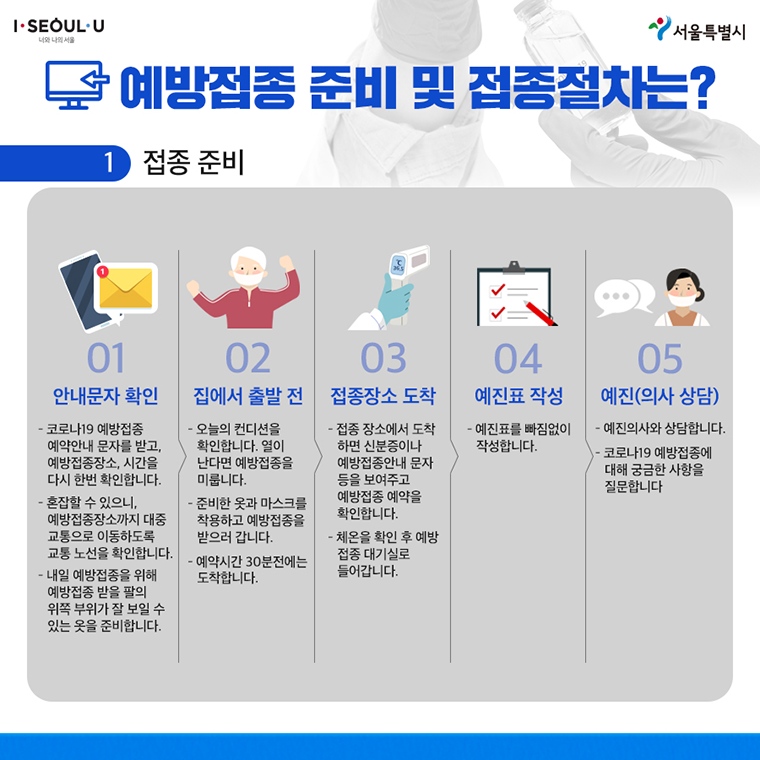
- 1. Check eligibility and schedule
Visit the Korea Immunization Web (nip.kdca.go.kr) or your local community health center to find out which vaccines are currently available and whether you are eligible.
- 2. Book a vaccination clinic
Search for a nearby contracted medical institution on the Korea Immunization Web and make a reservation.
- 3. Complete a pre-screening form and consult the doctor
On the day of vaccination, fill in the pre-screening form (a health-status questionnaire) and have the doctor check that you are fit to be vaccinated.
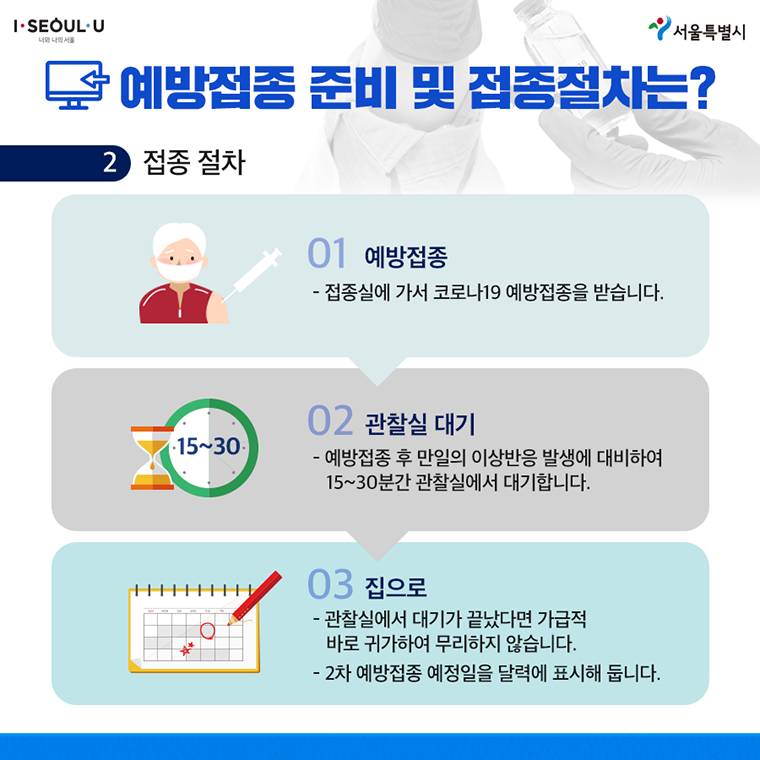
- 4. Receive the vaccination
If there are no contraindications or reasons to postpone, you will receive the vaccine.
- 5. Wait 15 to 30 minutes at the clinic
Stay at the clinic and be observed for any adverse reactions. If you have a history of allergies, wait for 30 minutes.
- 6. Monitor your health for 3 days after returning home
If you develop a high fever or any unusual symptoms, see a doctor right away.
- 7. Report adverse reactions and apply for compensation if needed
You can report adverse reactions at your local community health center or through the Korea Immunization Web. If necessary, apply for national compensation for vaccine injury.
Which Vaccine Will I Receive?
As of 2026, COVID-19 vaccination in Korea is managed by updating the vaccine each season to match the circulating variant. For the 2025-2026 season, mRNA vaccines based on the LP.8.1 strain — recommended by the WHO (World Health Organization), EMA (European Medicines Agency), and FDA (U.S. Food and Drug Administration) — are being supplied. A total of 5.3 million doses have been procured through contracts, including 3.28 million doses from Pfizer and 2.02 million doses from Moderna. For exact information on which vaccines are currently available, please check the Korea Disease Control and Prevention Agency (KDCA) Korea Immunization Web or your nearest community health center.
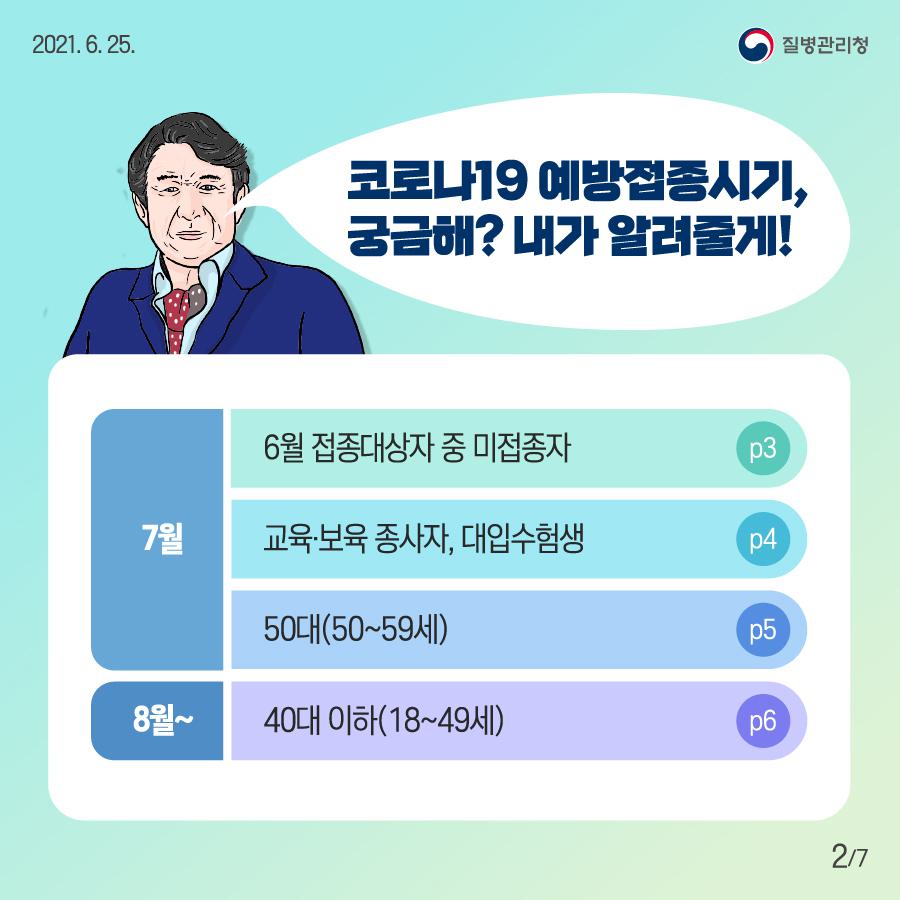
Who Receives Free Vaccination in the 2025-2026 Season?
If you belong to a high-risk group for COVID-19, the government provides vaccination at no cost.
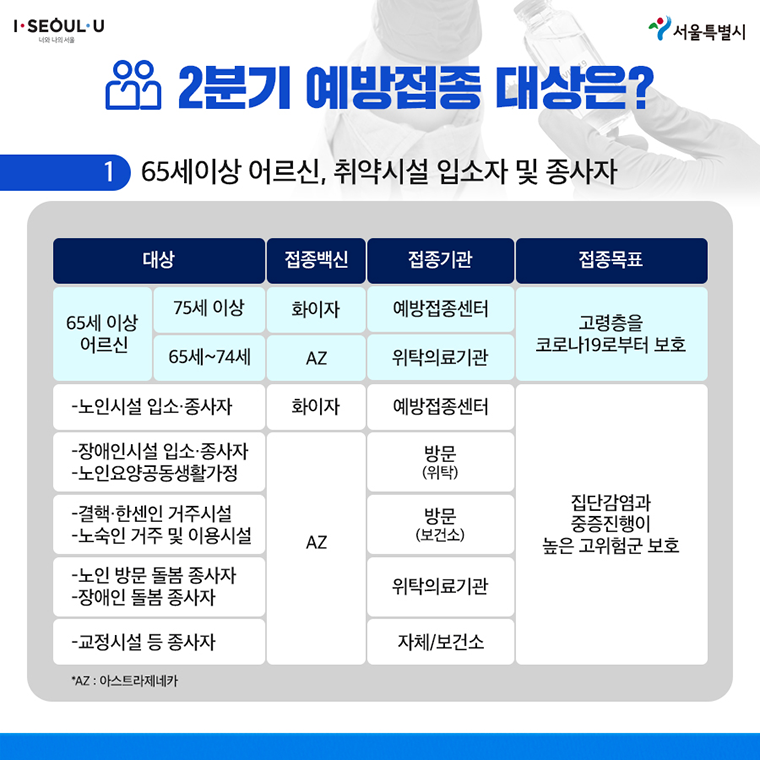
- People aged 65 and older (simultaneous vaccination with the influenza vaccine is recommended)
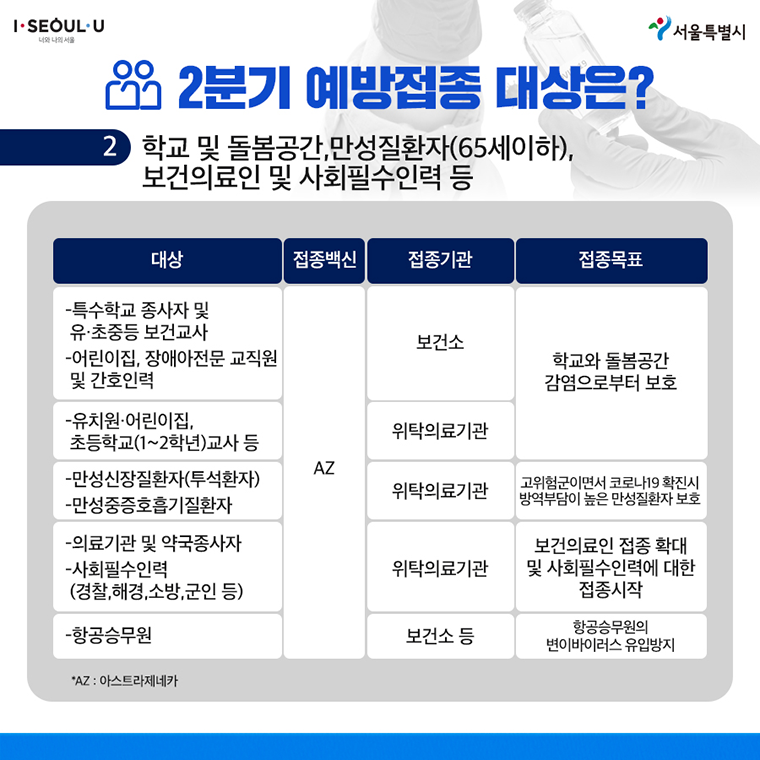
- People aged 6 months and older with immunocompromising conditions
- Residents and patients in infection-vulnerable facilities such as nursing hospitals and closed psychiatric wards
People outside the high-risk groups may still get vaccinated at local medical institutions, but they will need to pay for it themselves.
Numbers and deadlines may change over time, so please check the latest information with 1345 or your local community health center before getting vaccinated.
Precautions Before Vaccination
Check Your Health Status
- It is most important to get vaccinated when you are in good health.
- You must always have a pre-screening consultation with a doctor before vaccination.
When You Should Not Be Vaccinated (Contraindications)
Do not get vaccinated if any of the following apply to you:
- You have previously had a severe allergic reaction such as anaphylaxis to any ingredient in a COVID-19 vaccine.
- You experienced a severe allergic reaction after your first dose of a COVID-19 vaccine.
People who are allergic to polyethylene glycol (PEG) or polysorbate, which are ingredients found in some vaccines, may also be contraindicated. These substances are also found in some medications, bowel-cleansing preparations, cough syrups, cosmetics, toothpastes, and contact lens solutions. When filling in the pre-screening form, please note any history of allergies to medicines, foods, cosmetics, or similar products in as much detail as possible.
When Vaccination Should Be Postponed (Temporary Deferral)
- If COVID-19 infection is suspected: visit a screening clinic first and postpone vaccination until you have your test results.
- If you are in quarantine as a confirmed COVID-19 case or a close contact: get vaccinated after your quarantine period ends.
- If you have a fever (37.5 degrees Celsius or above) or an acute illness: wait until symptoms have resolved before getting vaccinated.
Pregnant People and Children and Adolescents
Vaccination recommendations for pregnant people, children, and adolescents may change. Please consult your local community health center or attending doctor before deciding whether to get vaccinated.
Precautions After Vaccination
- Stay at the vaccination clinic for 15 to 30 minutes and be observed for any adverse reactions. If you have previously had a severe allergic reaction to anything, wait 30 minutes.
- After returning home, continue to monitor yourself carefully for at least 3 hours.
- For at least 3 days after vaccination, watch for high fever or any unusual symptoms, and see a doctor immediately if you notice anything wrong.
- Keep the injection site clean.
- Older adults should not be alone after vaccination; please stay with a family member or another person who can help if needed.
Can I Get COVID-19 From the Vaccine?
Please do not worry. COVID-19 vaccines do not use live virus, so you cannot become infected with COVID-19 from the vaccination itself. After vaccination, you will not develop symptoms such as cough, loss of smell, or loss of taste.
If such symptoms do appear after vaccination, it is possible that you were already infected with COVID-19 before the vaccination, or that you were infected before your body had time to build immunity. In that case, visit a screening clinic right away for a test.
Possible Side Effects After Vaccination
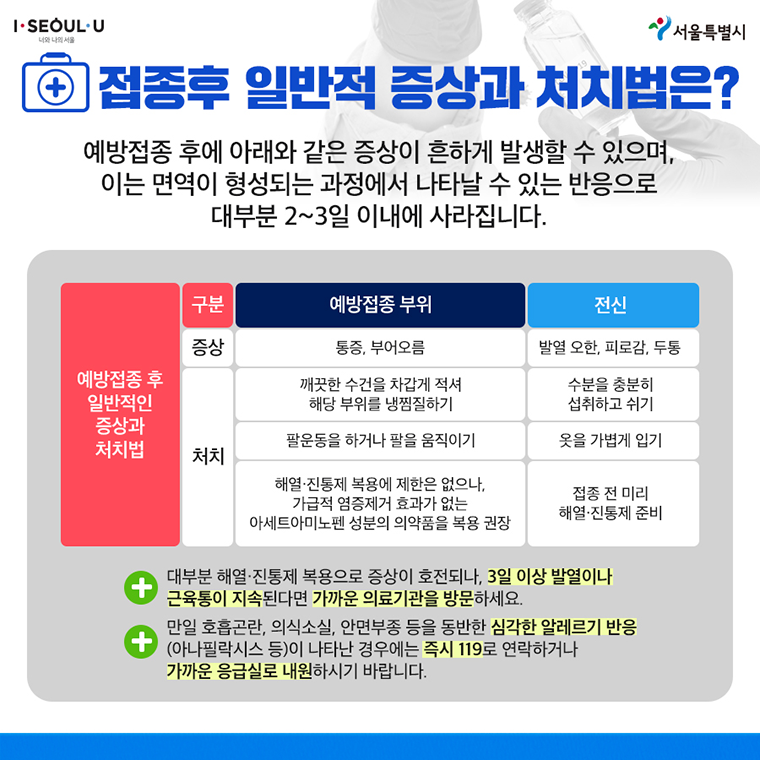
Common Reactions (Most Resolve Within 3 Days)
| Location | Symptoms |
|---|---|
| Injection site (local) | Pain, swelling, redness |
| Whole body (systemic) | Fever, fatigue, headache, muscle pain, nausea, vomiting |
Rare but Serious Reactions
In very rare cases, anaphylaxis (shock, difficulty breathing, loss of consciousness, swelling of the lips or mouth, etc.) may occur. This is precisely why you are required to wait at the clinic after vaccination.
You can find a full list of possible adverse reactions and how to manage them on the Korea Immunization Web under “Checking Your Health After Vaccination.”
What Should I Do If I Have an Adverse Reaction?
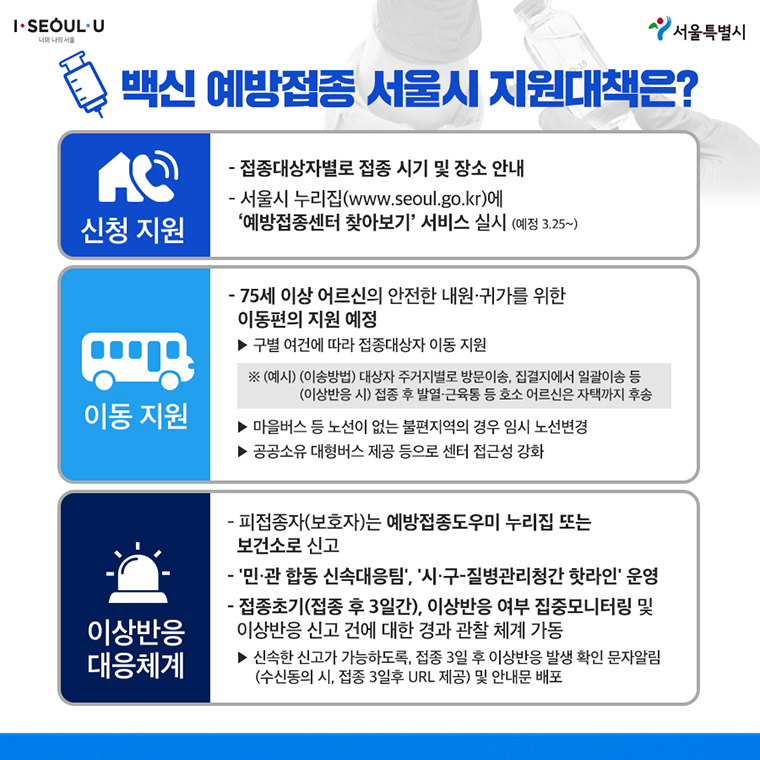
- If you experience a severe allergic reaction (such as anaphylaxis), call 119 (emergency services) immediately or go to the nearest emergency room.
- If you suspect you are having an adverse reaction, you can report it at your local community health center or through the Korea Immunization Web.
National Compensation for Vaccine Injury
If you believe you have suffered a health problem as a result of vaccination, please know that there is a government program through which you may receive compensation.
- Legal basis: The program operates under the Infectious Disease Control and Prevention Act and the Special Act on Compensation for COVID-19 Vaccination Injury.
- Application deadline: You may apply within 5 years of the date on which the adverse reaction occurred (or the date of disability diagnosis or death).
- How to apply: Gather the required documents and apply at the community health center responsible for your registered address.
- Compensation decision: Causation is assessed through an injury investigation and review by a specialist committee. If a causal link is recognized, compensation is provided and may include medical expenses, nursing care costs (for cases requiring inpatient treatment), and lump-sum payments for disability or death.
For more details, please contact your local community health center or visit the Korea Immunization Web. Numbers and deadlines may change over time, so please check the latest information with 1345 or your local community health center before applying.
Guidance for Special Situations
Can I Receive Another Vaccine at the Same Time?
From the 2024-2025 season onward, it is recommended to receive the influenza (flu) vaccine and the COVID-19 vaccine on the same day. In particular, adults aged 65 and older are encouraged to get both vaccines at the same time. For other vaccines, please ask the doctor whether simultaneous administration is appropriate before your visit. Check the latest guidelines with 1345 or your local community health center.
What If I Have Already Had COVID-19?
Even if you have previously been infected with COVID-19, vaccination is still recommended as long as there are no contraindications. Please consult your doctor about the best timing for vaccination after infection. If you have received plasma therapy or monoclonal antibody treatment, you may be advised to postpone vaccination for a set period after completing treatment, so be sure to consult your doctor.
What If I Have a Blood Clotting Disorder or Take Blood Thinners?
You can still be vaccinated, but a fine-gauge needle should be used and the injection site should not be rubbed — firm pressure should be applied for at least 2 minutes. Please let the doctor know about your condition before receiving the injection.
What If I Am Immunocompromised or Living With HIV?
People with weakened immune systems may have a somewhat lower immune response to the vaccine. However, because COVID-19 vaccines do not contain live virus, vaccination is still recommended as long as there are no contraindications. People aged 6 months and older with immunocompromising conditions are classified as a high-risk group and are eligible for free vaccination. Please consult your doctor before getting vaccinated.
What If I Am Breastfeeding?
Data on safety for breastfeeding people are still limited, but vaccination is recommended as long as there are no contraindications. Please consult your doctor.
Useful Links
- Korea Immunization Web (KDCA): Find vaccination clinics, report adverse reactions, check your health status, and view vaccine information.
- KDCA Official Website: Latest COVID-19 vaccination guidance and press releases.
- Government24 COVID-19 Vaccination Information: Regional vaccination announcements.
- National Law Information Center — Special Act on COVID-19 Vaccination Injury Compensation: Read the relevant laws on compensation.