
To drive in Korea, you need a Korean driver’s license. Licenses are divided into categories based on the type and size of vehicle you want to drive, and there is a set process to follow to get one. If you already have a license issued in another country, you may be able to exchange it for a Korean license, depending on certain conditions. Fees and detailed requirements can change, so please always check the latest information with the Immigration Contact Center (1345), your local driver’s license test center, or the Road Traffic Authority’s Safe Driving Integrated Civil Services website (safedriving.or.kr) before you apply.
Types of Driver’s License
Korean driver’s licenses are broadly divided into Class 1 and Class 2. Class 1 covers a wider and larger range of vehicles, but if you only plan to drive a regular passenger car, a Class 2 Ordinary License is what most people need.
Vehicles You Can Drive by License Type
| License Type | Vehicles Permitted |
|---|---|
| Class 1 Large | Passenger cars, vans/buses, trucks, construction machinery (dump trucks, concrete mixers, etc.), special-purpose vehicles (excluding large/small towing vehicles and wreckers), motor-assisted bicycles |
| Class 1 Ordinary | Passenger cars, vans/buses (up to 15 people), trucks (under 12 tonnes load capacity), construction machinery (forklifts under 3 tonnes), special-purpose vehicles (total weight under 10 tonnes, excluding wreckers), motor-assisted bicycles |
| Class 1 Special | Large towing vehicles, small towing vehicles (3.5 tonnes or under), wreckers |
| Class 1 Small | Three-wheeled trucks, three-wheeled passenger vehicles, motor-assisted bicycles |
| Class 2 Ordinary | Passenger cars, vans/buses (up to 10 people), trucks (up to 4 tonnes load capacity), special-purpose vehicles (total weight up to 3.5 tonnes, excluding wreckers), motor-assisted bicycles |
| Class 2 Small | Motorcycles, motor-assisted bicycles |
| Class 2 Motor-Assisted Bicycle | Motor-assisted bicycles only |
If you ride a motorcycle for delivery work, check the engine displacement first. A motorcycle with an engine displacement of 125cc or less (for an electric motorcycle, a maximum rated output of 11kW or less) counts as a ‘motor-assisted bicycle’. So, as in the table above, you can also ride it with a Class 2 Motor-Assisted Bicycle License or a Class 1 or Class 2 Ordinary License. To ride a motorcycle with an engine displacement over 125cc, you need a Class 2 Small License (Road Traffic Act, Article 2, Item 19, Article 80, Enforcement Rule of the Road Traffic Act, Attached Table 18).
Person who are Eligibility
Age Requirements
- 16 years of age or older: Class 2 Motor-Assisted Bicycle License
- 18 years of age or older: Class 1 Ordinary, Class 1 Small, Class 2 Ordinary, Class 2 Small License
- 19 years of age or older, plus at least 1 year of driving experience in vehicles other than motorcycles: Class 1 Large License, Class 1 Special License
ID Requirements
You will need to present a valid ID at every stage of the licensing process. The Road Traffic Authority accepts the following forms of ID:
- Resident registration card (주민등록증)
- Student ID card (with an enrollment certificate attached)
- Passport
- Residence Card (Alien Registration Card)
- Domestic Residence Report Card for overseas Koreans (외국국적 동포 국내거소신고증)
Your ID must clearly show your photo, date of birth, and name.
How to Get a Korean Driver’s License
There are two main ways to go about this.
- Study on your own and sit the tests at a test center: This costs less, but you need to arrange your own vehicle for practice. To practice on public roads, you must first obtain a learner’s permit, and someone who has held a full license for at least two years must sit in the passenger seat.
- Enroll in a driving school (운전면허학원): An instructor will teach you and you can take the skills test and road driving test using the school’s vehicles. This costs more, but the learning is more structured.
Step-by-Step Overview
- 1. Traffic Safety Education
Complete a one-hour audio-visual safety course at a test center or driving school. Please check the place and schedule of the course with the test center where you will take the test.
- 2. Physical Examination
A simple check of your eyesight, hearing, and general fitness at the test center's examination room or at a designated hospital.
- 3. Written Theory Test
A computer-based test (CBT) of 40 questions. You can choose to sit it in Korean, English, Chinese, or Vietnamese.
- 4. Skills Test (on the test center course)
Basic vehicle handling is assessed on the test center's practice track. If you do not pass, you may retake it after 3 days.
- 5. Learner's Permit Issued
Applies only to Class 1 Ordinary and Class 2 Ordinary license applicants. You must receive this before taking the road driving test.
- 6. Road Driving Test
You drive on actual public roads on a randomly assigned route. If you do not pass, you may retake it after 3 days. You must pass within the learner's permit validity period (1 year).
- 7. Driver's License Issued
Once you pass the road driving test, you get your license at the driver's license test center. It is issued by the chief of the relevant police station or by the Road Traffic Authority.
Step 1: Traffic Safety Education
- Cost: Free
- What to bring: Your ID
You complete a one-hour traffic safety course. You must finish this before you can sit the written theory test.
- Online registration: Available at the Road Traffic Authority’s Safe Driving Integrated Civil Services website, but a Korean resident registration number is required for online booking.
- On-site registration: Bring your ID to the driver’s license test center and register before the session begins. Course schedules vary by location, so check in advance by visiting or calling the test center.
- If you are enrolled in a driving school, first check with the school whether you can take this course there.
Step 2: Physical Examination
- Cost: 8,000 KRW for Class 1 Large and Special licenses / 7,000 KRW for all other licenses (this is the price at the examination room inside the test center; if you go to a hospital, the price differs by hospital)
- What to bring: Your ID, application form, examination fee
This is a basic check to confirm you are physically fit to drive. It is available at the examination room inside most test centers. However, the test centers in Gangneung, Taebaek, Mungyeong, Gwangyang, Chungju, and Chuncheon do not have on-site examination rooms, so you will need to visit a nearby designated hospital separately. Before you go, check with 1345 or the relevant test center whether a physical examination is available on-site.
Step 3: Written Theory Test
- Cost: 10,000 KRW for Class 1 and Class 2 licenses / 8,000 KRW for Motor-Assisted Bicycle license
- What to bring: Your ID, application form, test fee, 3 color passport-size photos (3.5 cm x 4.5 cm, taken within the last 6 months)
This is a computer-based test (CBT) taken at a driver’s license test center. 40 questions are drawn from the published written test question bank, covering Korean traffic rules, road signs, and safety. You can book in advance at the Road Traffic Authority’s Safe Driving Integrated Civil Services website, or walk in and register on the day.
You can sit the test in Korean, English, Chinese, or Vietnamese. A revised question bank came into effect in March 2026, so please check the current question formats before your test.
Step 4: Skills Test
- Cost: 25,000 KRW for Class 1 and Class 2 Ordinary, Large, and Special licenses / 14,000 KRW for Class 2 Small license / 10,000 KRW for Motor-Assisted Bicycle license
- What to bring: Your ID, application form, test fee
This test checks your basic ability to handle a vehicle and takes place on the test center’s enclosed track. Scoring criteria were partially updated in 2026, so before you take the test, check the current course layout and scoring standards in the notice board at the relevant test center. You must sit this test within 1 year of passing the written theory test. If you do not pass, you may retake it after 3 days.
Further guidance on the skills test is available at the Road Traffic Authority’s Safe Driving Integrated Civil Services website.
Step 5: Learner’s Permit (Class 1 Ordinary and Class 2 Ordinary only)
- Cost: 4,000 KRW
- What to bring: Your ID, application form, issuance fee
Once you have passed both the written theory test and the skills test, you need to obtain a learner’s permit before you can take the road driving test. The learner’s permit is valid for 1 year, and you must pass the road driving test within that period.
Step 6: Road Driving Test
- Cost: 30,000 KRW
- What to bring: Your ID, application form, test fee, learner’s permit
This test involves driving on actual public roads. One route from several options near the test center is assigned to you at random. If you do not pass, you may retake it after 3 days, and you must pass before your learner’s permit expires (within 1 year).
For information on traffic law penalties that apply to foreign drivers in Korea, you can also refer to Korean Laws and Penalties Foreign Nationals and Refugees Should Know.
Guidance videos on the road driving test are available at the Road Traffic Authority’s Safe Driving Integrated Civil Services website.
Step 7: Driver’s License Issued
- Cost: 10,000 KRW
- What to bring: Your ID, application form marked as passed, issuance fee, 1 color passport-size photo (3.5 cm x 4.5 cm, taken within the last 6 months)
Once you pass the road driving test, you get your driver’s license at the driver’s license test center. You must get it within 30 days of the date you pass, and you must not drive before your license has been issued. It can be collected from the chief of the relevant police station or from the Road Traffic Authority.
For detailed guidance, visit the Road Traffic Authority’s Safe Driving Integrated Civil Services website:
Driver’s License Test Center Locations
There is at least one test center in every province and in most special and metropolitan cities across Korea. You can find the location of the nearest test center on the Road Traffic Authority’s Safe Driving Integrated Civil Services website. Fees and schedules can vary by location, so please contact 1345 or the relevant test center directly before you apply.
Exchanging a Foreign Driver’s License for a Korean License
If you are staying in Korea for more than 90 days, have completed alien registration, and hold a driver’s license issued by a foreign government, you may be able to exchange it for a Korean Class 2 Ordinary License (Road Traffic Act, Article 84; Enforcement Decree, Article 52 and Attached Table 3).
Required Documents
- Original foreign driver’s license
- Original passport (for foreign nationals and overseas Koreans, entry and exit records from departure to entry into Korea must be verifiable; for Korean citizens and permanent residents, a stay of more than 90 days in the country that issued the license must be confirmed)
- Original Residence Card or Domestic Residence Report Card for overseas Koreans
- 3 color passport-size photos (3.5 cm x 4.5 cm, taken within the last 6 months)
- Embassy confirmation letter for the license, or an Apostille certificate
- Certificate of entry and exit records (from your year of birth to the present)
How to Apply and Fees
You can apply at any driver’s license test center across Korea.
- License issuance fee: 10,000 KRW
- Physical examination fee: 7,000 KRW (this is the price at the examination room inside the test center; if you go to a hospital, the price differs by hospital)
Fees are subject to change. Please verify the current amounts with 1345 or the relevant driver’s license test center before you apply.
Countries Whose Licenses Are Recognized and Those That Are Not
As of April 2026, licenses from a total of 133 countries and territories are recognized for exchange in Korea. If your license was issued by a recognized country, the written theory test is waived. If your license was issued by a country not on the recognized list, you must separately pass the written theory test (40 multiple-choice questions). In addition, some countries require your original foreign license to be surrendered upon exchange, while others return it to you. Please confirm this before proceeding with the exchange.
The full list of recognized countries and information on whether your original license will be surrendered can be found on the Road Traffic Authority’s Safe Driving Integrated Civil Services website.
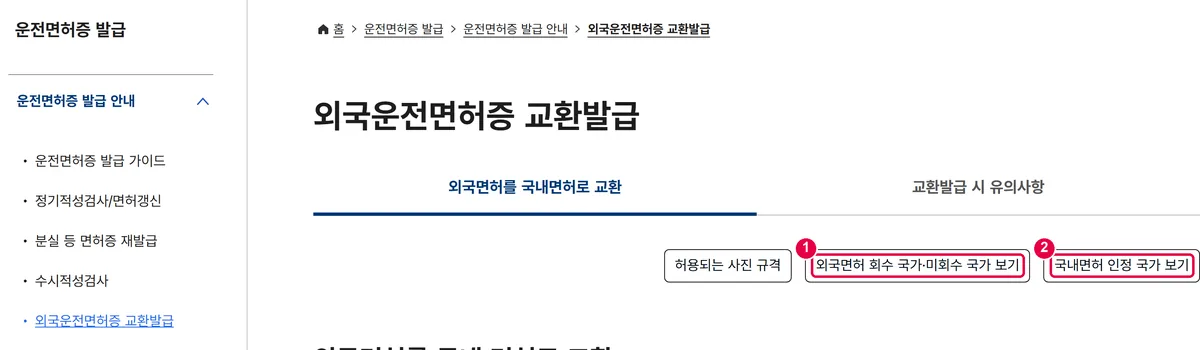
- Press 외국면허 회수 국가·미회수 국가 보기 (View countries that keep or do not keep the foreign license) to see in which countries the foreign license is taken back at exchange and in which it is returned.
- Press 국내면허 인정 국가 보기 (View countries whose license Korea recognizes) to open the list of recognized countries in a window (133 countries in the notice of 6 April 2026).
For matters related to changing your registered address or alien registration, please refer to How to Report a Change of Residence for Foreigners via HiKorea Online and How to Fill Out and Submit the Integrated Application Form for Foreigner Residence Matters.