
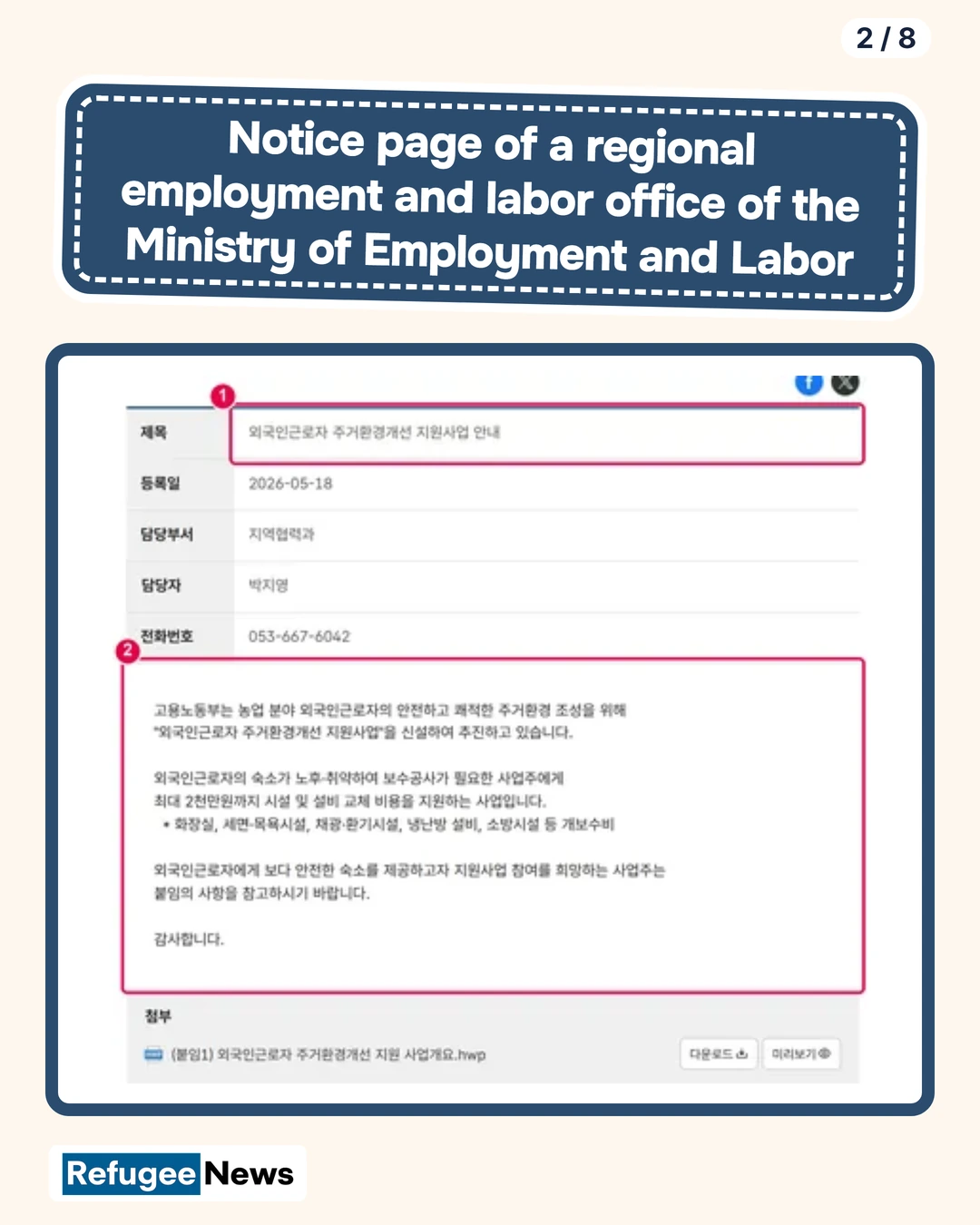
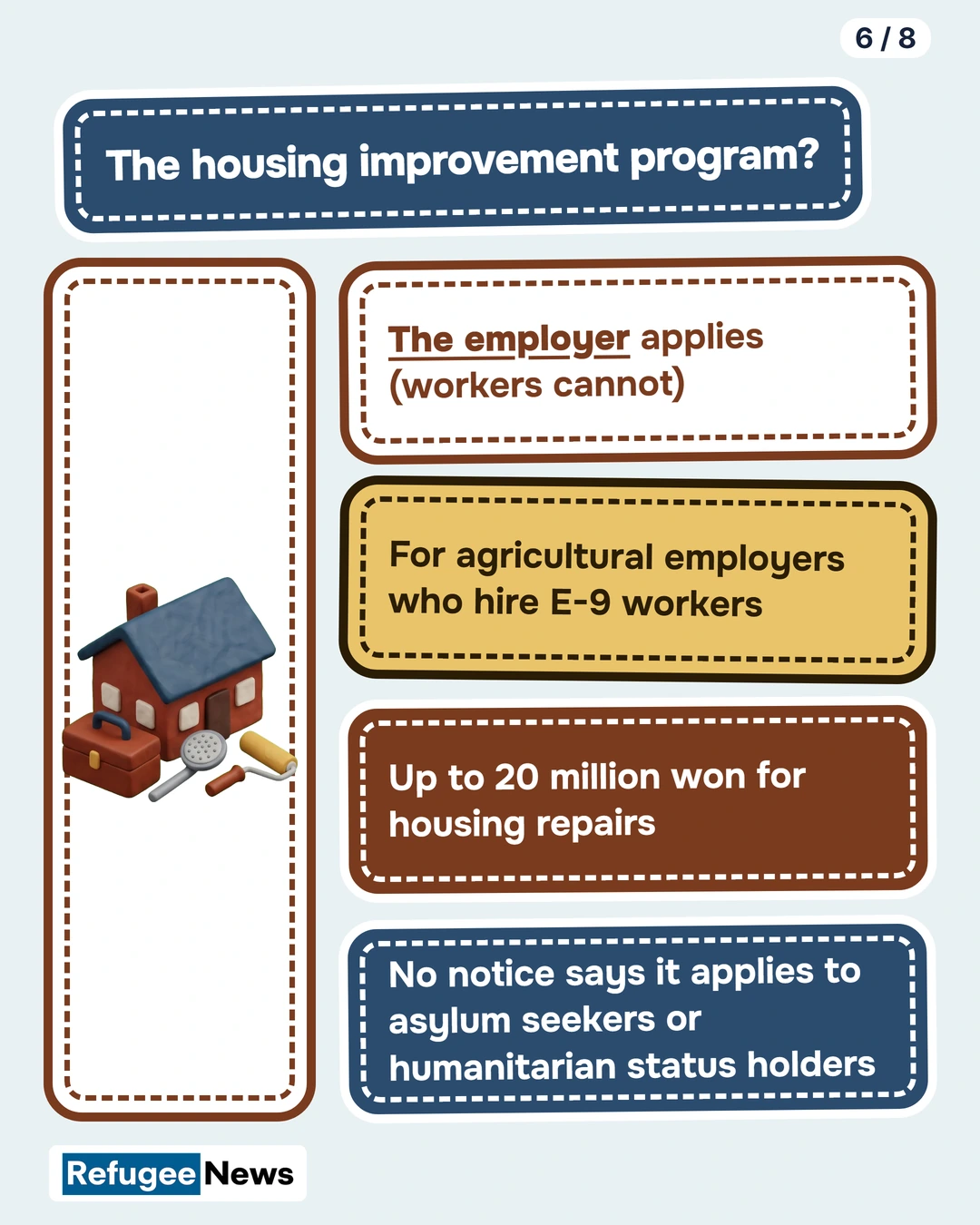
In 2026, the Ministry of Employment and Labor (고용노동부) started the new Housing Improvement Support Program for Foreign Workers (외국인근로자 주거환경개선 지원사업). It supports employers whose housing is old and dangerous and needs repair, paying up to 20 million won for replacing facilities and equipment. The employer who provides the housing applies. Workers do not apply directly.
If you live in housing provided by your workplace, it is good to know both whether this program applies to you and what you can do if the housing is dangerous or too much is taken out for housing costs.
What the housing improvement support program is
This program has the state and local governments pay part of the cost of repairing old housing that employers in agriculture provide to foreign workers. The Ministry’s program overview gives as its background that at some sites, such as agriculture and fisheries, foreign workers stay in facilities that are not meant for living and are exposed to disasters such as fire, cold waves, and heat waves, and fatal accidents keep happening.
Who is covered and what is supported
The program overview names as the target employers who hire E-9 foreign workers at Employment Permit System (고용허가제) workplaces in agriculture (crop cultivation under the Korean Standard Industrial Classification). The program is carried out by local governments selected by the Ministry of Employment and Labor. The 2026 program totals 4.2 billion won for 210 workplaces.
The items supported are as follows.
- Toilets, washing facilities, bathing facilities, lighting and ventilation equipment, heating and cooling equipment, and fire safety facilities that must be fixed to meet the facility standards of Article 100 of the Labor Standards Act
- Other facilities and equipment that need improvement for a comfortable living environment
The cost of buying consumable items such as home appliances and the cost of fire insurance are not supported. Unlicensed buildings that violate the Building Act or the Farmland Act, and temporary structures such as containers and prefabricated panels, are also excluded.
The limit is 20 million won per site for each employer. When the employer repairs a rented building, the national budget pays 45%, the local budget pays 45%, and the employer pays 10%. When the employer repairs a building in the name of the employer or a family member, the national budget pays 25%, the local budget pays 25%, and the employer pays 50%. A rented building must be provided as housing under a lawful lease signed after the program notice date, the lease must run 2 years or longer, and the building owner’s written consent to the work is required.
Priority goes to workplaces that received an order to correct housing in an inspection by a regional employment and labor office, workplaces judged by a local government inspection to have a high risk of safety accidents, and employers who voluntarily reported illegal temporary structures and made a plan to bring them into order.
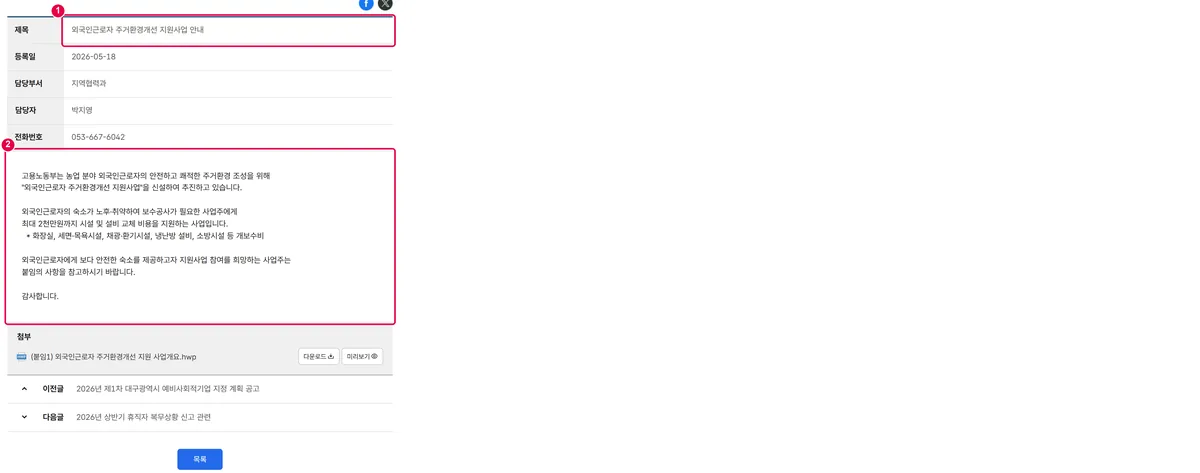
- The name of the program is the Housing Improvement Support Program for Foreign Workers.
- In the body, check the support limit and the items supported.
Application steps
The employer applies. The steps in the program overview are as follows.
- The local governments that will carry out the program are selected.
- The employer applies to the local government to take part.
- The local government reviews the improvement plan.
- After the work is finished, the local government confirms that the improvement is complete.
- The employer applies for the support money and receives it.
- The employer and the local government manage the housing afterward.
The Ministry of Employment and Labor recruited more participating local governments and announced the selection result. The program runs only in the selected regions, so to find out whether the region of your workplace takes part, search for the program name in the notices on the website of the regional employment and labor office with jurisdiction, or call the Ministry of Employment and Labor counseling line 1350. A worker can tell the employer about this program and ask whether they will apply, but eligibility to apply and the decision rest with the employer and the local government.
Whether it covers refugees and other migrant workers
Eligibility to apply for this program rests with employers in agriculture who hire E-9 workers. The notice does not say that an employer becomes eligible for this program merely because they employ an asylum seeker (G-1-5), a humanitarian status holder (G-1-6), or a recognized refugee (F-2-4). The notice also does not say whether such workers benefit from a repair when they live in the same housing as E-9 workers, so in that case, check with the regional employment and labor office with jurisdiction or 1350.
The dormitory standards of the Labor Standards Act and the rule that wages must be paid in full are labor law that applies to workers regardless of status of stay (see the related article below). However, the housing cost guidelines and the Standard Labor Contract were made for foreign workers who came under the Employment Permit System, so whether they apply as they are to workers with other statuses of stay can depend on the case. If you are worried about your status of stay and the scope of work you may do, first ask the Immigration Contact Center (외국인종합안내센터) 1345.
Related article: Labor Rights Basics for Foreign Workers and Refugees: Contracts, Minimum Wage, Leave and Social Insurance
Legal standards for housing
When an employer sets up and runs a dormitory, they must meet the standards set by Article 100 of the Labor Standards Act. Article 100-2 of the same Act requires measures to maintain workers’ health and protect their privacy. When an employer provides a dormitory to a foreign worker, under Article 22-2 of the Act on Foreign Workers’ Employment, Etc. they must meet these standards and make it possible to protect the worker’s health and safety, and when signing the labor contract they must tell the worker in advance the dormitory’s structure and equipment, location, living environment, and floor area. From 10 June 2027, this article changes to add the condition that the housing must be entered in the building register or the temporary structure register for residential use.
The standards in Articles 55 to 58-2 of the Enforcement Decree of the Labor Standards Act are summarized in the attachment to the guidelines of a branch of the Ministry as follows.
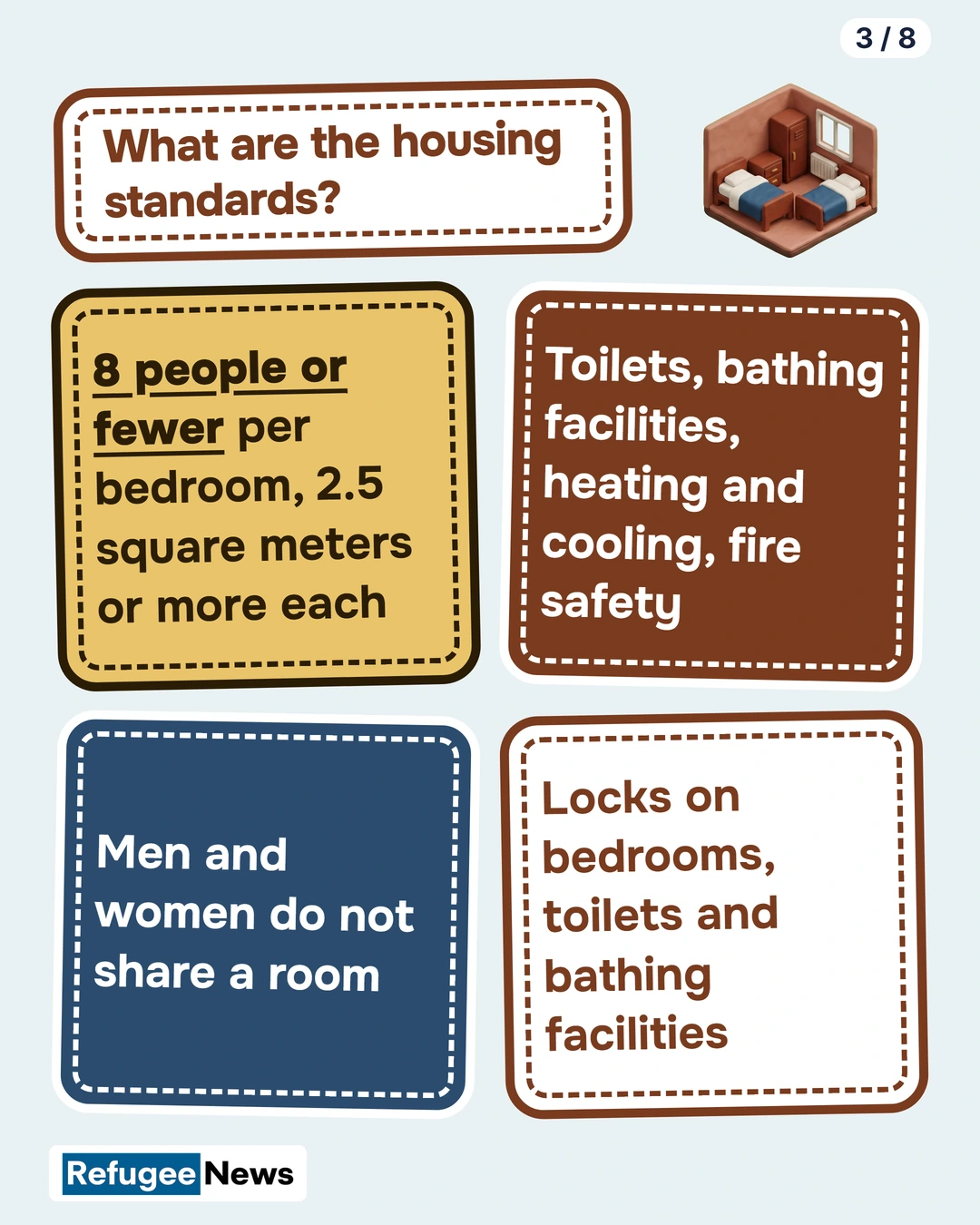
- Bedrooms: A bedroom must be built for 8 people or fewer, and the floor area must be at least 2.5 square meters per person.
- Facilities: There must be toilets, washing facilities, bathing facilities, lighting and ventilation equipment, suitable cooling and heating equipment, and equipment for fire prevention and safety measures in a fire.
- Location: A dormitory must not be placed in a place with heavy noise or vibration, a place with a high risk of landslides or avalanches, a place with a lot of moisture or a risk of flooding, or a place with a high risk of contamination from filth or waste.
- Living environment: Men and women must not stay in the same room, and workers on different work shifts must not sleep in the same bedroom. The exception is when their sleeping hours are completely separate and do not disturb sleep.
- Privacy: Bedrooms, toilets, and bathing facilities must have locks, and there must be storage space for personal belongings.
The amendment of the Act on Foreign Workers’ Employment, Etc., promulgated on 9 June 2026, also gives the Ministry of Employment and Labor a legal basis to provide administrative and financial support for local governments’ housing improvement programs for foreign workers. This article takes effect on 10 December 2026. In its explanatory material, the Ministry stated that it has also prepared a basis to prohibit providing illegal temporary structures as housing.
Rules on housing cost deductions
The Ministry of Employment and Labor explains that employers have no duty to pay foreign workers’ room and board, but when they provide room and board, they may collect a reasonable amount. How to collect it is set in the housing guidelines for foreign workers as follows.
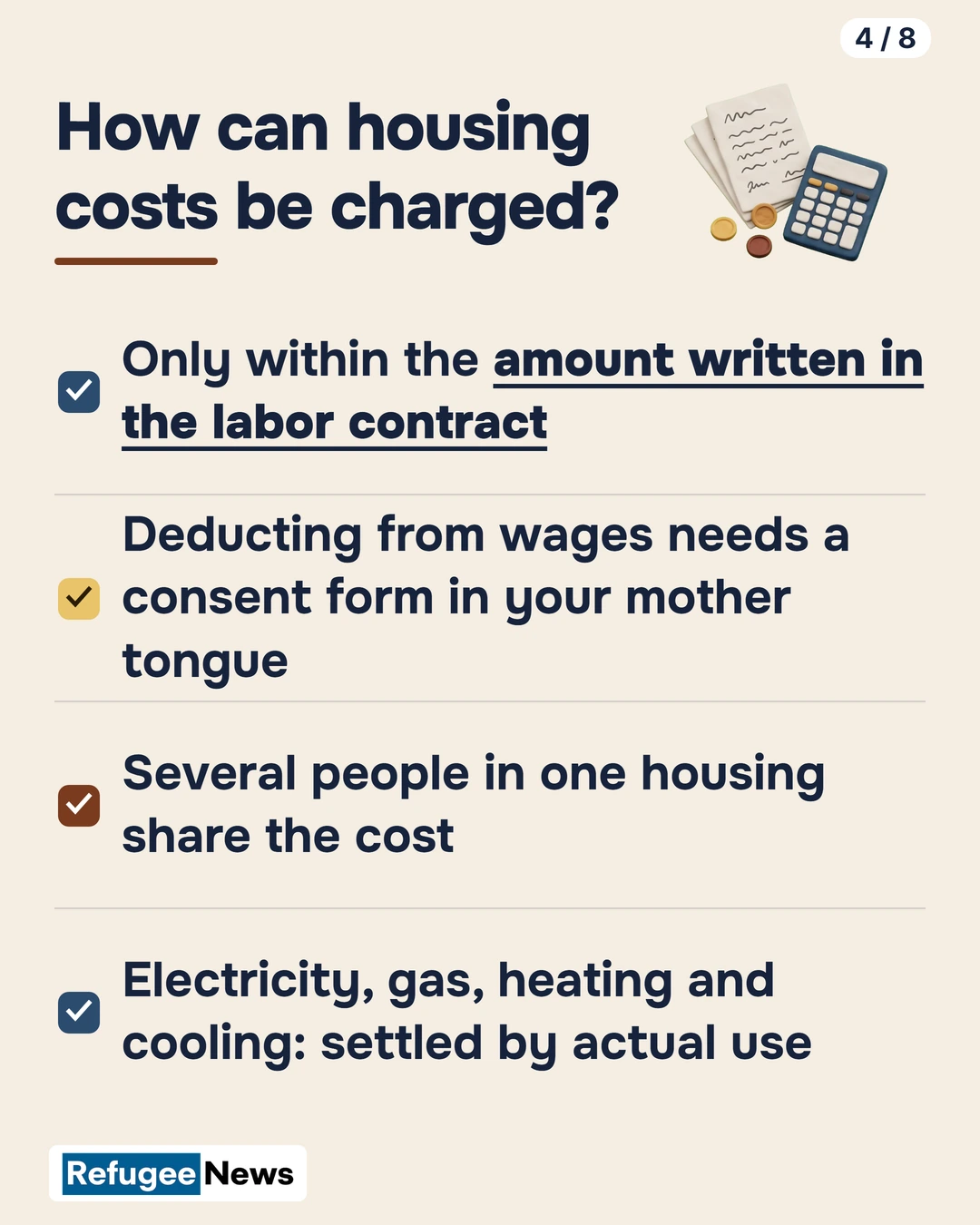
- Put it in the contract: The form of the housing provided and the amount the worker pays must be written in the labor contract. To collect housing costs, the employer must show enough basis for how the amount was calculated.
- Only within the contract amount: The employer may collect room and board only within the amount written in the Standard Labor Contract (표준근로계약서).
- How it is collected: The employer may collect it separately after paying wages, or deduct it from wages in advance only if the worker agreed of their own free will. To deduct in advance, the employer must get a written deduction consent form written in the worker’s mother tongue.
- When several people live together: When several people live in one housing unit, they share the housing cost. If two or more people live in housing with a monthly rent of 300,000 won, the employer must not collect 300,000 won from each of them.
- Temporary structure housing: When a temporary structure reported to the local government is used as housing, the cost in principle must not exceed the lowest monthly rent in that area.
- Meals: The worker chooses whether to be provided meals, and the meal cost is agreed within the cost actually incurred.
- Electricity, gas, and heating and cooling costs: Costs that depend on use are in principle settled afterward according to the cost actually incurred.
Regional employment and labor offices sometimes set their own housing cost standards that reflect local rent levels. For example, the Seoul Southern Branch guidelines apply from 1 July 2026 to workplaces in Gangseo-gu, Yangcheon-gu, and Yeongdeungpo-gu in Seoul. Ask the regional employment and labor office with jurisdiction whether your workplace area has its own standard.
Wages must be paid directly to the worker in currency and in full, and part of them may be deducted only when a law or a collective agreement has a special provision (Article 43, paragraph 1 of the Labor Standards Act). The Ministry’s guidelines say that if the amount deducted differs from the deduction consent form, it may amount to unpaid wages. The labor office and the courts make the final decision on which deductions are illegal.
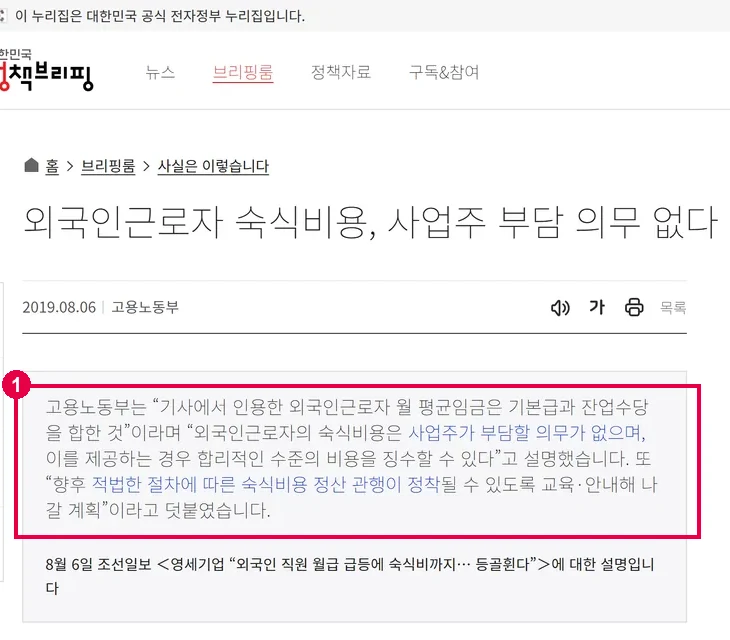
- This is the Ministry of Employment and Labor's explanation of room and board costs. When an employer provides room and board, they may collect a reasonable amount.
Related article: Unpaid Wages and Unfair Dismissal: How to Report and Apply for Remedy
What to do about dangerous housing and excessive deductions
Check in the following order.
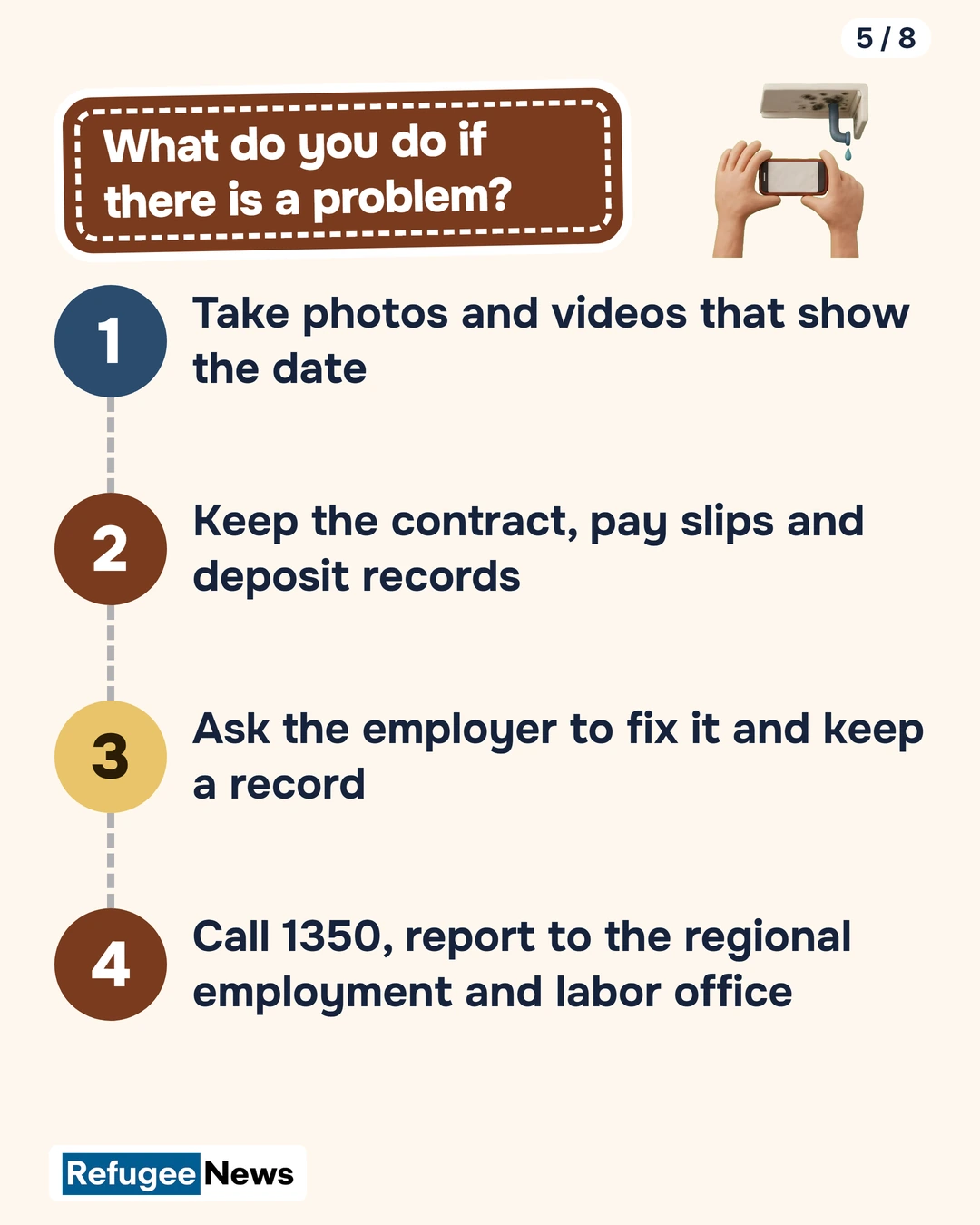
- Record it: Keep photos and videos, with the date visible, of leaks, mold, exposed electrical wiring, broken heating and cooling equipment, doors that do not lock, and the condition of the toilet or shower room.
- Gather documents: Keep your labor contract, deduction consent form, the pay slip you get every month, and your bank deposit records. Comparing the housing cost written in the contract with the amount actually deducted shows the difference.
- Tell the employer: Keep a record, by text or message, of the date you asked for repairs and the answer.
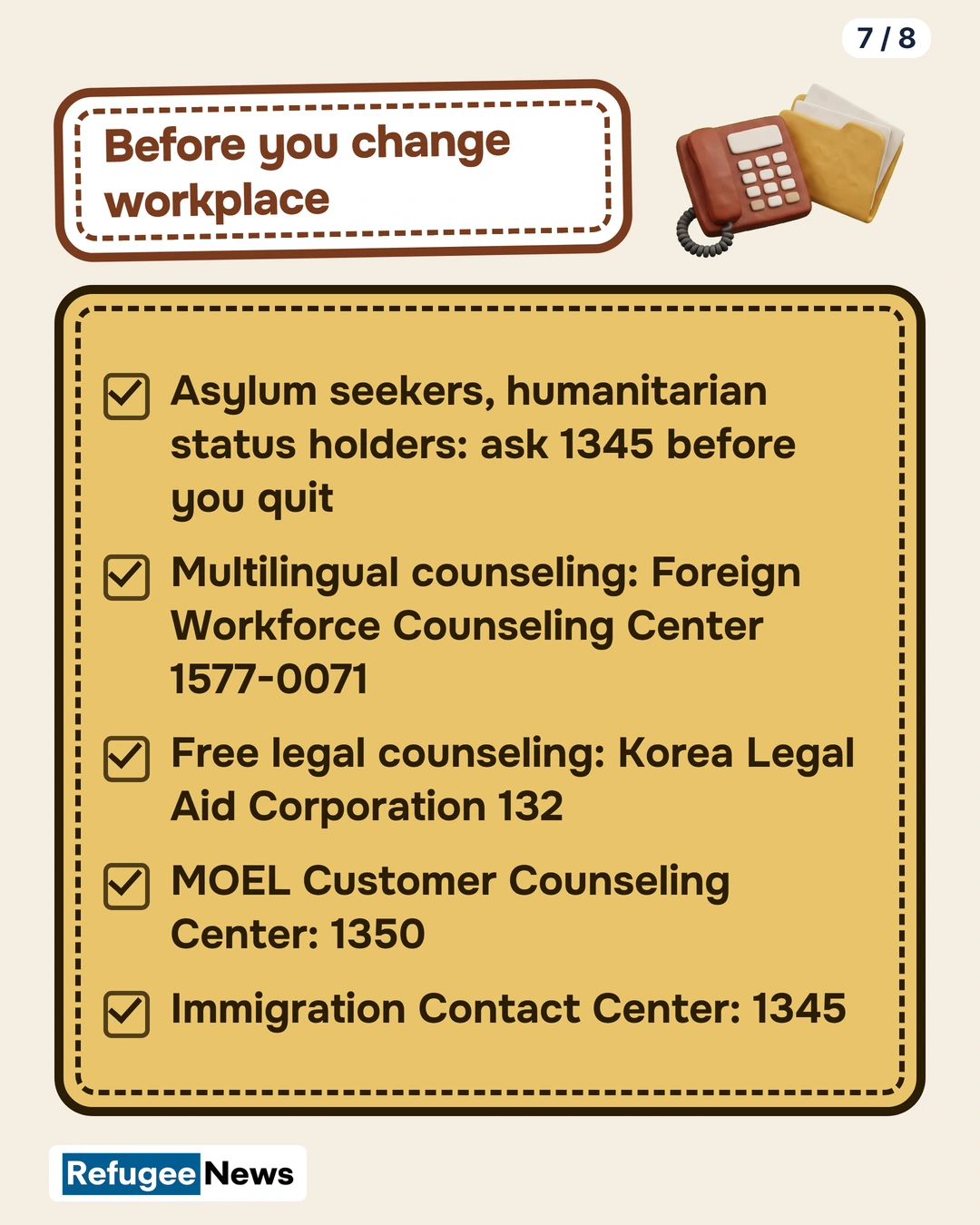
- Get counseling: If it is not resolved, contact the Ministry of Employment and Labor Customer Counseling Center 1350. There is also multilingual phone counseling for foreign workers (Foreign Workforce Counseling Center 1577-0071), and the Ministry says it runs this counseling every day of the year.
- Report it: File the report with the regional employment and labor office with jurisdiction. A labor inspector can inspect the workplace and the dormitory on site.
Whether you can change workplaces because of housing and wage problems depends on your status of stay. Under Article 25 of the Act on Foreign Workers’ Employment, Etc., an E-9 worker under the Employment Permit System can apply to change workplaces when it is recognized that they cannot keep working for a reason that is not their fault, such as being given housing in violation of the law, and the Minister of Employment and Labor has made a public notice. The Ministry of Employment and Labor decides whether a specific case is recognized. Asylum seekers and humanitarian status holders have different work permit conditions and different procedures when moving workplaces, so before you leave your workplace, first check with 1345 or the Immigration Office with jurisdiction.
If you need legal counseling, you can ask for free counseling from the Korea Legal Aid Corporation (대한법률구조공단) at 132.
Related article: Beware of Brokers Offering Seasonal Work (Immigration Act Amendment, January 2026)