
Some people want to apply for refugee status in Korea because they suffered violence for being a woman, or are at risk of it. Female genital mutilation, domestic violence, sexual violence, and forced marriage are typical examples. These experiences can also be considered in the refugee review. However, whether you are recognized depends on the facts of your case and your evidence, and the final decision is made by the Ministry of Justice (법무부) and the courts. For the full steps of the application, see How to Apply for Refugee Status in Korea: At a Port of Entry, While in Korea, and the Review.
What gender-based persecution means
Gender-based persecution means persecution that is carried out because a person is a woman or because of the roles society expects of women. The law has no separate provision with this name. The review applies the definition of a refugee in the Refugee Act to the experiences of women.
In its guidelines on gender-related persecution, the UN Refugee Agency (UNHCR) explains that gender-related refugee claims have included sexual violence, domestic violence, coerced family planning, female genital mutilation, punishment for transgressing social mores, and discrimination against sexual minorities. This range is a set of examples, not a closed list. Men can also make gender-related claims, but the guidelines state that this kind of persecution appears more often against women.
The definition of a refugee in the Refugee Act
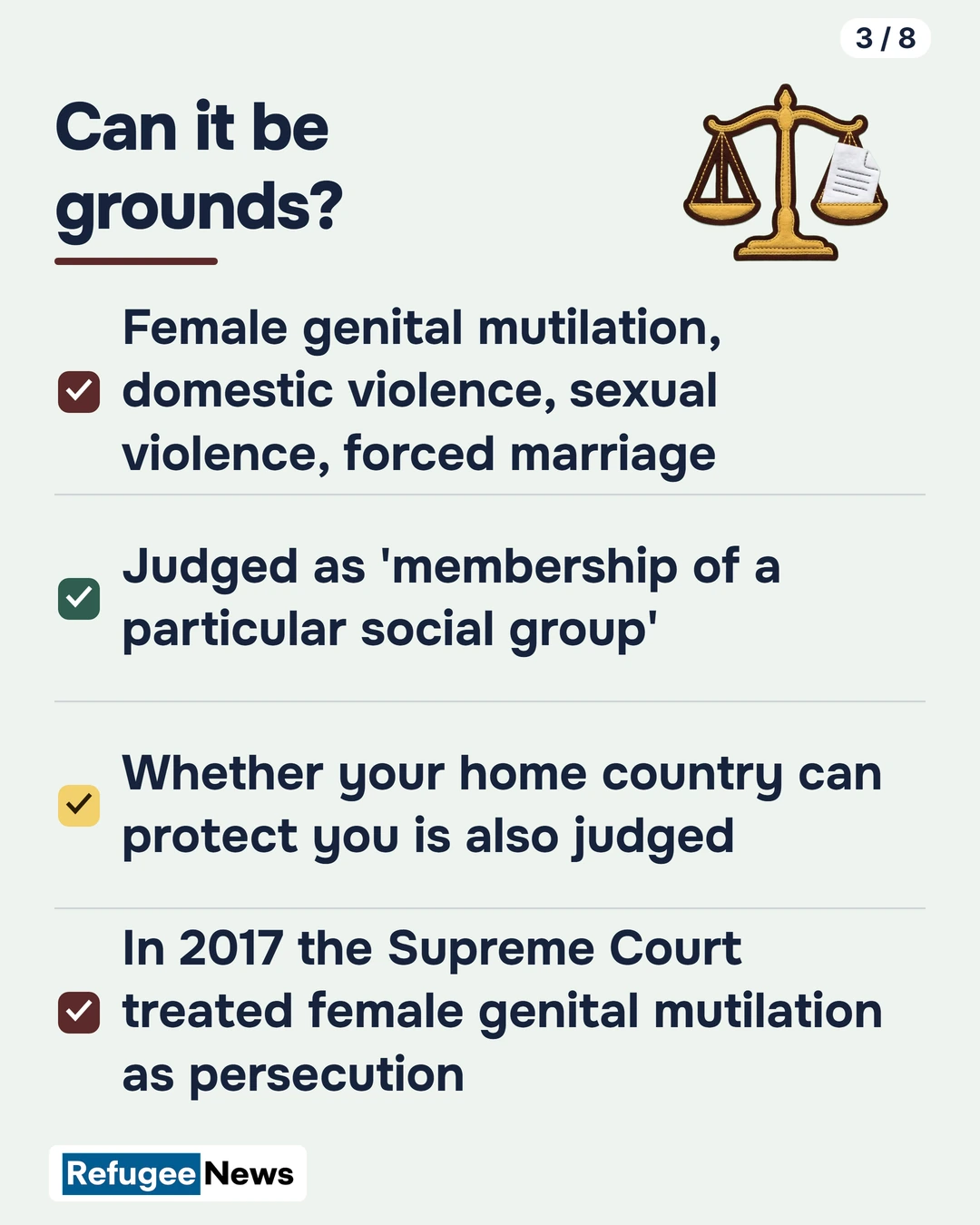
Article 2, item 1 of the Refugee Act defines a refugee as a foreigner who is unable or unwilling to receive the protection of the country of nationality because of a well-founded fear of persecution on the grounds of race, religion, nationality, membership of a particular social group, or political opinion.
‘Sex’ is not listed separately. So violence against women is mainly judged by asking whether it is persecution on the ground of ‘membership of a particular social group’, and whether the country of nationality can prevent the harm. What the applicant needs to explain comes down to three points.
- What happened to you, or what risk you face
- How that is connected to being a woman or to the norms for women in your society
- Whether you could receive protection from the police, courts, family, or community in your home country, and if you could not, why not
Your rights at the interview
The general rights at the interview are set out in How to Apply for Refugee Status in Korea: At a Port of Entry, While in Korea, and the Review. The items that matter most for women applicants are the following.
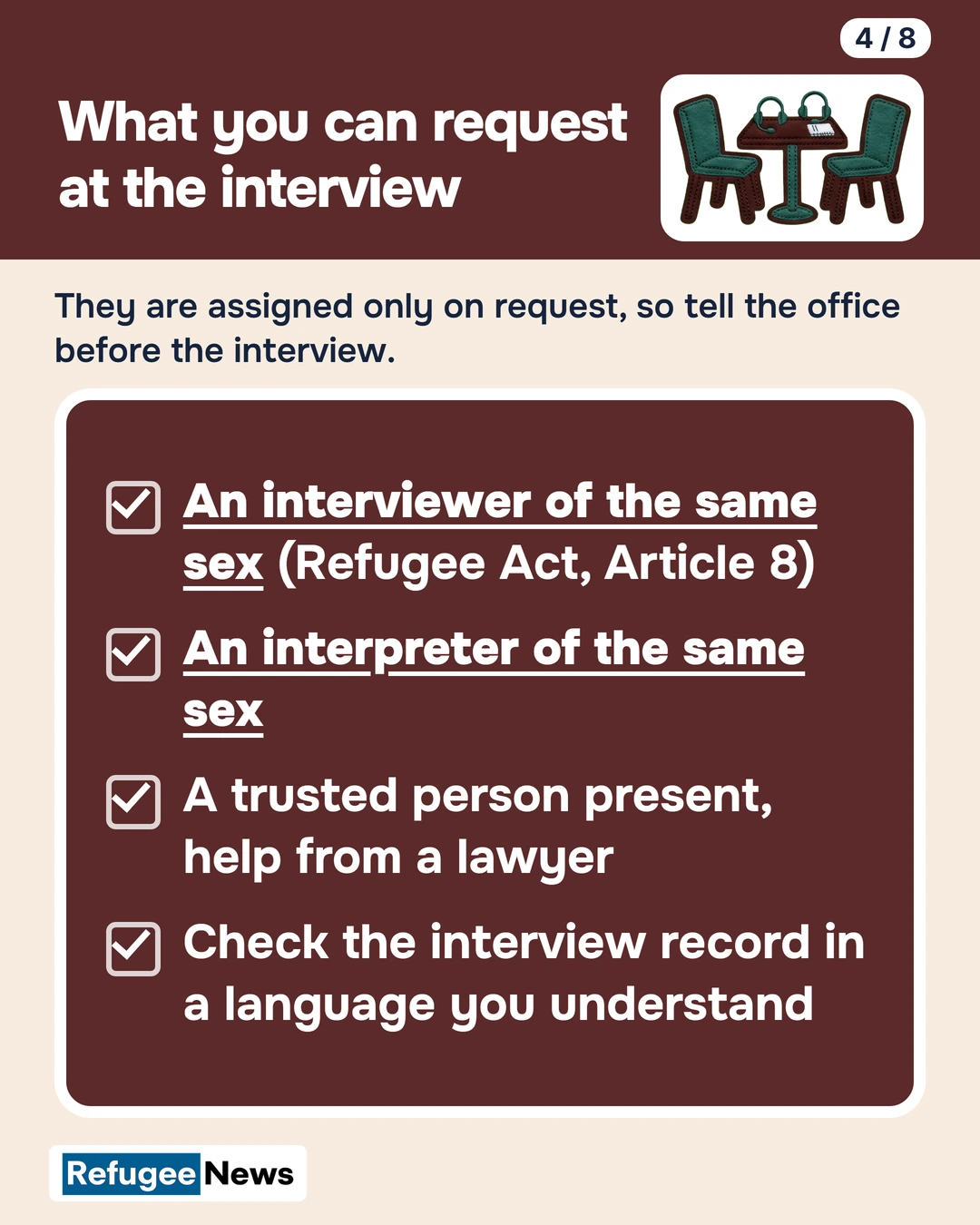
- An interviewer of the same sex: If you request it, an official of the same sex must conduct the interview (Article 8, paragraph 2 of the Refugee Act).
- An interpreter of the same sex: If you cannot speak Korean well enough, an interpreter interprets the interview, and if you request it, a refugee-specialist interpreter of the same sex must interpret (Article 8, paragraph 2 of the Enforcement Decree of the Refugee Act).
- A trusted person present: If you apply, a person you trust may be allowed to attend as long as it does not harm the fairness of the interview. You also have the right to be assisted by a lawyer (Article 12 of the Refugee Act).
- Checking the interview record: After the interview, the interview record is interpreted or translated into a language you understand so that you can check it. If anything is wrong, ask for it to be corrected.
- Confidentiality: Information about a refugee application must not be given to the country of origin, and disclosing the applicant’s personal details is also prohibited.
A same-sex interviewer and interpreter are assigned only if you ask, so tell the Immigration Office in charge before the interview. Ask the Immigration Office in charge or 1345 (Immigration Contact Center, 외국인종합안내센터) whether you can still make the request after you have been given the interview date.
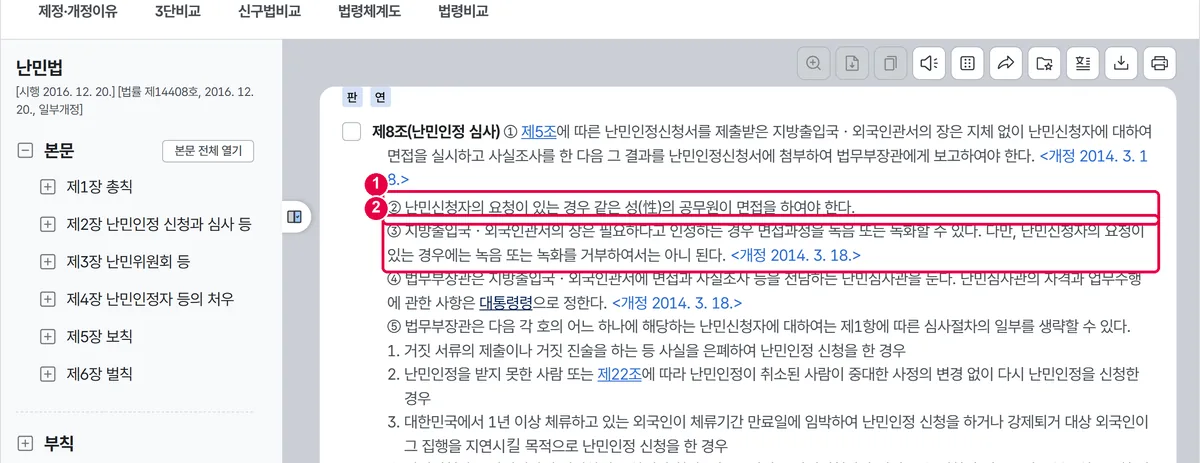
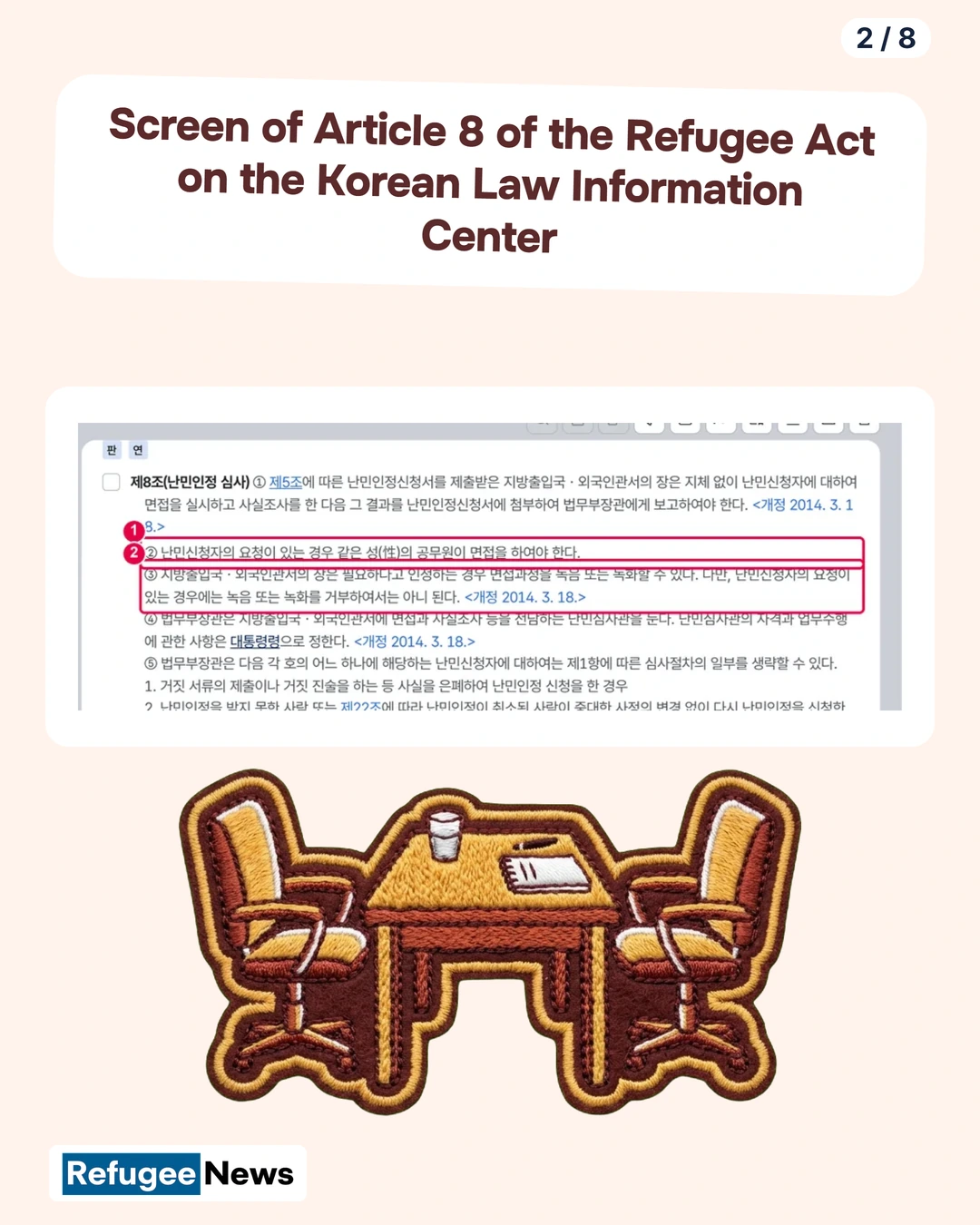
- Paragraph 2 states that if the refugee applicant requests it, an official of the same sex must conduct the interview.
- Paragraph 3 states that a request to record the interview in audio or video must not be refused.
Related article: How to Apply for Refugee Status in Korea: At a Port of Entry, While in Korea, and the Review
UNHCR guidelines
In 2002, UNHCR issued the Guidelines on International Protection No. 1: Gender-Related Persecution (HCR/GIP/02/01). The guidelines explain how to interpret the refugee definition in light of women’s experiences and what to observe in the review procedure. They describe international standards, and how they are reflected in an individual case in Korea differs from case to case.
The following is what the full text of the guidelines (English PDF) says.
- The guidelines explain that sexual violence, dowry-related violence, female genital mutilation, domestic violence, and trafficking are acts that inflict severe suffering, and that they have been used as forms of persecution whether carried out by the state or by private persons.
- They explain that harmful acts by residents or individuals can also be treated as persecution when the authorities knowingly tolerate them, or when the authorities refuse or fail to provide effective protection.
- On procedure, they ask that women applicants be interviewed separately without male family members, that information about the procedure and legal advice be given in a language they understand, and that they be told they can choose an interviewer and an interpreter of the same sex (paragraph 36).
- In sexual violence cases, they explain that the exact details of the act itself do not need to be given, but the events before and after it and the surrounding circumstances may be needed.
Court rulings
Supreme Court ruling 2016Du42913 (female genital mutilation)
Supreme Court, 5 December 2017, Case No. 2016Du42913 is a Supreme Court ruling that treated female genital mutilation as persecution under the Refugee Act. The case was a lawsuit to cancel a refugee non-recognition decision, brought by a 14-year-old girl who was a Liberian national. The immigration authorities decided that the applicant was not a refugee only because her mother had not been recognized as a refugee.
The Supreme Court decided the following.
- Female genital mutilation inflicts direct harm on a woman’s body with extreme pain and violates human dignity, so it is persecution inflicted on the ground of membership of a particular social group.
- If, on return to the home country, there is a risk of undergoing female genital mutilation against one’s will and sufficient protection from the home country cannot be expected, the person cannot receive the protection of the country of nationality because of a well-founded fear of persecution.
- The risk here must go beyond a general and abstract risk and must be one to which the applicant is individually and specifically exposed. This must be reasonably recognized from objective evidence about the situation of the family, region, and society the applicant belongs to.
- The Supreme Court held that the authorities could not refuse refugee recognition only for reasons unrelated to the refugee requirements, quashed the lower court’s judgment, and sent the case back to the Seoul High Court.
This ruling sent the case back for a new hearing, and the Supreme Court did not recognize the applicant as a refugee. The ruling also decided only female genital mutilation. Domestic violence, sexual violence, and forced marriage were not directly addressed in it.
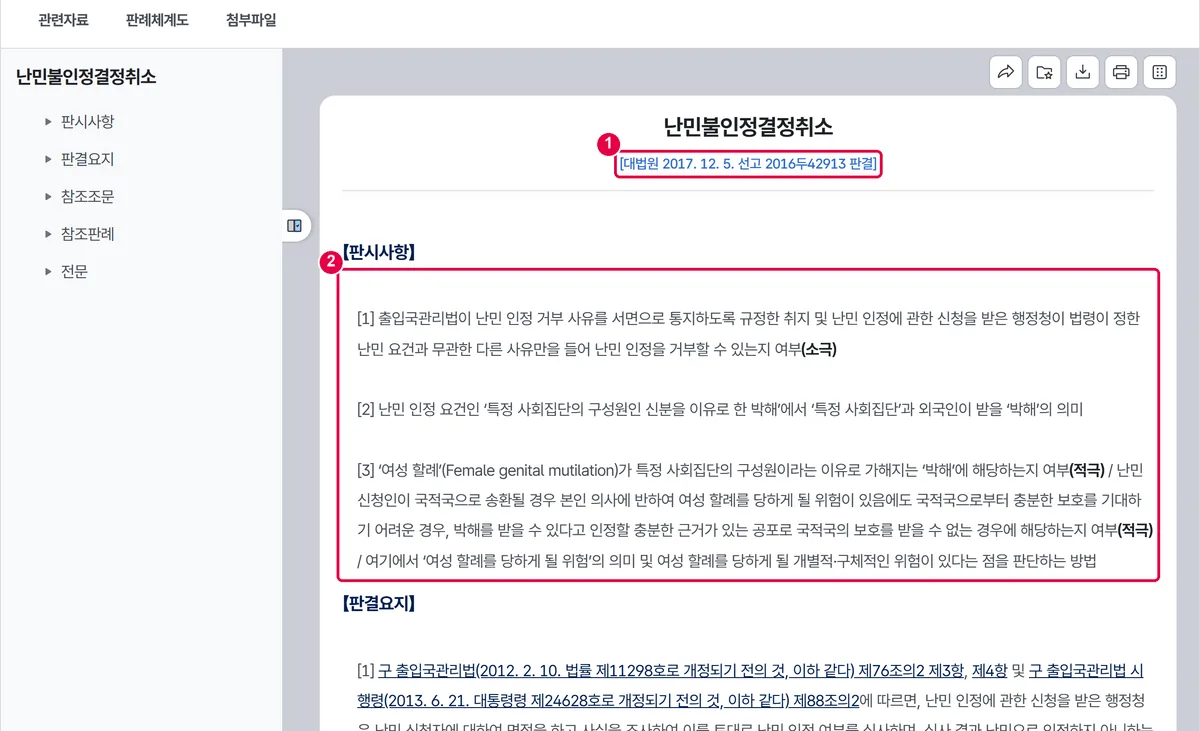
- Check the case name, the date of the ruling, and the case number.
- Holding [3] summarizes the decision on whether female genital mutilation is persecution inflicted on the ground of membership of a particular social group.
Supreme Court ruling 2018Du41723 (credibility of statements)
Supreme Court, 14 February 2019, Case No. 2018Du41723 is a case based on political opinion, but it set out general standards for how to assess a refugee applicant’s statements. It is also useful for a woman applicant preparing for the interview.
- A refugee applicant cannot be required to prove the whole claim with objective evidence. If the statements are consistent and persuasive, so that it is reasonable to accept the claim on the overall credibility, the claim should be treated as proved.
- Even if details of the statements differ slightly or some points are exaggerated, the overall credibility must not be denied right away.
- The court must consider whether the differences come from the mental shock of the persecution experience, an unstable psychological state, the limits of memory over time, or differences in cultural and language sense, and must assess overall consistency centered on the core of the statements.
Seoul High Court ruling 2024Nu46776 (domestic violence claim)
A domestic violence claim is not always accepted. Seoul High Court, 8 November 2024, Case No. 2024Nu46776 held lawful the decision not to refer for review a refugee application that a Tunisian woman made at the airport. The applicant claimed violence and threats from her former husband.
The court cited the following circumstances in this case.
- Her divorce had been recognized in her home country, and the applicant herself stated that the police had once detained her former husband after she reported him.
- The court found that material supporting ongoing harm was lacking.
- The applicant’s answers about whether she could live in another part of her home country were also used in the judgment.
This ruling is an individual judgment based on the facts of the case. It shows that in domestic violence cases, whether the home country’s state actually protected the person and whether there is material supporting the harm are judged together.
Preparing your statement for the interview
The following is what is good to organize before the interview. Not every question has a set answer, and the most important thing is to tell what happened as it happened.
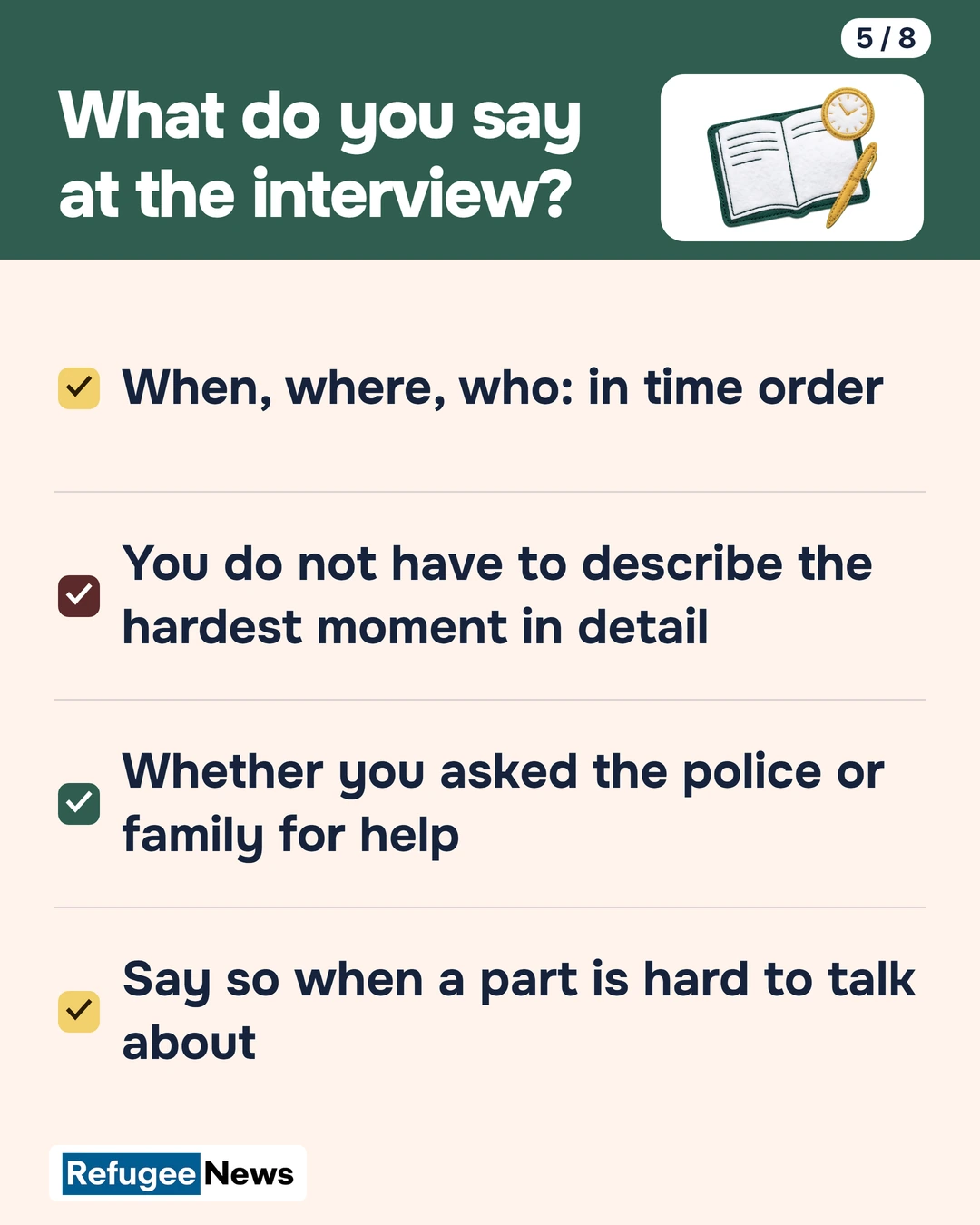
- Time order: Organize in order when it happened, where, and who was involved, with approximate times. If you do not remember exact dates, you may say you do not know.
- Level of detail: You do not have to describe the hardest moment in detail. The UNHCR guidelines also explain that in sexual violence cases the exact details of the act itself are not needed. Focus on the events before and after and the surrounding circumstances.
- Efforts to get protection: Say whether you asked the police, courts, family, local leaders, or medical institutions for help, and what the result was. If you could not ask, say why.
- The link to being a woman: Explain, as far as you know, why it happened because you are a woman and how it is connected to community norms or family expectations.
- Whether you can avoid it inside your home country: You may be asked whether you could live in another part of your home country. Think specifically about whether you could, and if it is hard, why.
- Parts that are hard to talk about: If there is a part that is hard to talk about during the interview, say so. If you later tell something you did not tell before, also explain why you could not say it then. When you check the interview record, you can ask for missing or wrong content to be corrected.
Evidence
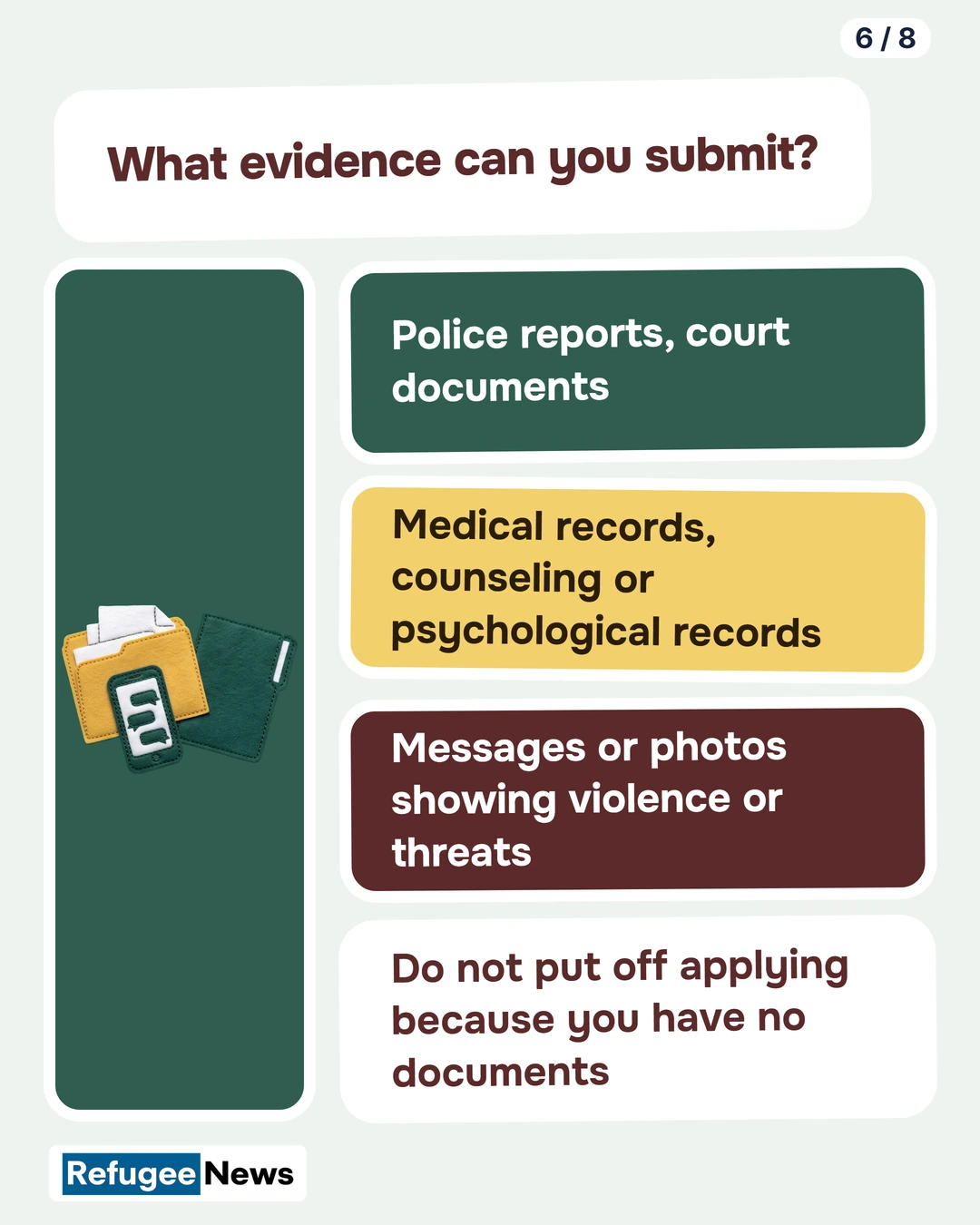
When you apply for refugee status, you submit documents and other materials that can be used in the review, if you have them (Article 5, paragraph 2 of the Refugee Act). The Minister of Justice must also actively collect materials favorable to the applicant and use them in the review (Article 9 of the Refugee Act). Even so, if you have materials, it is better to submit them.
- Police reports, court documents, and documents about a divorce or a protection order
- Medical records, medical certificates, and counseling or psychological records (including those obtained in Korea)
- Messages, photos, and call records showing violence or threats
- Statements written by family, acquaintances, or support organizations
- Reports by international organizations or government agencies on violence against women in your home country and the state’s protection
The UNHCR guidelines explain that, depending on the case, it may be appropriate to obtain objective psychological or medical evidence. Do not put off your application because you have no materials. It is safer to talk to the support organizations below about how to prepare materials.
Legal support organizations
Refugee applicants have the right to be assisted by a lawyer. The organizations introduced in other articles on this site are the following. Whether they can accept your case and the scope of their support differ by organization and may change, so check directly with each one.
- NANCEN (Refugee Rights Center, 난민인권센터)
- Advocates for Public Interest Law (APIL, 공익법센터 어필)
- Korea Legal Aid Corporation (KLAC, 대한법률구조공단)
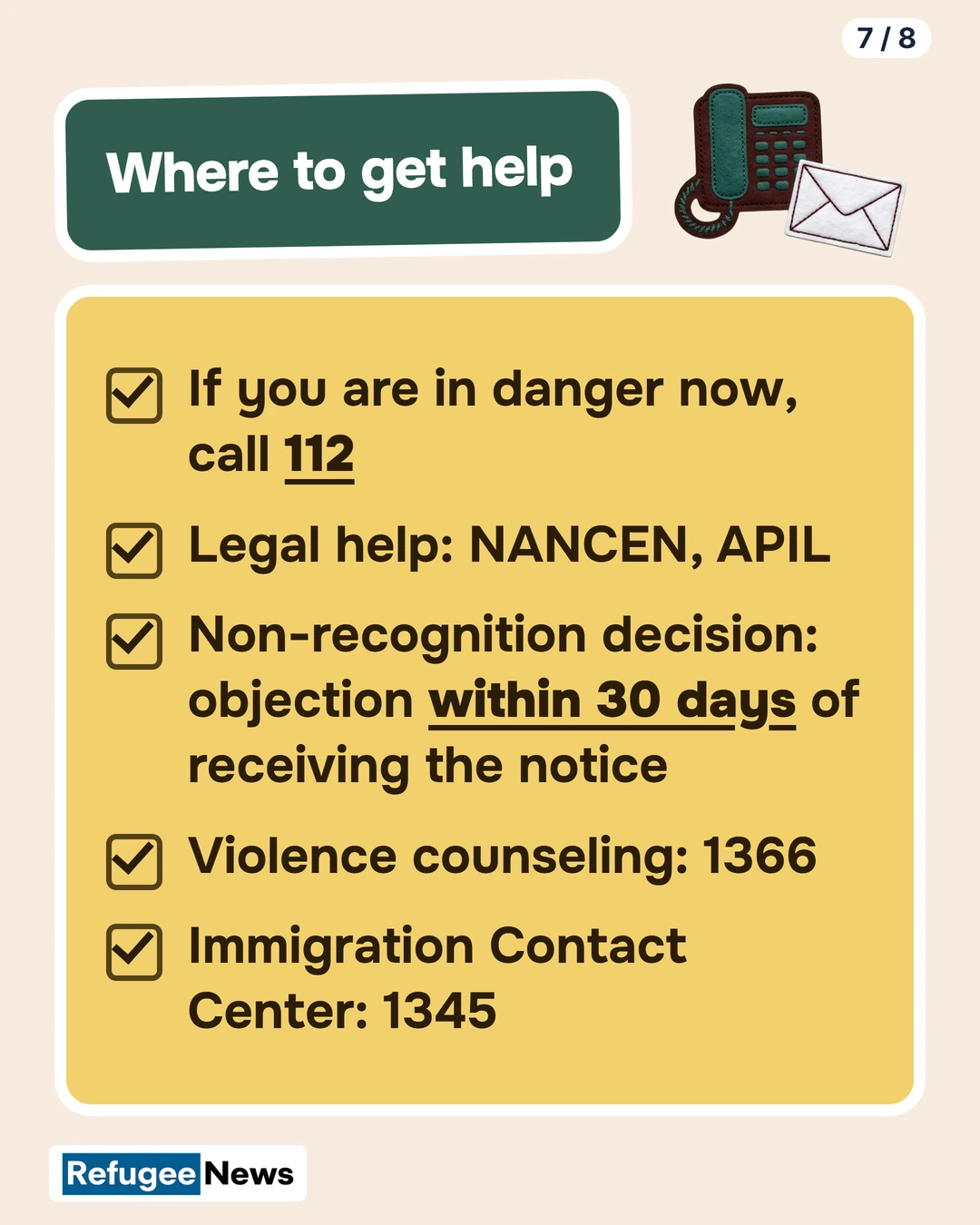
- Immigration Contact Center (외국인종합안내센터) 1345 (interpretation available)
If your physical safety is at risk or you are being subjected to violence now, call 112. You can get counseling about violence at 1366. For more details, see Korean Laws and Penalties That Foreigners and Refugees Should Know.
If you receive a non-recognition decision, you must file an appeal (이의신청) within 30 days of receiving the notice. If it is needed for your safety, the Refugee Committee or the court may, on your request, hold the deliberation or hearing in private.
Related article: After a Refugee Non-Recognition Decision: Objection and Administrative Lawsuit
Related article: Glossary of Korean Refugee Legal Terms (Korean · English · French)