
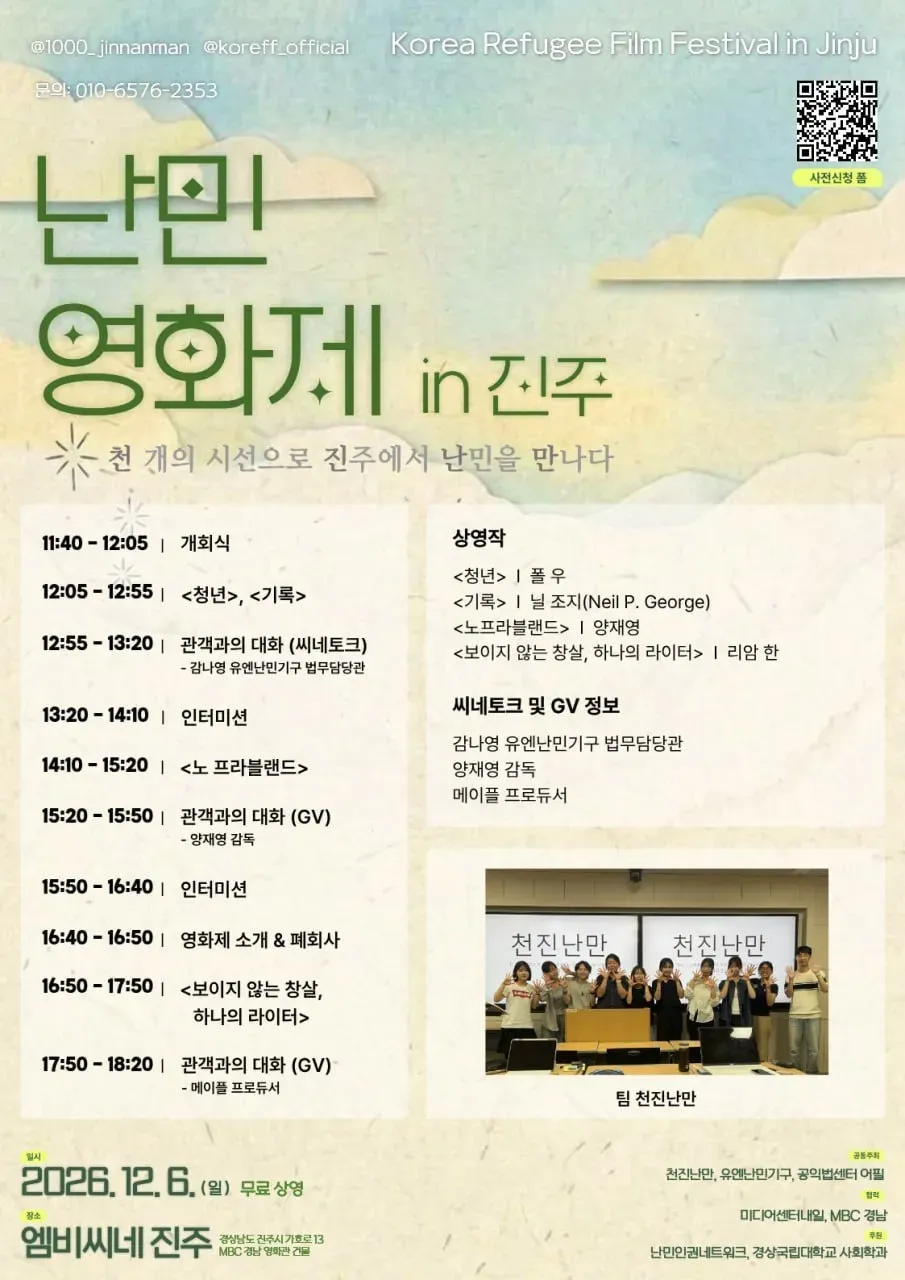
In Jinju, a student team from Gyeongsang National University is seeking to create a new space for engaging with refugee issues through cinema. The Korea Refugee Film Festival in Jinju is scheduled to be jointly hosted by Cheonjin Nanman, the United Nations High Commissioner for Refugees (UNHCR), and Advocates for Public Interest Law (APIL), in partnership with Media Center Tomorrow and MBC Gyeongnam, and with support from the Refugee Rights Network and the Department of Sociology at Gyeongsang National University.
Bringing together film screenings and discussion sessions, the festival aims to raise questions about stereotypes, the diversity of human experiences, and the role of non-refugees in sharing refugee stories.
The initiative is led by Cheonjin Nanman (천진난만), a team of students from the Department of Sociology at Gyeongsang National University. Its aim is to bring the experience of watching and discussing refugee films beyond the capital, Seoul, and to Jinju, where the team believes refugee issues need more space in public discussion.
The festival’s slogan, “Meeting Refugees in Jinju Through a Thousand Eyes,” reflects the initiative’s central idea: moving away from a single, stereotypical image of refugees and encouraging audiences to engage with the diversity of their experiences and perspectives.
During an interview with the “Refugee News” team, members of Cheonjin Nanman spoke about the festival’s origins, the preparations behind it, and their goals of using cinema to create more space for public discussion of refugee issues in South Korea.
From a University Idea to a Festival in Jinju
The idea began with a proposal from Associate Professor Kim Chulhyo (김철효) of the Department of Sociology, College of Social Sciences, at Gyeongsang National University. During his interview with ” Refugee News” he believed that holding a local festival in Jinju would give students and residents the opportunity to watch refugee films without having to travel to Seoul to attend similar events.
Some students had previously taken part in volunteer activities connected with the refugee film festival in the capital, giving them an initial understanding of how such events are organized , the professor said. With the professor’s encouragement and the students’ cooperation, the idea developed into a project that the team began working to bring to life as they descriebed.
Team members say they were initially unsure whether the project could be carried out, given the time, effort, and financial resources required to organize a film festival. Nevertheless, they decided to take on the challenge.
The Team’s Name and Its Meaning
The team chose the name “Cheonjin Nanman” (천진난만), a Korean expression associated with spontaneity, cheerfulness, and innocence as they said. The students wanted to connect the name to the festival’s message, pairing it with the phrase: “Meeting Refugees in Jinju Through a Thousand Eyes.”
This idea is also reflected in the festival’s promotional design. The visual identity uses shades of green to create a sense of warmth and peace, alongside visual references to eyes and multiple perspectives. These elements highlight the importance of seeing refugees’ lives from different angles rather than reducing them to a single image, they explained.
Through the name and visual design, the team hopes to make engagement with refugee issues more accessible and relatable to the public without diminishing the seriousness or importance of the subject.
Organising the Festival
Turning the idea into reality was not easy. The team faced financial challenges from the outset. It began working without a budget and had to seek funding to cover the costs of renting the cinema venue and organizing the screenings , one of the student said.
However, entering the competition required them to establish a formal organization. This led to the creation of Cheonjin Nanman as a non-profit civic organization focused on culture and the arts, enabling the team to open a bank account in the organization’s name and receive funding.
The students describe the registration process and communication with official bodies as some of the most difficult stages of preparation. At the same time, these steps helped turn a student initiative into a project that could be implemented in practice.
Films Offering Different Windows into Refugee Lives
The team hoped to screen a larger number of films and asked each member to suggest two or three works they considered suitable. However, financial constraints, difficulties in securing screening rights, and challenges in contacting some directors and producers limited the final selection.
The team drew on films that had previously been screened at the refugee film festival in Seoul, aiming to present a range of different experiences. These included the realities of Yemeni refugees in South Korea, the experiences of young people, and stories that extend beyond the Korean context to explore broader issues.
One of the films featured in the festival is No Probland, directed by Jae-young Yang (양재영). The film follows three Yemeni asylum seekers on Jeju Island through what appears to be an ordinary day, but one that brings significant developments in the lives of its protagonists.
At the same time, Askar, a kick boxer described in the film as a “refugee kick boxer” preparing for his first match in Korea. His story also points to the challenges that can arise when a person’s immigration status affects their ability to pursue sporting opportunities As the trailer shows.
On what was supposed to be Omar’s first day at work, he is informed that his starting date has been postponed. Meanwhile, Adnan unexpectedly finds himself taking part in an independent film.
Through these everyday details, the film seeks to portray asylum seekers as individuals with interests, dreams, and aspirations not Just as statistics or news headlines associated with the refugee crisis.
The students also discussed the film Youth (청년), which they had initially hoped would serve as a starting point for an academic discussion about young people’s attitudes toward refugees and the possibility of living together.
The festival programe also includes Writing to Reach You, directed by Neil P. George. The film tells the stories of four refugees living in South Korea and rebuilding their lives after arriving from different countries. It explores what their lives were like before and after coming to Korea.
Another film in the programe is A Lighter Between Invisible Bars, which explores the experiences of Myanmar refugees in Mae Sot, a town on the Thai-Myanmar border. The film follows a former undocumented resident who returns to the area as a graduate student in Seoul to conduct research on migrant children. The film was selected to broaden the range of topics under discussion and ensure that the conversation is not limited to the Korean experience alone.
Film and Public Attitudes
The influence of films on attitudes and perceptions was one of the main themes of the discussion. One student believes that cinema allows people from different walks of life to sit together in front of the same screen and then interpret the same scenes in different ways. The discussion following a screening also gives audiences an opportunity to exchange views and ask questions.
This idea is particularly relevant in Jinju, where team members believe refugee issues do not receive the same level of public discussion and attention as they do in the capital, Seoul.
The team also draws on an earlier experience at the university, when students organized a small migration film festival as part of a course. They conducted surveys before and after the screenings to compare participants’ attitudes toward migration and refugee issues.
The results showed that some participants reconsidered their assumptions, including the belief that refugees might take job opportunities away from young South Koreans. After watching the films, some became less attached to this view and more willing to consider the issue from different perspectives.
This experience strengthened the students’ belief in cinema’s ability to open up discussions about issues that may not otherwise feature in the public’s everyday lives.
Festival Programme
The Korea Refugee Film Festival in Jinju is scheduled to take place on Sunday, December 6, 2026, at MBC Cine Jinju.
The programme begins with an opening ceremony from 11:40 a.m. to 12:05 p.m., followed by the first screening session, from 12:05 p.m. to 12:55 p.m., featuring Youth and Writing to Reach You.
A Cine Talk session will follow from 12:55 p.m. to 1:20 p.m., with Na-young Gam, Legal Officer at the UNHCR Representation in the Republic of Korea. After an intermission, No Probland will be screened from 2:10 p.m. to 3:20 p.m., followed by a discussion with its director, Jae-young Yang, from 3:20 p.m. to 3:50 p.m.
Following another intermission, the programe will resume with a presentation about the film festival and closing remarks from 4:40 p.m. to 4:50 p.m. The final film, A Lighter Between Invisible Bars, will be screened from 4:50 p.m. to 5:50 p.m., followed by a discussion with the film’s producer, Maple, from 5:50 p.m. to 6:20 p.m.
Through this programme, the festival seeks to combine film screenings with opportunities for audiences to engage directly with people working in refugee protection, filmmaking, and related fields.
Speaking About Experiences We Have Not Lived
Perhaps the most thought-important question raised during the interview came from one of the team members, who asked about the limits of the role that non-refugees can play when discussing refugee issues.
“As South Korean citizens who have not personally experienced displacement”, the students wonder whether they have the right to engage with this issue and how they can offer support without speaking on behalf of the people directly affected.
They also expressed concern that selecting certain films might bring some voices to the forefront while leaving others unheard. they added “refugees are not a homogeneous group: their experiences vary considerably and include those of children, women, and young people, as well as people who have gone through different stages of displacement and migration”.
During the discussion, it was suggested that a work of art carries its own message and that viewers should be given room to reflect and form their own opinions, rather than being presented with a prescribed interpretation.
The conversation also emphasized the importance of diversifying the subjects explored in films about refugees. Their representation should not be limited to suffering or the need for assistance, but should also include stories of achievement, the experiences of children and women, dreams, challenges, and everyday life.
Keeping the Conversation Going
The Cheonjin Nanman team does not yet know whether the festival will become an annual event. Nevertheless, its members hope this experience will mark the beginning of an ongoing space for dialogue and engagement with refugee issues in Jinju.